
2026 had one of the hottest summers ever recorded, and the mountains were in a dire situation. Open glaciers, rockfall, and generally treacherous mountaineering conditions made things difficult, to say the least. That made one type of objective particularly appealing: ridges. Here, the hot conditions were an advantage, as you could hope to find the rock perfectly dry, and with nothing above you but the blue sky, rockfall was less of a concern. And of course, one ridge in particular is Switzerland's most famous. The Mittellegi ridge reaches the top of the Eiger, a mountain surpassed in status as one of the Alps’ icons only by Mont Blanc or the Matterhorn. And access to the Eiger is rivalled by few mountains in Switzerland. Georgia and I boarded our train in Zurich at the leisurely time of 9 a.m. on Saturday and enjoyed a relaxed journey to Interlaken. Here, we boarded a crowded train to Grindelwald. Squished between tourists, we tried to peek out the train’s windows and catch a first glimpse of the imposing north face of the Eiger, towering more than a thousand metres above picturesque chalets and emerald-green meadows, too saturated to believe they grow naturally.
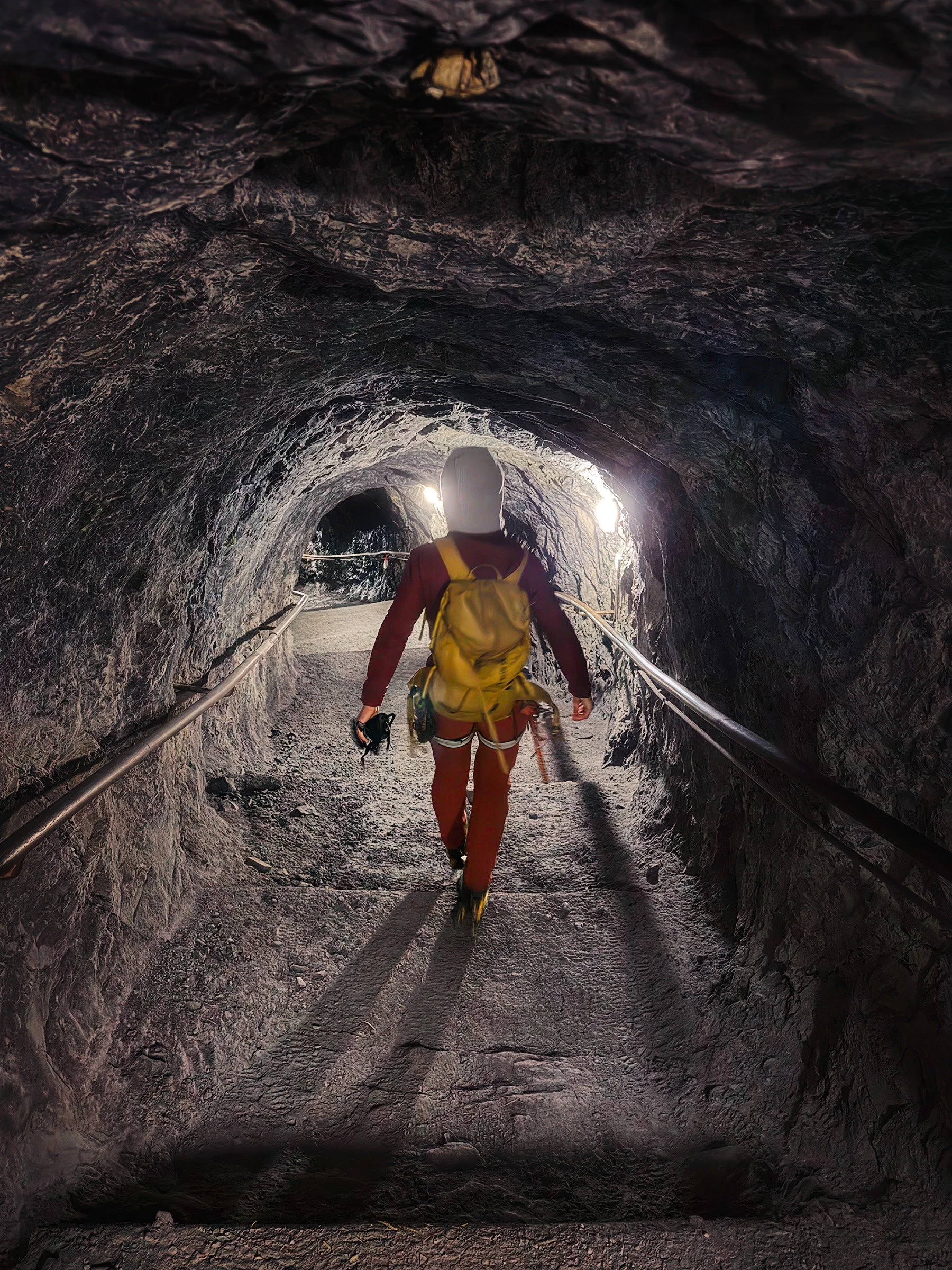
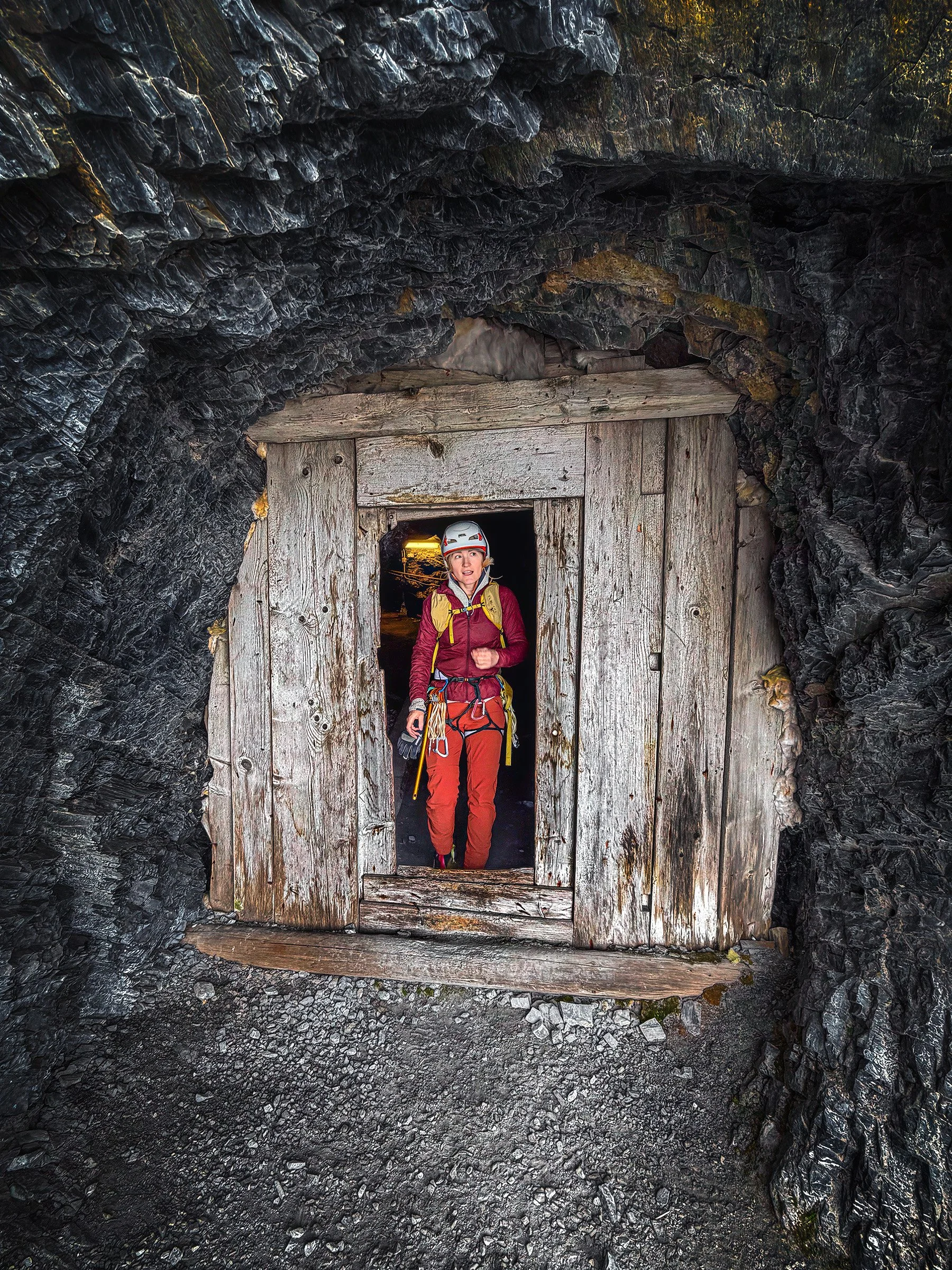
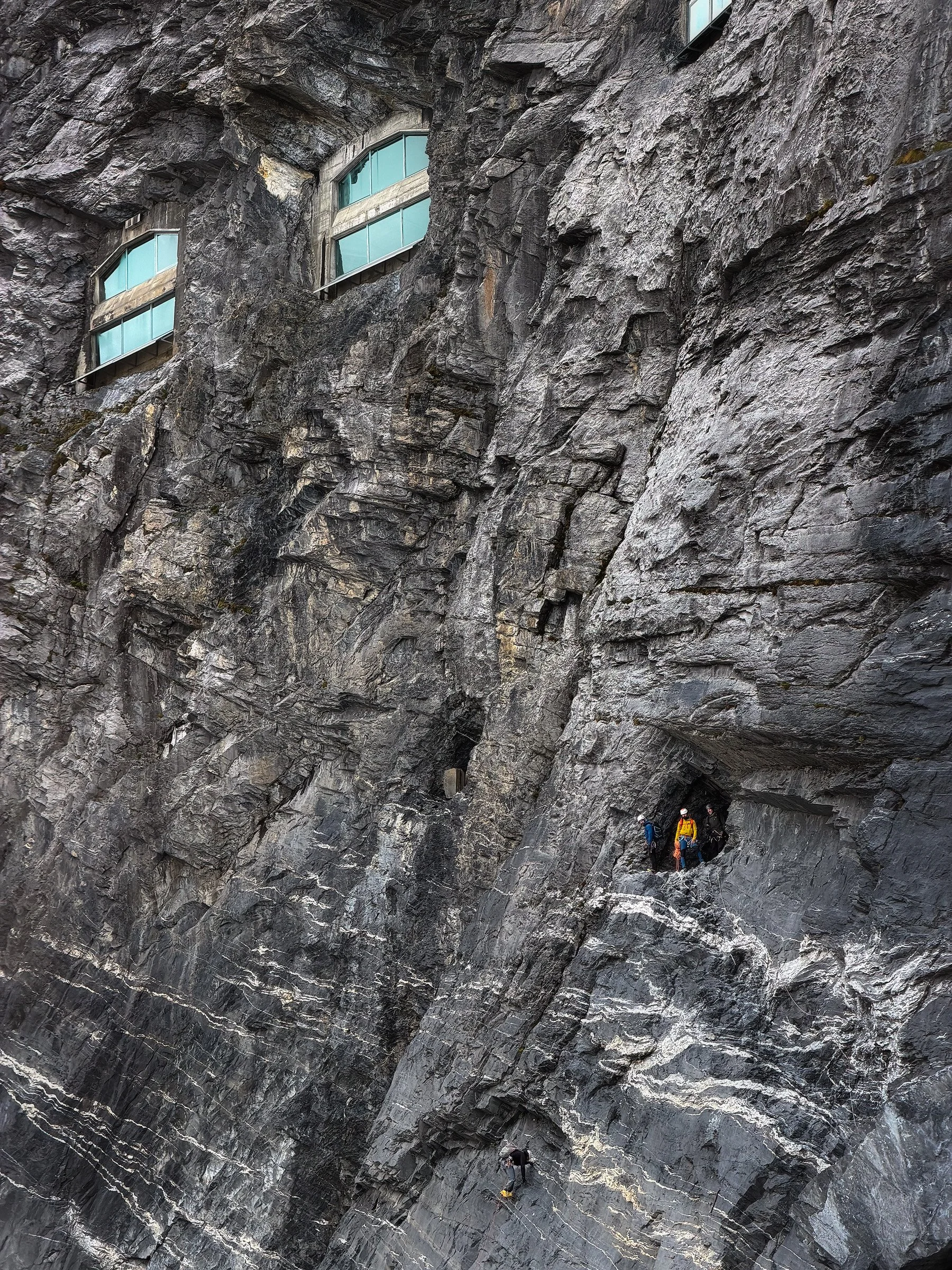
Stepping into the ducts carved deep into the mountain, which lead onto the glacier at the Eigergletscher station of the Jungfraubahn
While on the Eiger Express, the north face offered a depressing view. It was completely dry and even the upper snowfields were all but snow-free. Clear evidence of the devastating effect from this summer’s heat wave and a sombre reminder of how much the mountains were changing. At the Eigergletscher, things were much more relaxed than when Georiga and I had been here last March, equipped with skis which had to be put in the exact right carriage of the Jungfraubahn. Now we were free to choose our seats and enjoyed a ride that was cut short because we had to exit the train at Eismeer station. We were briefly confused about which tunnel to take to reach the Stollenloch exit. But one of the Jungfraubahn’s staff saw us, equipped with ropes and helmets, drew the correct conclusion, and quickly pointed us in the right direction, which was fenced off, presumably to keep unsuspecting tourists from getting lost there, or worse, accidentally ending up on a glacier.
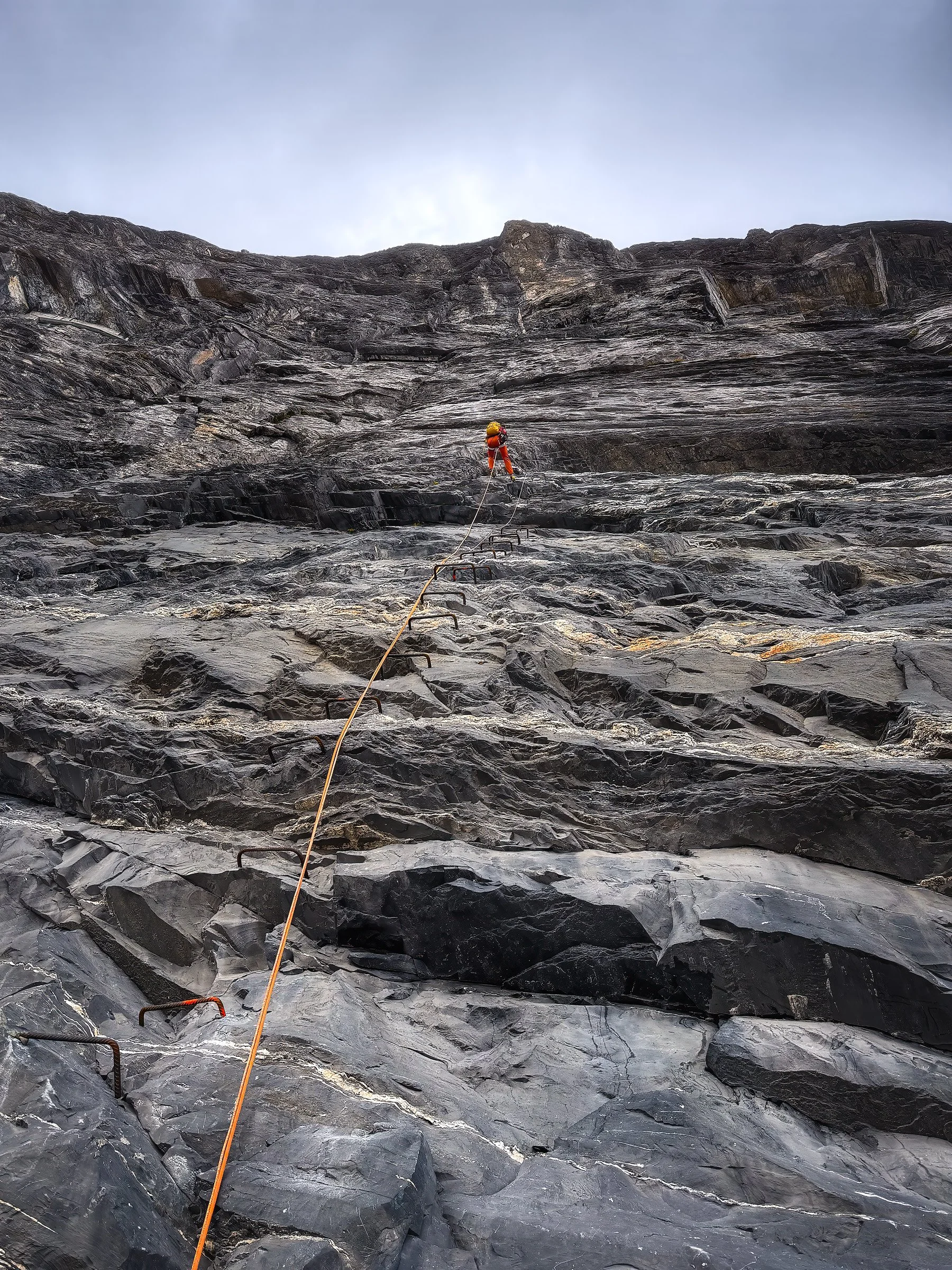
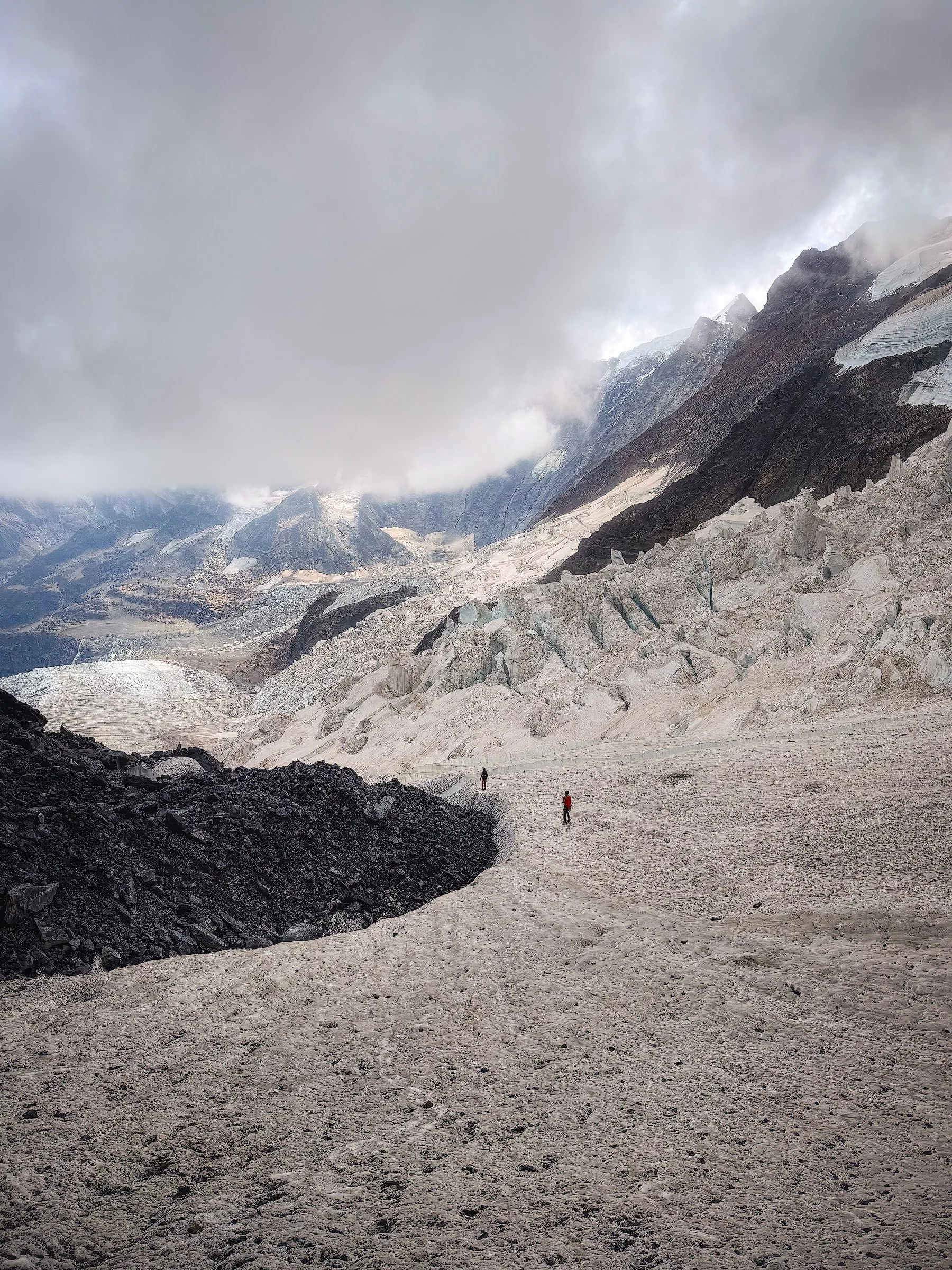
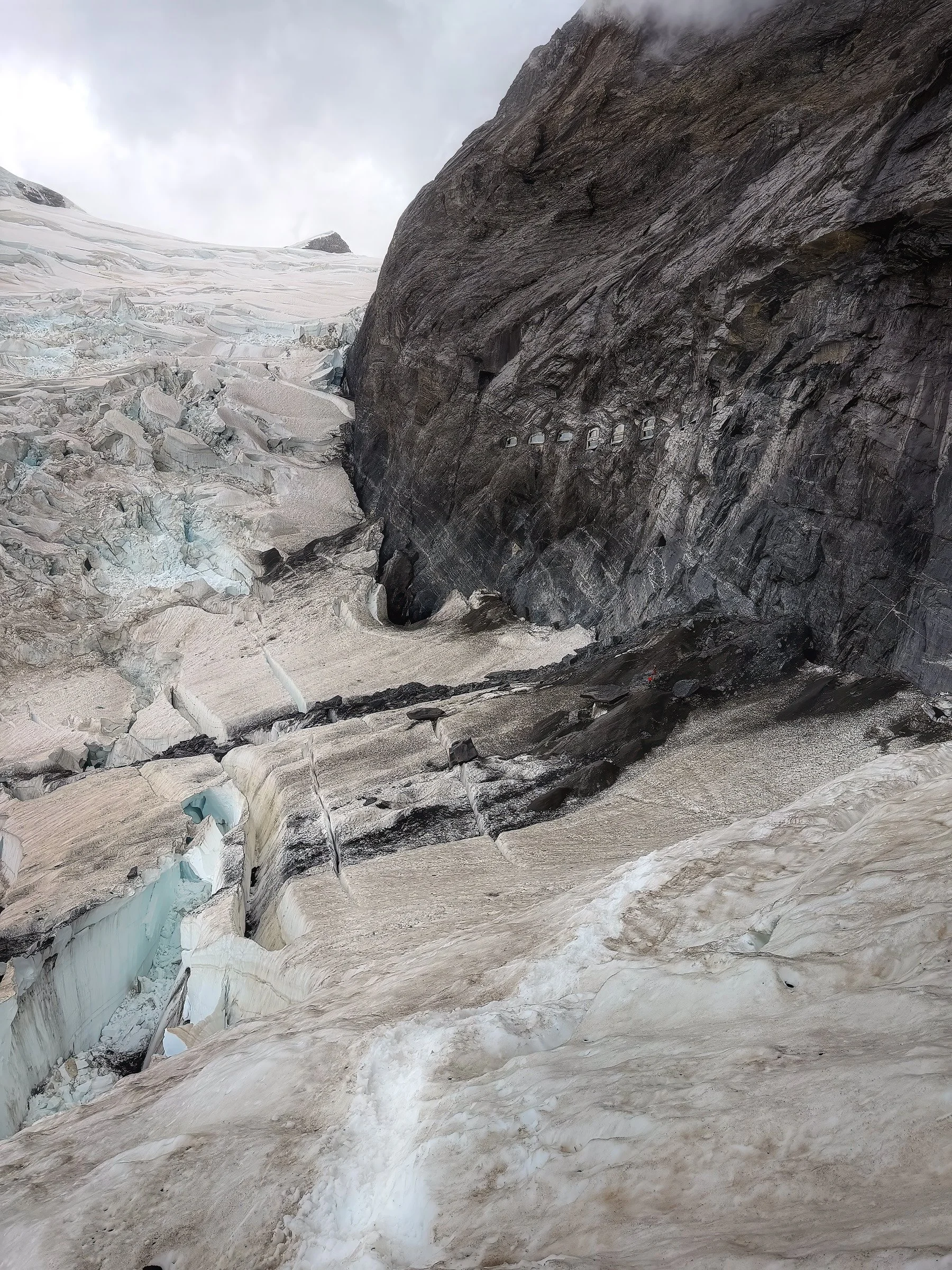
Through the big panoramic windows, we could already see the glacier below, broken up by huge, gaping crevasses. While we geared up, a group of three other mountaineers arrived. They were from the UK and obviously shared our goal. There really isn’t much else to do besides approach the Mittellegi hut when you exit these ducts carved deep into the mountain. Walking through the gate, a big sign warned of the dangers of the alpine environment we were about to enter. We walked a while through the tunnels before reaching the infamous exit, where the tunnel leads straight out of the wall. The glacier, once at eye level with the tunnel exit, was now nearly thirty metres below. Some iron bars drilled into the mountain made the smooth rock climbable, but we preferred to rappel. Using our thirty-metre rope and tagline, we made the rappel in one go, unlike the previous party, who had to set up an intermediate anchor when they realised their doubled-up 30m rope for the abseil didn’t reach the snow. But our efficiency stalled once we gathered ourselves and looked around the glacier. Where did we have to go? We knew we were supposed to traverse close beneath the steep and slightly overhanging south face of the Eiger, and do so quickly to get out of the potential rockfall zone. But where we expected a clear path in the snow, we found a giant field of seemingly fresh rockfall debris. A striking reminder of the very real dangers the mountains present. We weren't sure whether to traverse the charcoal-black limestone scree or look for another way. A French couple who had rappelled from the tunnel exit just before us seemed equally bewildered. They decided to follow faint tracks in the snow beside the debris, leading further onto the glacier. Georgia and I stayed put and waited to see whether their attempts would succeed. After a few minutes, it was clear these footprints came from other mountaineers' equally unsuccessful attempts to circumvent the rockfall zone. So Georgia and I decided to finally commit to exploring a possible path through the detritus. This turned out to be more straightforward than we’d thought; after just a couple of minutes, we emerged on the other side and immediately found a well-trodden path in the snow.
Approaching the wooden bridge
which spans a giant crevasse
Following the track was easy enough, and in the distance I could already see the small buttress where we would climb off the glacier. But another obstacle still lay ahead. Behind a snowcrest, a huge, gaping crevasse slowly appeared in our path. The glacier around us was in a dire state. Huge chunks of ice towered above steep precipices, carved free as the surrounding snow had all but melted. Remnants of collapsed seracs reminded one of this landscape's ever-changing nature, now amplified by a record-warm summer. This presented a unique challenge on the approach to the Mittellegi hut. We realised there was no way around the large crevasse, which is why a wooden footbridge had been installed. It truly looked like a segment from a Mount Everest documentary about the Khumbu Icefall. To reach the bridge, we had to descend a sharp snow crest, which made me glad we'd brought proper boots and crampons instead of going for the approach-shoe tactic we had briefly considered, given that the Mittellegi Ridge itself would be almost entirely snow-free. After balancing on the narrow ridge, we stood before the bridge. We inspected it with some healthy scepticism, but it seemed sturdy enough, so Georgia carefully took the first steps onto the wooden planks spanning the void beneath. The bridge felt a little wobbly, but overall we were quite impressed by the structural integrity of this piece of makeshift glacial architecture. As I tiptoed across it, I wondered if this bridge was a harbinger of what mountaineering would look like here in the Alps in the future. How many more years could the glacier be feasibly crossed this way before it became completely impassable, shutting down this iconic approach to the Mittellegi hut altogether and leaving it accessible only via significantly more technical routes?
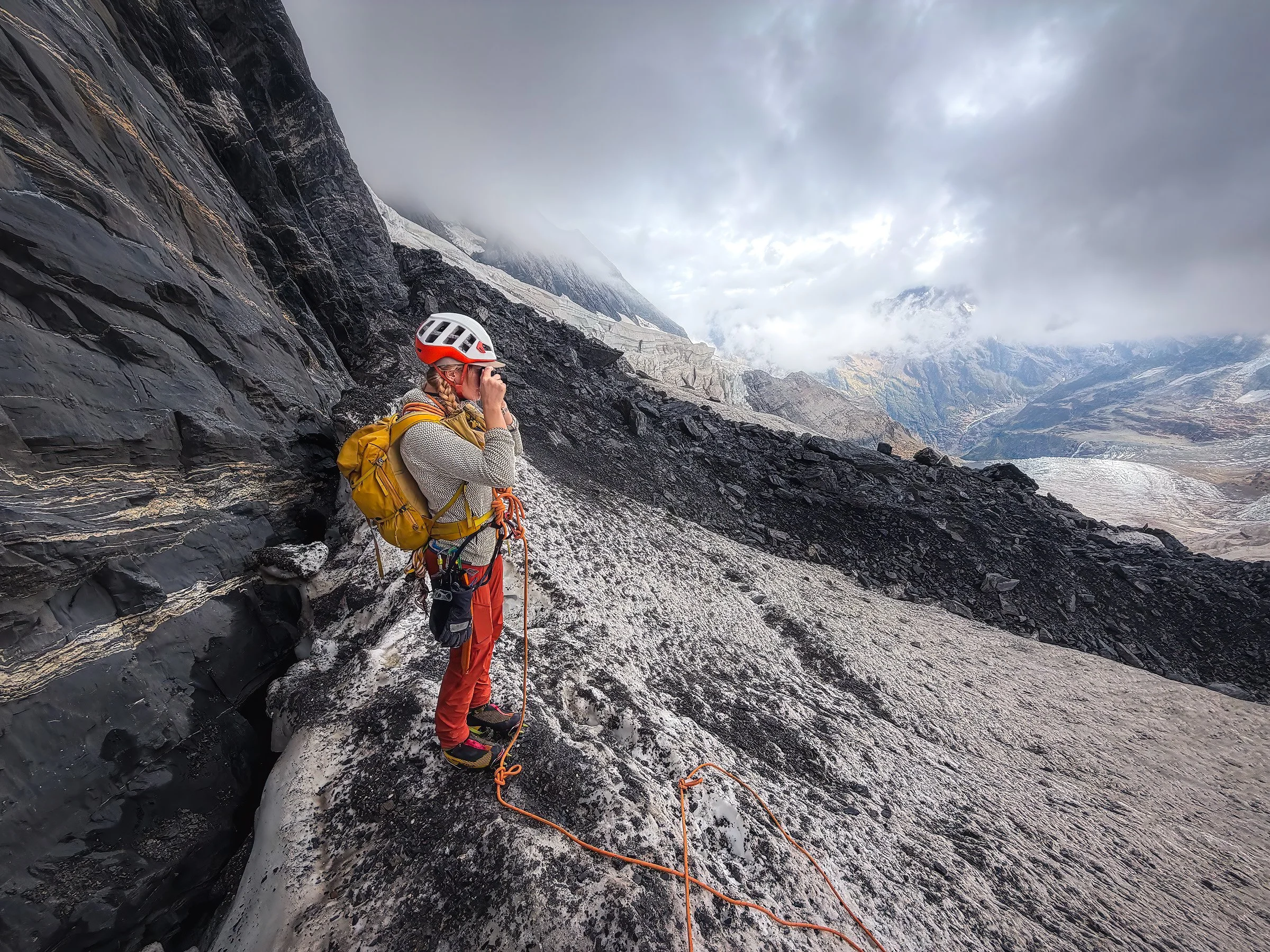
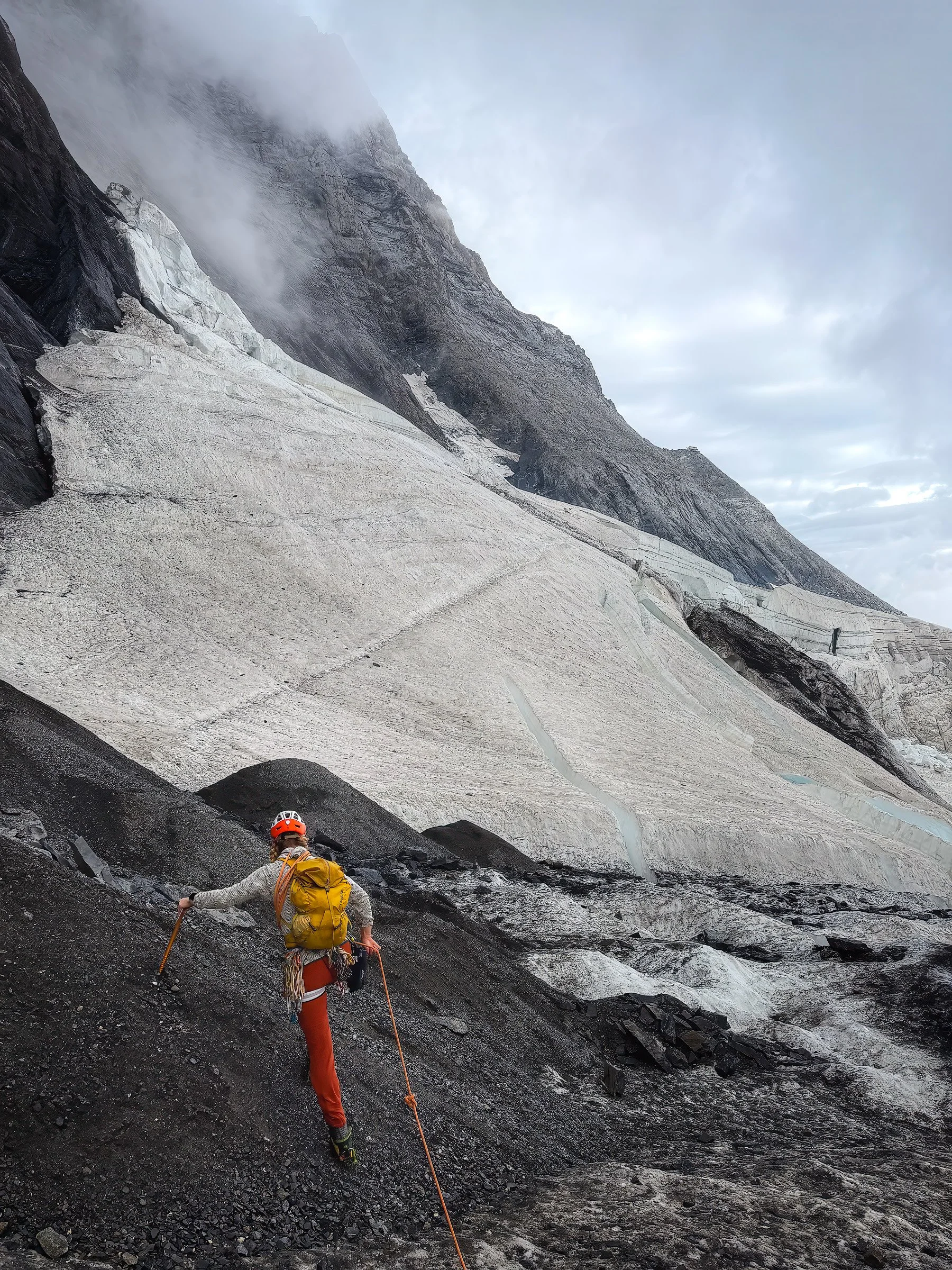
Afterwards, we reached the Bergschrund in a couple of minutes, where a line of bolts led off the glacier. As we removed our crampons to climb on the smooth limestone, several parties behind us caught up. I was quite glad we had managed to get a head start and now didn’t have to queue behind other climbers. The Bergschrund was easy to cross thanks to a snowbridge that still seemed in very sound condition. The climbing to the first bolt was certainly a bit farther than earlier in the season, and I was glad when I could clip it. I then started a traverse across quite polished limestone. Decades of climbers had left their marks on the rock, quite literally, as evidenced by all the crampon scratches. The climbing was only supposed to be 4a, but in mountain boots, even a slabby 4a traverse can feel quite engaging. As soon as Georgia started following me, a mountain guide was on her heels and joined me at the cramped belay as soon as she set off to lead the next pitch. He was nice enough, though, and we managed to get somewhat comfortable. The second pitch was easier than the first, and Georgia made quick work of it. I was glad to leave the crowded belay, but had to make some awkward initial moves to climb over the guide and his client.
The second pitch marked the end of the technical difficulties, so Georgia and I unroped to start the long traverse across the big, gravel-covered limestone slopes toward the Mittellegi hut, which we could already see in the distance. I ventured ahead to find something resembling a path, but it was difficult to discern any clear tracks in the scree. I felt the void of the big drop looming to my right, a near-vertical fall that would send me several hundred metres back down onto the glacier below. With one false step or slip on the loose pebbles, I would quickly face fatal consequences. So although the terrain was easy, I took great care navigating it and felt reluctant to venture too far ahead, fearing I might commit to the wrong path. I retraced my steps and went back to where Georgia was still packing up our rope. “I’m not quite sure this is the right way,” I said. By then, the mountain guide and his client had caught up to us, and it was clear the guide knew the way like the back of his hand. He climbed a couple metres higher across before starting to traverse, and I was glad I hadn’t committed to my previous routefinding attempt. It was clear now that this would likely have led me astray immediately. We followed the two others while Georgia complained that the climbing felt cumbersome in her stiff B3 boots. But she took her time and climbed across the slabby limestone to reach a well-trodden path. Now the routefinding was much more straightforward, and we just had to follow the path, perhaps a metre wide, that led us along the traverse with little difficulty. Still, a big drop loomed on our right the entire time.
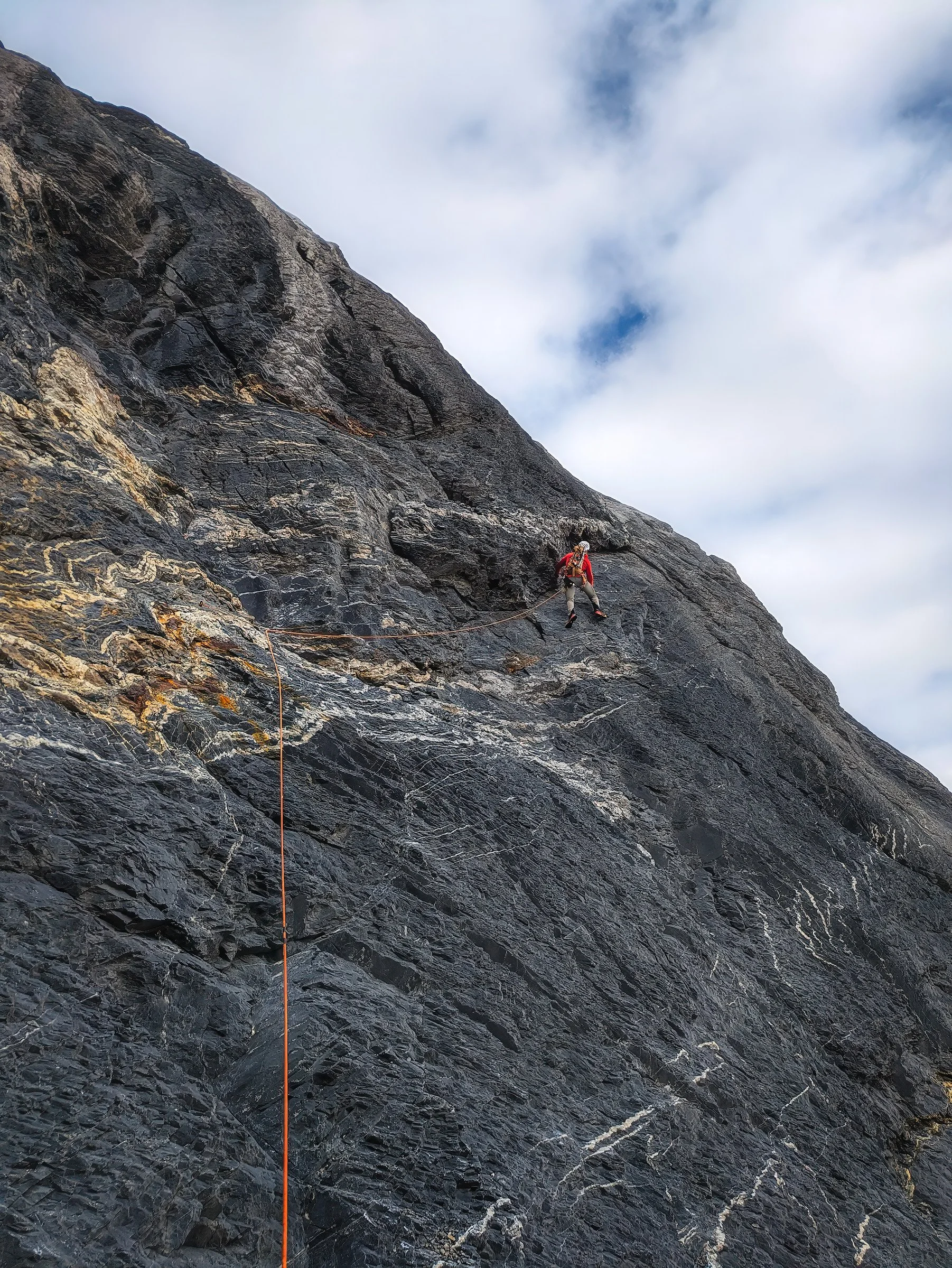
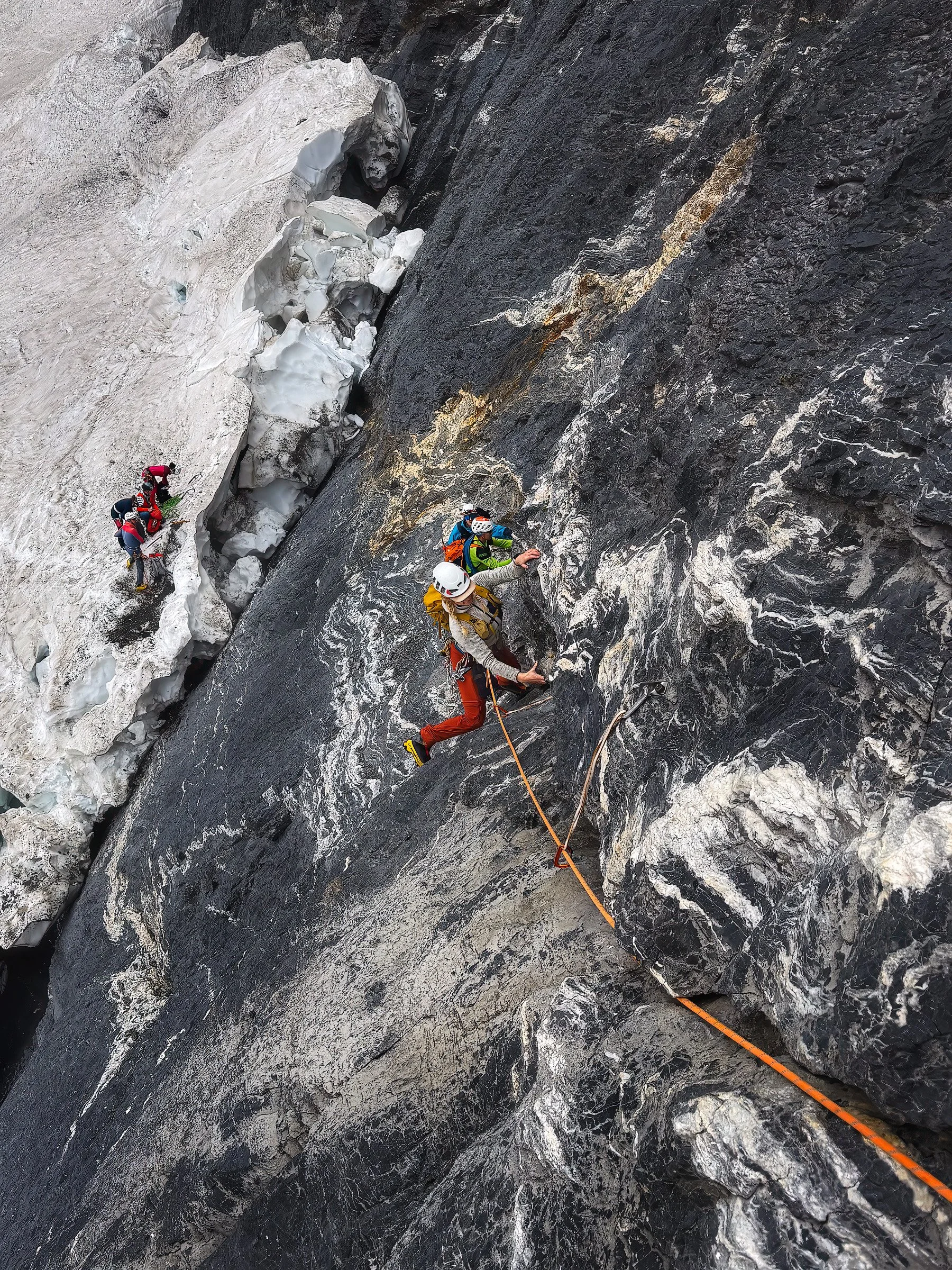
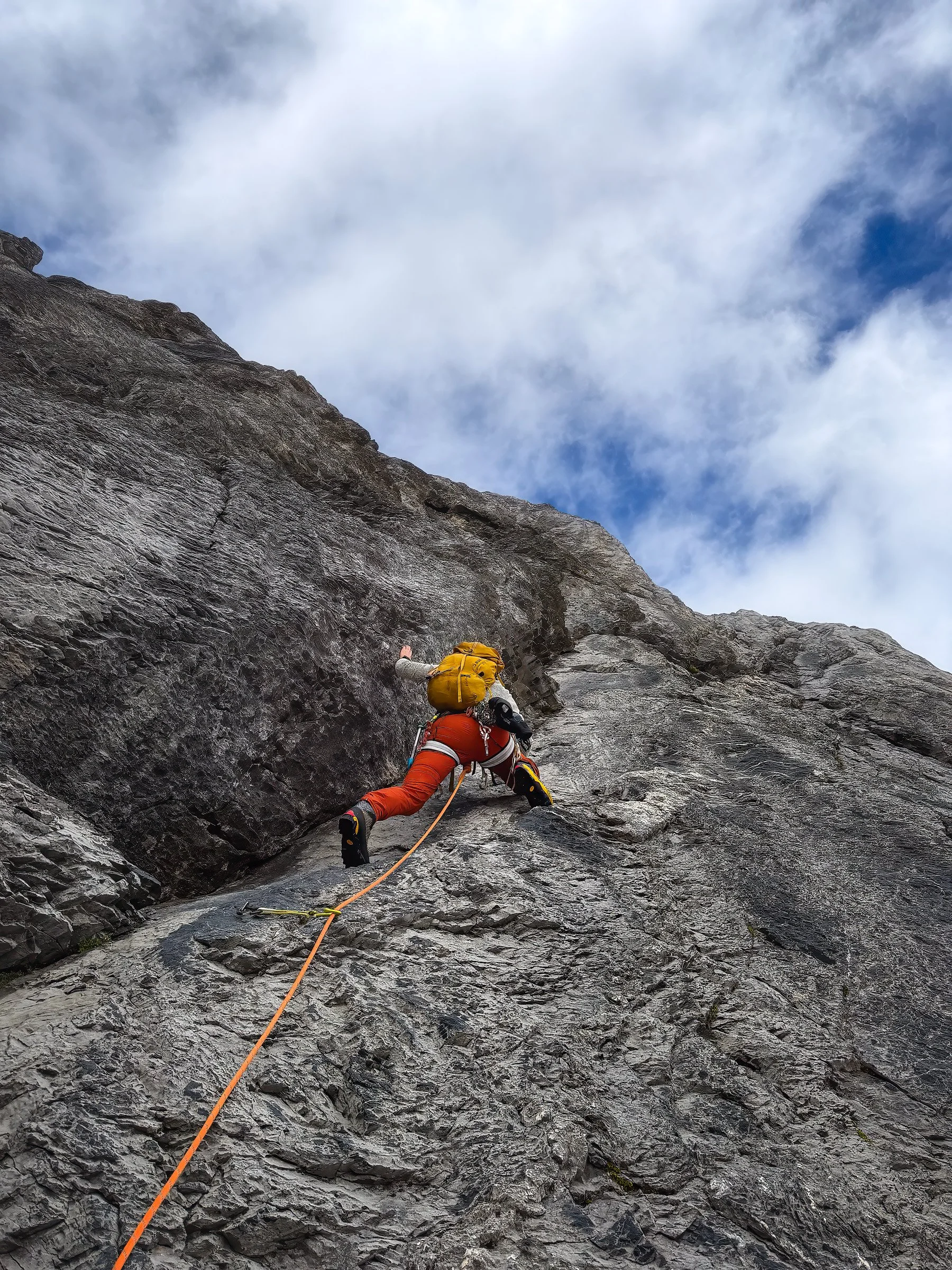
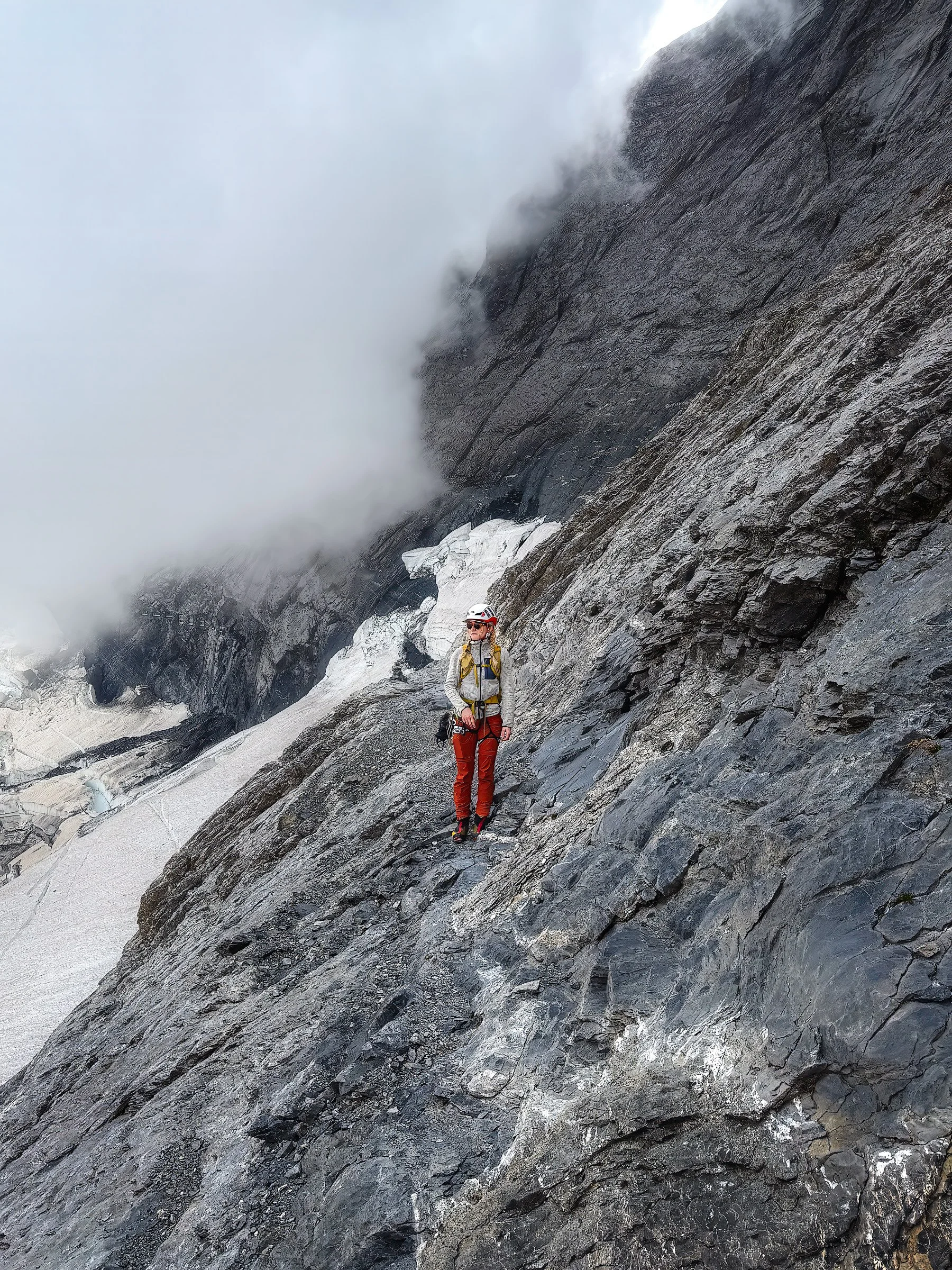
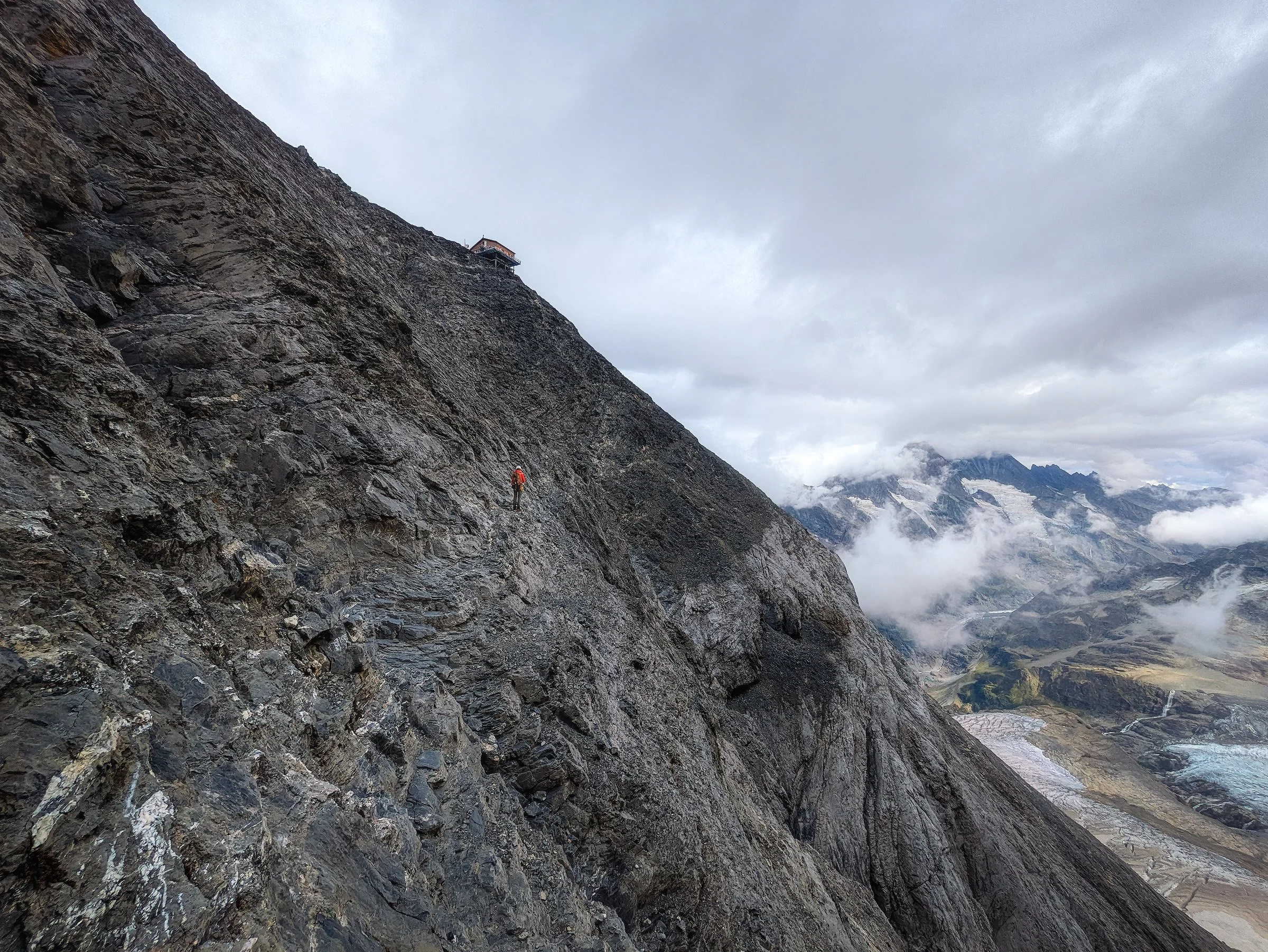
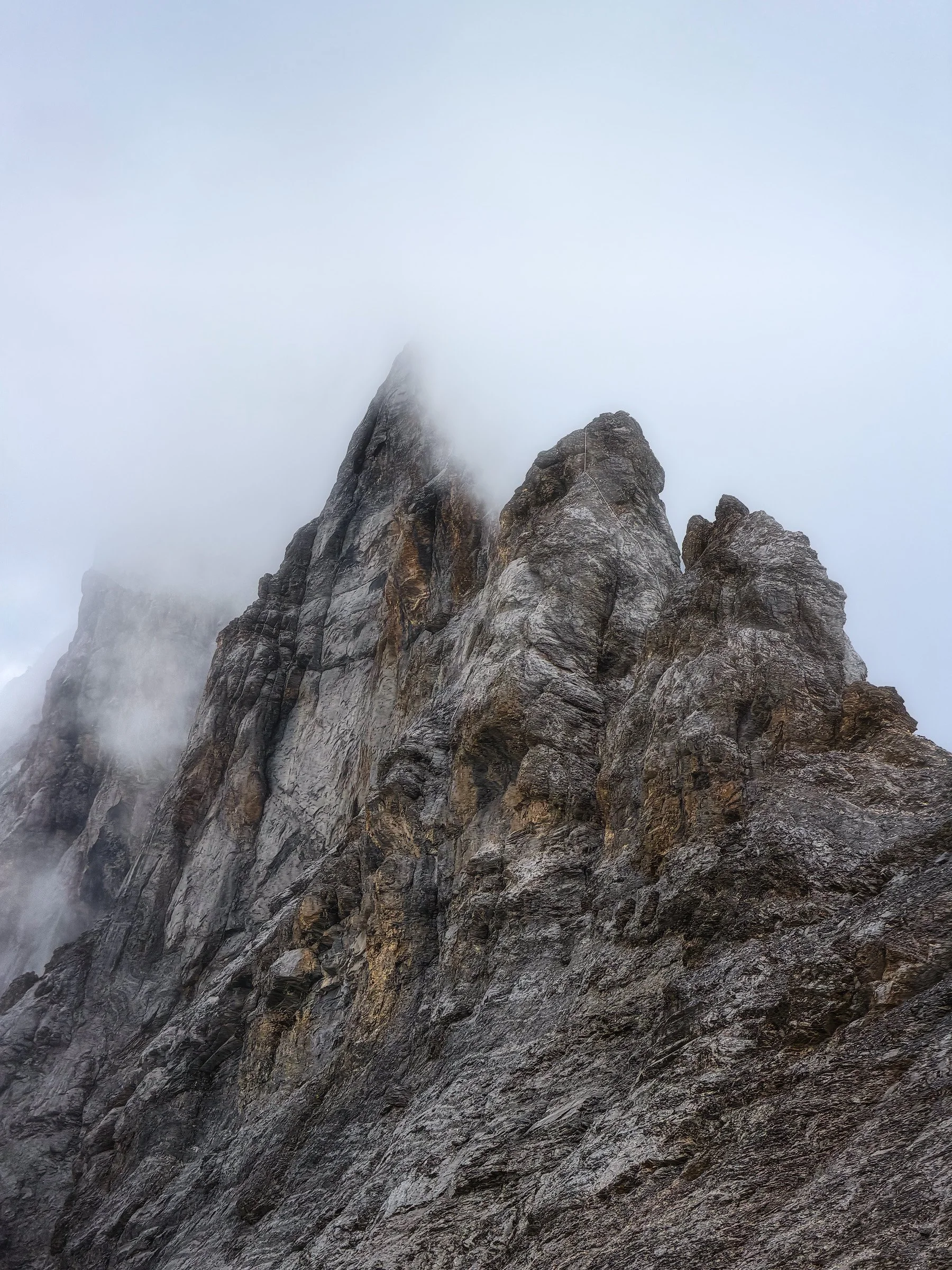
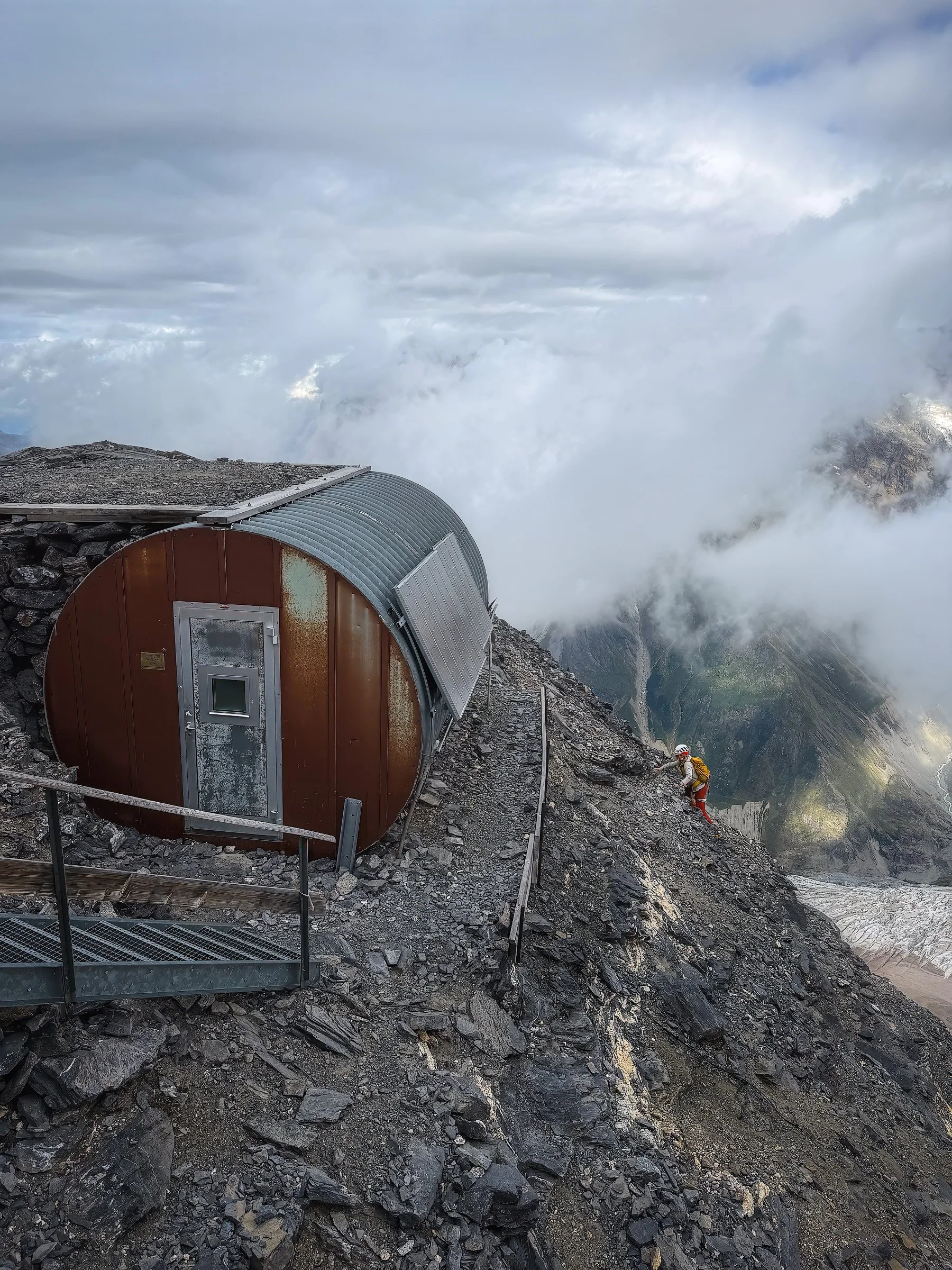
The iconic Mittellegi hut completely engulfed by thick clouds
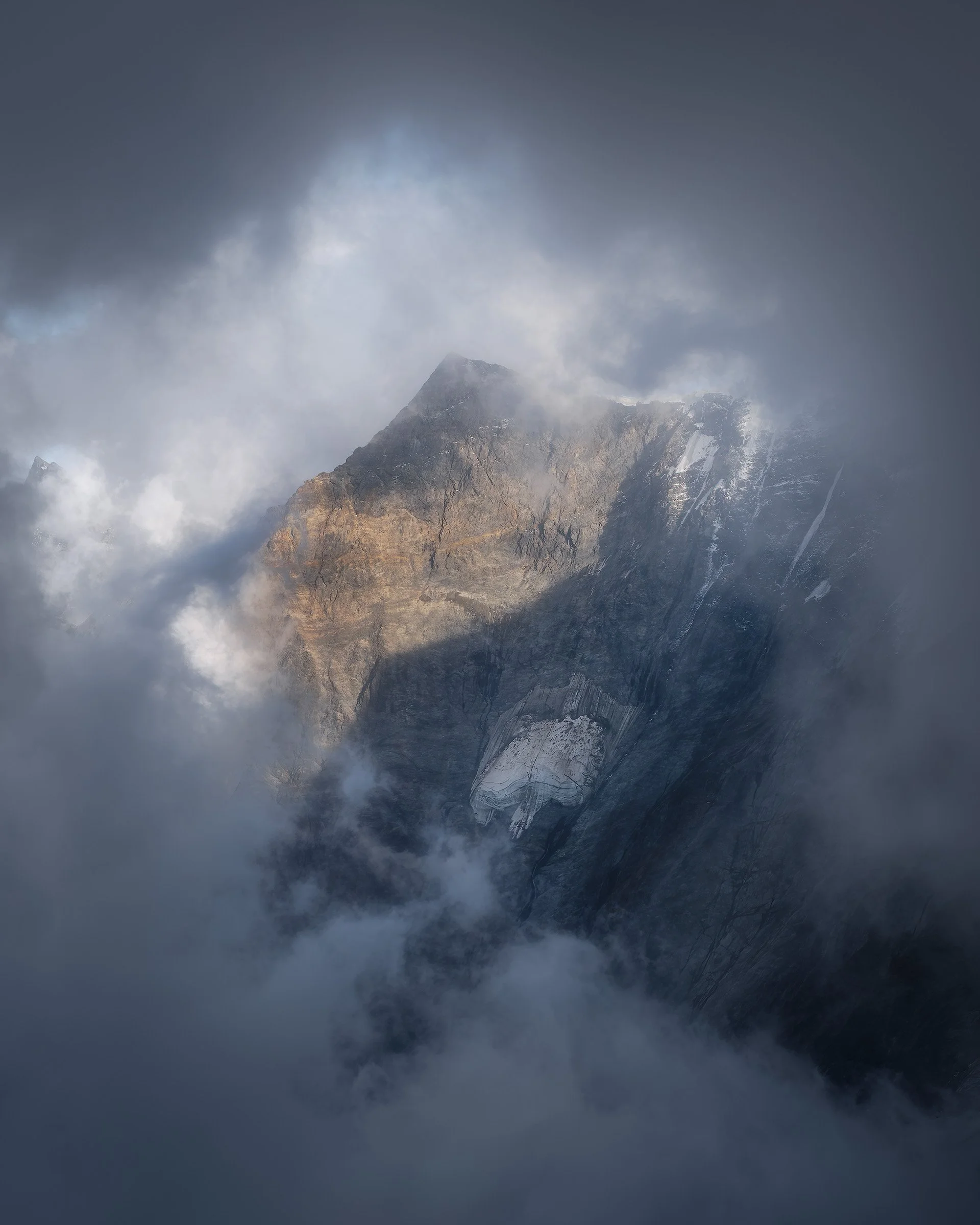
At one point, we came across a short downclimb – the only technical difficulty on the traverse – and we opted for a quick rappel (which we could do in one go with our 30-metre rope). As we reached the base of the slope leading up to the hut, the route finding got less obvious, but the terrain was easy enough that we could pick our own way and go up basically anywhere we pleased. The rock was quite loose, though, and I took care not to send any rocks down to Georgia climbing below me. When we reached the Mittellegihut, it was just half past four, and we could enjoy a relaxed afternoon nap. At dinner, I often rushed outside with my camera, leaving my soup to cool as I snapped pictures of clouds swirling around the summits of the Grosses and Kleines Fiescherhorn, revealing the peaks just before they hid behind a wall of clouds again. The thick fog had similarly obscured the Mittellegi ridge all afternoon, and I had to take a leap of faith to believe tomorrow's forecast, which promised clear skies and a beautifully pristine autumn day. Every now and then, the fog lifted enough to reveal the view toward Grindelwald, making me realise what an outrageous position the Mittellegi hut was in. Perched right on the precipice of this narrow ridge, even on something as trivial as the short walk to the lavatory, a tiny wooden railing was the only thing between me and a sheer thousand-metre drop. The setup of these toilets was actually somewhat curious. At one point, Georgia tried to open the door violently, unsure whether it was locked or just stuck. Later, I realised the screen on the door, which we'd thought was just a mirror, was actually the highly reflective outside of a window. “Whoever was sitting on that toilet must’ve had quite the curious sight of you jolting the door,” I told Georgia, who threw her head into her hands after realising the awkward encounter she'd unknowingly subjected the unsuspecting toilet occupant to. We had a good laugh about the whole situation, but why they’d installed a window on the toilet in the first place still eluded us.
After dinner, we had to wait until breakfast time was announced before we could head to our chamber. To spread the climbers out across the ridge and thereby pre-empt traffic jams, we were assigned one of several breakfast slots. Georgia and I got on the second-to-last slot at 5:30 a.m. Our dormitory was on the same level as the main floor, right next to the dining area, but no one stayed up too late, so the noise quickly died down. I spent an unusually restful night, most likely thanks to the relaxed approach.
The Gross Fiescherhorn poking through the clouds at sunset
A stream of headlamps going up the Mittellegi ridge
When I got up at quarter past five, many beds were already deserted, and as I stepped outside to brush my teeth, I saw a line of headlamps already high on the ridge. At breakfast, the Birchermüsli was already gone, so we made do with bread and jam. Once Georgia and I got ready to gear up, I was surprised to realise the Mittellegi hut was almost empty, even though another breakfast slot was supposed to be after us. It seemed people didn’t treat their allocated slots too seriously…
We roped up on the terrace, and then it was immediately game on. As soon as we left the hut, the huge drop to Grindelwald loomed to the north, even though it was still too dark to see the bottom of the face. Perhaps that was better so, giving us time to get accustomed to the exposure. At first the terrain was easy enough that we were simply walking. But there was no room for error as we balanced along the limestone crest, and I was acutely aware of how serious the terrain we entered was. You couldn’t afford to start the Mittellegi Ridge only half-awake, like you sometimes are at the beginning of a long day with an alpine start. I tried to flake the rope around features in the rock, but generally just trusted that neither of us would make a mistake on this easier terrain. Here, the rope did little to increase our safety, and I didn’t bother looking for protection in the rock. On a short traversing section where I had to use my hands for a couple of moves, I managed to place a purple cam, but it was mostly a futile endeavour. After the traverse, I reached a small tower where the first proper bit of climbing waited. My strategy for belaying Georgia across the traverse was to sit down and simply bet on my butt's friction against the rock. The sun was still hidden behind the horizon, but there was enough light by now to take in our surroundings and start to appreciate the position we were in. A vertical section of perhaps 10 metres followed, which proved more difficult than it looked, with holds worse than they appeared from below, and I was glad there were a couple of bolts to clip. At the top, a single bolt let me bring Georgia up. Looking back, only a handful of other headlamps were behind us. We were at the rear of today’s siege on the Eiger.
The party in front of us is trying to free-climb some of the fixed ropes
First light on the Gross Fiescherhorn
Georgia is setting off on a short, steep section on the ridge
Climbing with the glow of dawn in the background
Shortly after, we reached the first section of fixed ropes. We stood at the start of a short downclimb into a little notch, from where the ropes ascend about 60 metres across a steep slab that would’ve been quite tricky to climb without them. But we first had to wait for the party in front, and we watched, somewhat bewildered, as their leader seemed fixated on freeing the pitch without the help of the ropes. He looked quite awkward and eventually gave up on his free-climbing efforts, perhaps feeling the pressure of those waiting behind. We descended into the notch (also with the help of some ropes), and then Georgia started up the fixed ropes, not hesitating for a second to pull on them. I followed her, and we made short work of this section. Near the end, a short, near-vertical section required powerfully pulling on the ropes, but Georgia still seemed to enjoy herself. After all, by her own account, pulling on jugs is her speciality. When we topped out this section of fixed ropes, we took the chance to overtake the duo in front of us. They had taken a moment to sit down and rehydrate with tea, and we were glad their free-climbing ambitions would no longer hold us up.
A few ledges followed, which we overcame with easier climbing, unassisted by ropes this time, and I enjoyed using my hands on the rock for once. Even easier terrain followed, with more walking again. While climbing the fixed ropes, we could clip into the iron bars that secured them to the mountain, so we ourselves were always attached to it. But as we tiptoed along the narrow ridge again, the rope fluttered uselessly between us. It felt weirdly more perilous than the much harder, more powerful climbing we’d just done. All around, I started to see the mountain tops lit afire as the first morning light hit them. It was a pristine day after all, and the fog which had shrouded the mountains had lifted entirely overnight. Before a prominent tower, simply called Grosser Turm in the topo, the ridge widened enough that we could relax for a moment and walk without feeling exposed. “This would be a nice spot for a bivy,” I concluded. We used the opportunity to sit down, drink, and refuel. As I munched on my cereal bar, the sun rose in the distance over the prominent ridge between the Scheckhorn and Lauteraarhorn, which towered high above the surrounding peaks. It was just after 7 a.m.; we had been going for little over an hour.
Pulling on a steep section of the fixed ropes
A brief respite of relaxed walking on the ridge
A trio of climbers on the top of the big tower with the Schreckhorn and the ridge to the Lauteraarhorn in the background behind them
Georgia continued leading the way, first climbing through a big crack right behind the big ledge we had been sitting on. Then we reached another section of fixed ropes that led us to the top of Grosser Turm at 3688 metres. From here, a rappel allowed us to avoid a potentially sketchy downclimb. We had to wait briefly for the French couple that we had met on the glacier yesterday. We had caught up with them, but by the time we finished rappelling, they were already on their way again. With our tagline, we managed to make the 20-metre rappel in one go, even though our rope was only 30 metres. As we started climbing the next section of fixed ropes, we looked back and saw the British trio of climbers we had met at the tunnel exit the day before reach the top of the tower. I snapped some amazing photos of them, contrasted against the Schreckhorn in the distance, but they would sadly never see the results of their inadvertent modelling efforts. Some free climbing offered a welcome respite from hauling on cordage, and the climbing passages were interspersed with more exposed ridge walking. By now we were quite comfortable with the exposure, but every now and then Georgia still preferred to lower her centre of gravity, utilising a skill she had by now perfected: the alpine butt-slide. One could argue it's a legitimate technique, and on a short section next to a particularly steep drop, I tested its usefulness. It can indeed go a long way toward making a section go smoothly, which is maybe a bit too precarious for walking but still doesn't warrant turning face-in for full-on downclimbing.
Traversing the remaining snow near the summit
Eventually we eventually reached the largest section of fixed ropes. Checking the map, I also realised I'd been misled by the topo; it showed the big tower about two-thirds of the way along the ridge. In reality, it was more like halfway, and I realised the Eiger summit was still quite a bit further. We then climbed what was the longest section of fixed ropes, more than a hundred metres. Here, in the shade toward the north, even a few patches of slippery snow remained, giving us a taste of what it would be like to climb this route in different conditions. When not dry, the Mittellegi Ridge can become notoriously treacherous, and just two weeks ago I heard at least two parties had to be rescued after attempting the ridge after a night of fresh snowfall – the first of the season after this record dry summer. When we reached the end of the fixed ropes, we felt the summit must be close. Nevertheless, it would still be a while longer until we stood on top of the Eiger. These final bits felt like they stretched forever. When we reached what remained of the firn ridge, however, we knew we were finally getting close. The fresh snow from two weeks ago meant we couldn’t reach the summit completely without snow contact. But for most of summer, the approach-shoe tactic we contemplated would’ve worked out nicely, evidenced by none other than Alex Honnold, whom we’d missed by only a couple of days when he did the whole ridge in a day from the valley in trainers. Although he is probably not the one to take inspiration from in terms of mountain tactics. Now, even though a good track was in place, we decided to put on our crampons. “Might as well use them since we brought them,” was our spirit. A nice flat section ran along the snow ridge, and I knew this must be where climbers bivy after toping out the Eiger North Face. But after only a couple of metres, we could already stow the crampons and continue to the summit by hugging the rock.
On the summit of the Eiger!
The summit of the Eiger is rather unpronounced, and no summit cross marks its place. Two people were already sitting here, and we joined them and took in the views. “I thought I might have to cry,” Georgia said as she reached the highest point on the ridge. The Eiger had long been one of her dreams, and finally standing on its summit was clearly a moving moment. But the daunting look towards the seemingly interminable south ridge we would have to descend was enough to suppress the swell of emotions, and Georgia’s eyes stayed dry for now. We learned the other two climbers had come up from the Westflank, and given we could simply follow them to ease the notoriously difficult route-finding on that descent option, we were momentarily tempted to forego the south ridge. But in the end, the prospect of a 1700 metre descent through loose gravel and chossy rock wasn’t all that appealing either. So we stuck to our original plan. We didn’t linger long, since the south ridge meant a return to the Jungfraubahn, which put a hard deadline on our day. The last train would leave at quarter to six, giving us just over six hours for a descent that is supposed to take five. No need to stress, but no cause to drag our feet either.
So we continued past the drop down the Westflank to find the first of a series of rappels leading us down the south ridge. Two 20-metre rappels, which we completed with the help of our tagline, led us to a small iron cross. It felt a bit like someone had tried to erect a summit cross on the Eiger, but ran out of energy only a few metres short of the summit. But the sorry excuse for a cross wouldn’t have done this mountain justice anyways. When I tried to pull on it gently, I almost lost my balance as the wiggly cross tipped over at the slightest push of a finger. I quickly scrapped plans to use this as an anchor for further rappels. A short horizontal traverse brought us to another series of rappels, where we could skip one of the single-bolt “anchors” and go for a long 30-metre rappel, using the full length of our rope-tagling setup, after which we continued by downclimbing over long fields of schist-like slabs. Every now and then we still came across old slings or even bolts, but we mostly ignored them in the interest of time. Before a particularly precipitous section, however, we decided to use one final rappel, again stretching the full length of our rope. Georgia was visibly relieved to skip some of the slabby downclimbing, which in her stiff B3 boots was no easy task. We eventually reached the Nördliches Eigerjoch, and when I looked back towards the Eiger I could make out a party just starting their descent. I wasn’t sure which of the parties we had left behind, but I assumed it was the French couple we’d overtaken shortly after the final section of fixed ropes.
Descending to the Nördliches Eigerjoch (the small, oval patch of snow in the yellow gneiss, above the reddish veins in the rock, marks the steep wall that looked impassable from a distance but could be overcome by traversing around the overhang on the left)
Climbing around the steep overhang at the start of the climb up and over the south ridge (in the background, the well-defined threshold between the grey limestone and yellow gneiss is clearly visible)
Georgia squeezing through the narrow chimney on the south ridge
At the Eigerjoch, I was fascinated by a peculiar geological feature. This col marks the exact spot where the Eiger's limestone meets the gneiss of the Bernese Alps. It was a striking walk across such a clearly defined geological threshold. A seemingly unlikely encounter between two rock types: one formed deep in Earth's crust, the other once covered by an entire ocean. From here, the ridge rose again for almost 200 metres, and we faced a not insignificant amount of additional climbing. As I approached the start of the climb, I wondered where I was supposed to go. From afar, it looked like an almost vertical wall, guarded on the right by a steep, certainly unclimbable slab (partially covered in remaining snow) and on the left by sharp overhangs. But I knew there had to be a way through that wasn't particularly challenging. I started up a small rock crest, which led me to the base of the vertical wall. As I got closer, I realised a traverse to the left, underneath the imposing overhangs, looked feasible; when I followed it, I eventually found some bolts, which assured me I was on the right track. Around the left corner of the steep wall, the bolts led me up through easy but exposed climbing to reach the top of the cliff without too much difficulty. At the top, a gentle path led across horizontally for a bit before we stood before another steep wall. Here, the climbing was more straightforward, and we continued scrambling along until we reached a distinct feature of the south ridge: a narrow squeeze chimney.
The chimney was a real battle, and I was constantly fighting my backpack getting stuck. At least it felt quite secure given how tightly I was wedged in the rock. Afterwards, a few more bits of easy up- and down-scrambling brought us to the start of the firn ridge, which led onto the glacier. We took a short break to fuel up on some Haribo and relished the view back towards the Eiger and the Mittellegi ridge. If I squinted my eyes hard enough, I could even make out the hut as a tiny speck on the ridge. The firn ridge was quite icy in parts, and here we would’ve dearly missed our crampons if we'd gone for the approach-shoe tactic. On the glacier, we simply had to follow a wide path beneath the imposing east face of the Mönch and towards the Mönchsjochhütte. The final stretch up to the hut felt like a proper slog, reminiscent of the time we trudged up the same slope on our skis after a long weekend of ski mountaineering back in April. But just as back then, we eventually reached the Mönchsjoch, and now we had only a quick 20-minute stroll along the groomed hiking path to the Jungfraujoch in front of us. Our water supplies had been depleted for a long time, and we briefly considered heading up to the hut for a Schorle and Rösti, but eventually decided we didn’t want to take any risks with the train. We still had more than two hours until the last train, but given Georgia’s and my track record for missed connections, we felt like we should play it safe.
On the final firn crest of the south ridge…
… with a view towards the Mönch
Traversing on the glacier below the east face of the Mönch
Enjoying our well-earned lunch
In the end, we arrived at the Jungfraujoch just before 4 p.m. The descent took just as long as the ascent, almost exactly 5 hours. We could relax knowing we wouldn't miss any trains today, and Georgia even had time to buy a cold beverage before we boarded the Jungfraubahn. In Grindelwald, we were hit by the full force of the September sun, still burning with summer strength. We felt quite hungry and decided to make a little detour to a burger restaurant before heading towards the train station. We found a nice spot on the rooftop terrace, though we had to position ourselves carefully in the shade of an umbrella. While munching on chips, we enjoyed a stunning view of the Eiger and the entire Mittellegi ridge. Sitting here, back in the comfort of civilisation, it felt unlikely we had been climbing up on the ridge just this morning. But as I enjoyed the feeling of being back after a successful tour, my eyes couldn't help but wander east from the Mittellegi hut, scanning the rest of the ridge, and I already knew today wouldn’t mark the end of my relationship with the Eiger.