
Patrouille des Glaciers
Skinning along the flat strech after a steep climb up the ski piste out of Arolla – in the upper left corner the bootpack, which I thought we had to reach, can be seen
Saturday 7:17 a.m.
“There is just no way,” I thought, “it looks so far away.” My thighs were burning from the steep skin up the ski piste out of Arolla, and now, on this flat section, it felt as if my legs were completely zapped of energy. Less than an hour. This was how much time we had until the next checkpoint, which I believed was at the top of the col I could see in the distance. There were already numerous climbers making their way up, and as my gaze followed the track towards that bootpack, the queue of skiers looked like a colony of ants following a trail of sugar on the ground. It looked impossibly far away. Much farther than I felt my tired legs were capable of covering in 55 minutes. Yet I kept going. Hugues was in front of me, apparently still believing in our success. Connor was falling farther and farther behind me. He was carrying our rope and had just had to ascend the steep ski piste with the bamboo stick that replaced his broken ski pole. To say the odds didn’t seem to be in our favour would be an understatement. When we had left the aid station in Arolla, it had felt that two hours to ascend the 800 metres towards the Col de Riedmatten should have been enough time, even for our already tired legs. But when I had first laid eyes on the long flat stretch in front of me, doubts had started to creep into my mind. And ever since we learned from another team that the cut-off time was actually 8:15 a.m., not 8:30 a.m. as we had originally thought, I had seriously doubted we would make it. Now that doubt had turned into all but complete certainty. But Hugues was still going strong, and I was not about to leave him by himself. So I forced myself to push on, going as fast as I could manage. There was still a sliver of hope I clung to, which could save us if it proved to be true.
Friday 11:17 a.m. – 20 Hours Earlier
It was a beautiful, clear day as Hugues and I stepped out of the train station. The weekend promised prime conditions. The familiar streets of Zermatt were bustling with activity in preparation for tomorrow’s – or rather tonight’s – race. The Patrouille des Glaciers is the most famous ski mountaineering race in Switzerland, and it was only now that it really hit me we were going to participate. 57 kilometres, and over 4000 metres of elevation, from Zermatt, through high-alpine terrain all the way to Verbier. It was going to be one of the toughest things I’d ever attempted, that was already for sure. All around town, tents with military officers were ready to help the flood of people find their way, all equipped with the tiniest skis one could find (except for us, of course, who would do the race with our normal touring setup). Under one tent, even a free ski-waxing service was advertised. The start line, as well, had already been set up. In fact, it had already been used. Just two days ago, the first batch of the race – split into two starts to accommodate more participants – started here. Hugues and I were basking in the atmosphere of anticipation that filled the air, and then turned our attention to where we should go. Connor, our third team member for this race, had already arrived in Zermatt yesterday, and together, our first task of the day would be to have all our gear inspected and approved for the race. So we headed towards the Zermatt sports centre, where the inspection was supposed to take place. Hugues and I completed a full orbit of the building before locating the entrance, where we found Connor waiting outside in the shade. I had been worried about long queues at the gear check, but my worries were unwarranted. We waited for no more than 5 minutes before a guy in a military uniform showed us a table where we laid out all of our gear. Another soldier then inspected our skis, boots, skins, harnesses, helmets, ice axes, and the rope we had to carry, marking them with an official PDG sticker once he was satisfied. There were no objections on his part, and the whole affair didn’t last very long. We were then handed our racing numbers and instructions on how to attach them to our clothes and backpacks, and were led towards a guy with a large camera, who took photos of us posing with our skis. It wasn’t even noon once we were done, which then begged the question of how to spend the rest of our day. Our start slot was at 10:45 p.m., nearly 11 hours away, which we would hopefully spend mostly eating and relaxing.
Getting our gear checked…
… and adorned with official PDG stickers
In the distance, two big signs, blue and red, can be seen, marking where the courses Zermatt-Verbier and Arolla-Verbier split. Our bootpack lay towards the right, making its way straight through the prominent muddy, snow-free slope.
Saturday 7:55 a.m
“No way, do we still have a chance?” I thought. The one hope I had harboured in these last minutes proved true. The bootpack I had been staring at this entire time wasn’t the one we would have to go up after all. To avoid a bottleneck between skiers attempting the full race from Zermatt to Verbier and those who had just started the half-distance in Arolla, the route was split into two behind the piste leading out of Arolla. But I soon realised this was little consolation. Even though this other bootpack appeared shorter and much closer, it still seemed impossible that I would make it there by 8:15 a.m. But Hugues was still heading up, and so was I. I could sense the resignation around me, as other teams probably had similar thoughts. “Tim!” I looked up. “It's right there behind this rock. The checkpoint. You have 15 minutes,” Hugues shouted eagerly. Miraculously, the checkpoint wasn’t on top of the bootpack but at the start. I felt a sudden surge of energy. “Go, go, go!” Hugues cheered me on, trying to infuse me with some of his energy. It worked. When I passed the soldier scanning the chip on my race number, it was exactly 8:07 a.m. We were still in. That is, Hugues and I were. Connor was still somewhere behind, out of sight. I had no idea how far behind he was. Given how tired he had looked, I felt pessimistic about him making the cut-off as well. I felt bad for him, as he had taken on the burden of the rope, and now it seemed it had cost him the race. Either way, we had to wait and take the rope from him before we were allowed to continue the race. Hugues and I nervously waited, hoping for some sort of miracle.
Friday 12:31 a.m.
"What was your number again?” The concierge at the front desk was curiously eyeing the screen of his computer. We stood around awkwardly, holding on to our skis and feeling decidedly out of place in the lobby of such a fancy-looking hotel. This certainly wasn’t our usual type of accommodation for adventures in the mountains. Connor repeated our official race number from the email he had been sent. “I don’t seem to find you. What was your hotel again?” I started to feel a bit nervous; had there been some kind of mix-up? “The Hotel Alpenhof,” Connor responded, looking at the email. “Ahh, you’re in the wrong place,” the concierge answered with a well-tempered smile. “The Hotel Alpenhof is the next building over.” It looked like we had been a bit too distracted on our way to the hotel. After finishing the gear check and picking up our race numbers, we had been contemplating how to proceed with our day. But after walking around for a couple of minutes with all our backpacks and skis, it was clear we wanted to get rid of our luggage first. And so we had walked through town to the hotel provided for us by the PDG (or rather, included in its extraordinary sign-up fee), even though our rooms would likely not be ready until the afternoon. The Hotel Alpenhof was a similarly lavish establishment. Low-hanging, wood-clad ceilings and sumptuous leather couches created a feeling of heavy luxury that was almost suffocating. But at the front desk, we were greeted warmly and told we could leave our luggage, even though our rooms wouldn't be ready for a couple of hours. After we rid ourselves of skis and backpacks, we started to feel hungry, and our attention turned towards the nearest opportunity to load up on more carbs. I was somewhat surprised my stomach was already demanding more food after an opulent breakfast on the train that morning and an even bigger pasta dinner the evening before. Perhaps my body was sensing the upcoming high-energy demands I would place on it?
Connor barley making the check point before the bootpack up the Col de Riedmatten
Saturday 8:22 a.m.
The cereal bar in my mouth was a dry lump; I didn’t want to chew it any more. Ever since we started the race, my stomach had been feeling uneasy. Maybe it was my nerves, or the fact that my digestive system was already fast asleep when we started our race in the middle of the night. Every time an opportunity to eat presented itself, I had to force myself to overcome my nonexistent appetite. Now I wanted nothing more than to swallow the rest of the bar I had stuffed in my mouth minutes earlier and be done with it. But the longer I chewed, the more persistent the sticky mix of saliva and oats in my mouth seemed to become. Eventually, I gave up, kept the rest of it in my cheeks like a hamster, and continued with the bootpack to the Col de Riedmatten. Miraculously, we were still three. After Hugues and I had given up nearly all hope that Connor would make the cut-off, he suddenly appeared on the crest of the slope in the distance like a mirage. When he passed the cut-off, we had exactly three minutes to spare. Connor immediately dropped the rope and handed Hugues the gpx tracker we had to carry. He seemed done, and it was clear he didn’t have much faith he would be able to keep going. But after being handed a sugary drink, his spirits slowly returned. We now had two hours and 15 minutes to reach the next cut-off at La Barme, at the end of the long flat along Lac des Dix. It was quite a bit of distance, but hardly any elevation. And so we set off on the last 100 metres to the top of the col. The path on this south-east face was almost completely devoid of snow, which made the climb quite straightforward. At some point, there was an intersection with a steeper option that headed straight up the slope. “This has probably been put into place for the pros,” I thought to myself. I didn’t have to think twice and continued following the switchbacks.
On the other side of the Col de Riedmatten, a steep descent along metal chains (which have kindly been reinforced with ropes for easier handling during the race) leads down to the ski descent towards Lac des Dix. The downclimb was slippery, and I gripped the rope as tightly as I could, regretting not having put on more heavyweight gloves. Every now and then, a soldier in uniform gave shouts of encouragement along the way. Once I reached the bottom of the downclimb, I looked up, pleased to see that Connor was handling the climb well. He had evidently rediscovered his belief that this race wasn’t over for him just yet. We hurried over to the transition zone, where we put on our skis. The sun was shining brightly from the crystal-clear blue sky, but it was still early, and the snow would remain frozen solid for at least a couple more hours. Hugues had some trouble stepping into his bindings. “My pins are iced up,” he complained. When he finally managed to click into the binding on the fourth or fifth try, he didn’t seem very confident and added, “I feel like they are just going to release on the first turn.” Maybe it was the time pressure, but despite not feeling very secure on his skis, Hugues chose to forgo further tampering with his bindings and roll the dice on the descent. This turned out to be a mistake. It wasn’t the first turn, but on the second, his ski released on the bumpy slope, just as he had predicted. All Hugues could do was watch as his ski started to shoot down the slope, gaining more and more speed on the icy snow.
Connor and Hugues Climbing up to the Col de Riedmatten (official PDG photo)
The start of the descent down the Col de Riedmatten
Connor descending along the fixed ropes
Hugues soaking in the Hotel Alpenhof’s hot tub
Friday 3:29 p.m.
I couldn’t sleep. Restlessly, I rolled around on the bed. Why was it so hard to relax? We had hours until the race, and tonight I would need every minute of sleep I could get. After our lunch at a nearby restaurant, we returned to the hotel, where we were glad to find our room ready and waiting for us. Connor went out to meet his mum, who had arrived in Zermatt after a long journey from New York. I decided to use the time until the official race ceremony at 4:30 p.m. for an afternoon nap. But even though I had managed to doze in and out of sleep in the very comfortable bed of our hotel room, I didn’t feel very rested, and my heart rate had remained abnormally high for simply lying in bed. Perhaps the first signs of nerves before the big race? I was almost glad when it was time to head into town for the ceremony inside Zermatt’s church. Hugues had been lying on the floor for his nap, and the hard surface had evidently worked wonders, as he felt quite rested. We got to the church a little late and were told no more people were being let in. In front of the church, we then ran into Connor and his mum. They had apparently also been too late to get a seat inside. Connor’s mum was overflowing with excitement, happy to meet her son’s racing companions. With not much else to do after missing the ceremony, we returned to our hotel, where Connor tried the bed for a nap. Hugues and I, however, decided to make full use of a hotel we would never usually afford and visit the spa area. After enjoying the big indoor pool, Hugues spotted something even better. Outside, a jacuzzi was bubbling, giving off steam that rose to the sky. It felt a bit surreal to be soaking in the warm water, enjoying all the luxuries an establishment like the Hotel Alpenhof has to offer, while in only a couple of hours we would sweat and shiver through a long, dark night on our skis.
The flat skin along the Lac des Dix
Saturday 8:57 a.m.
I watched as Hugues’ ski raced down the slope. “This was it. The race is over for us,” I thought – again. We all watched in disbelief, but luck was on our side for once. Hugues’ ski was heading straight for a pile of rocks and hit them head-on. I raced down to prevent the ski from sliding further down the mountain and was glad to find it caught between some small stones. We could soon continue our descent towards the lake. Here, I removed all layers until I was down to my sun hoodie. We would now feel the sun's unrelenting heat for the first time that day. The traverse along the lake shore looked impossibly long, but I knew distances in the mountains can be deceiving, and I was confident we would make it to the next checkpoint in time. Connor had found some new energy and was in front of the skin track. It was now Hugues who seemed to struggle, falling further and further behind. I was in the middle, just focusing on putting one ski before the other. My legs felt better than they had on the climb out of Arolla, but I was already dreading the final climb to the Rosablanche. On this flat section, I tried to relax as much as possible and recover some energy. But the skin along the lake followed undulating terrain and was never truly flat, still requiring concentration and engagement of my ski edges. It was now every man for himself as we suffered in the sun. After perhaps two-thirds of the way, I overtook Connor, who had removed his boots to relieve some of the pain he felt on this section of skinning. He told me he would remove his skins and skate the rest of the way along the lake. I was unsure whether this was a sound choice, worried Connor might risk missing the cut-off once more. But when he easily overtook me mere minutes later, he proved me wrong, showing that skating the Lac des Dix, at least partially, was certainly a worthwhile consideration.
Reaching the aid station at La Barme
We reached La Barme at quarter past 10, with fifteen minutes to spare before the cut-off. We approached the tables set up in the snow, ready to serve us drinks and refreshments. All around, the rubbish bags were already brimming with empty plastic bottles, and the fruit baskets were nearly empty. I quickly grabbed the last slices of some oranges and washed them down with a cup of Coke. It felt a bit as if we had arrived at the smouldering remains of a battleground. Clearly, we were among the last teams to reach this checkpoint, which was to be torn down imminently. From La Barme, we could already see the bootpack up to the Roasblanche in the distance. It looked impossibly far away, and I knew these last 800 metres of ascent were going to require us to dig deep into our energy reserves. But we had more than two and a half hours to reach the checkpoint at the top, and I felt confident we could make it. As I sat down on a bench carved out of the snow to shove some chocolate-covered slices of almond into my mouth – the only thing I felt any semblance of appetite for in that moment – a woman in military uniform started shouting in French, addressing the teams still gathered at the checkpoint. Hugues quickly provided a translation: “She says there is another checkpoint, before the Rosablanche, in 200 metres at 11 a.m.” I was confused. As far as I knew, the next cut-off was supposed to be after the big bootpack up to the Rosablanche. “Anyway,” I thought, “200 metres in half an hour shouldn’t be an issue”, and so we set off on the last big climb of the race. I took over carrying the rope from Hugues and stuffed it into my backpack. I knew this would be tough, but suffering through 800 more metres of elevation seemed just about doable.
Starting the climb up towards the Rosablanche. The red circle marks the bootpack in the distance, very far away still
The heat was becoming a real issue, however. Noon was approaching, and the sun stood high in the sky, relentlessly burning. We had been going for almost 20 minutes, and I felt we should soon reach the checkpoint we had been warned about. Behind the crest of the next hill, I sensed a short flat section. Surely this was where the alleged checkpoint would be. In fact, it had to be if we wanted to remain in the race. The next bit of climbing I could make out in the distance was certainly not doable within the 12 minutes remaining until 11 a.m. I felt a sense of déjà vu. Was this already the next time during the race when it looked like we would not make it in time for the cut-off? This can’t be. I had been so sure we had gotten our shot at making it up to the Rosablanche when we reached La Barme in time. Yes, the Rosablanche looked far away, the people climbing the bootpack appearing like tiny ants, but I was convinced it would be doable in the 2,5 hours until the cut-off at 1 p.m. Now it looked like all of that didn’t even matter. Would we even get the chance to race up the bootpack against the clock and see what our tired legs were still capable of? As I reached the crest of the small hill, I indeed entered a short flat. But wherever my eyes looked, there wasn’t a checkpoint in sight. Had we missed it? No, that was impossible. All I knew for sure was that there was no way I could make it to the top of the next hill in front of me before 11 a.m. “It’s over,” I thought. “We had failed.”
My plate of salad from the buffet and a fancy Tiramisu for desert
Friday 6:14 p.m.
“Are you sure this is a good idea?” Hugues looked sceptically at my plate, loaded with everything the salad buffet had to offer. He and Connor had opted for soup as a starter during our dinner at the hotel. But I had a big appetite and couldn’t resist the buffet’s opulent offerings. In my estimation, a big appetite was a good thing, as it allowed me to fill up as much as possible, and we still had over four hours until the race, which I thought was surely enough time to digest whatever dinner I fancied. But Hugues wasn’t convinced; he seemed already worried about demanding too much of his digestive system, which would surely be pushed to its limits within the next couple of hours. Perhaps he was right? Some doubt started to creep into my mind as I finished my plate, but now it was too late. The main course was, of course, pasta, which we all finished quickly before being treated to a Tiramisù for dessert, giving us a glimpse of the fancy dishes usually served here. We then went back to our hotel room, where I tried to nap for a while longer. Eventually, though, it was time to get ready for the race. We laid out all our gear in the hotel room, double- and triple-checked that we hadn’t forgotten anything, and attached the race numbers to our pants and backpack. We left the hotel around 10 p.m. and made our way to the start line.
At the start line!
There was a long queue of people, all seemingly trying to get into a service lift. It wasn’t entirely clear to us what the purpose of this was, but everyone seemed to be in silent agreement that this was where one was meant to go, so we joined the queue. Connor's mum had mingled with the crowd to give us some final words of encouragement and was snapping as many pictures as she could before the lift doors closed. It was only a short ride, thankfully, as the lift was filled to the brim and one could get the impression this was an exercise in testing its load limits. When we stepped out of the lift into a warehouse-type facility, it became clear why we had been shoved into the lift like cattle. There were three final gear checks we had to pass, so we started making our way through the tight corridors, which were definitely not made for crowds of people all equipped with skis and skiboots on their backpacks. We had to prove our headlamps were operational, show we carried a spare pair of gloves, and, finally, have our beacons checked. I was so glad once the procedure was done that I promptly forgot my poles inside the building after I had left them to go for a final run to the toilet. When we were finally all assembled in the start zone, we had mere minutes to go until the start of the race. I didn’t even really have time to get nervous. When I heard the pistol go off, it took a couple of seconds before the wave of starting runners caught up to us at the back of the starting field. We switched between walking and jogging through Zermatt, with spectators lining the streets. At first, it was too crowded to even have enough space to run, and once we hit the incline leading towards the end of the city, we were wary of tiring ourselves out before the race had even properly started. Every now and then, we overtook some slower parties in front in a quick burst of jogging. But as we left the last houses behind us and started up the hiking path in the glow of our headlamps, we eventually settled into a steady, fast hiking rhythm. The night was calm, and as the adrenaline from the start line began to wear off, I slowly felt the mix of nervousness and excitement flowing through my veins. This was it. We were actually racing the PDG!
Saturday 11:16 a.m.
I was confused. Really confused. Ever since the clock had struck 11 a.m., about a quarter of an hour ago, I had been sure the race was over for us. But there was little to do except keep going upwards. Following the route to Verbier was still the quickest way to get back to civilisation, even if we were no longer officially part of the race. And so we had continued to slog up the steep slope beneath the unrelenting sun. However, when I had climbed the next bit of uphill and still couldn’t see any sign of the supposed cut-off station, I started to get sceptical. Only a couple of minutes later, that scepticism had turned into certainty. There wasn’t another cut-off station before the Rosablanche. There couldn’t be, as I could now see the entire rest of the stretch until the steep bootpack, where numerous climbers were still making their way up, a queue of black dots against the glistening snow. I waited for Hugues and Connor to join me. They were going really slowly, and it seemed both of them were out of gas. I was glad I had taken the rope from Hugues. After Connor had set a crucially important brisk pace on the hike out of Zermatt and after Hugues had pushed us both to make the elusive cut-off before the Col de Riedermatten, now it was my turn to carry the team. As I realised we were still in the race, I felt a surge of motivation. We still had almost one and a half hours to reach the Rosablanche, which now looked a lot less far away than it had just minutes ago. I could even hear cowbells reverberating in the mountains, cheering the people climbing the bootpack on. This was doable! I had no doubt; we just needed to keep going. “Let’s go, guys, we can do this!” I tried to infuse Connor and Hugues with some of my newfound energy and set off to reach the bottom of the bootpack. By now, I had almost 4000 metres of vertical gain in my legs, but I felt the least tired I had in hours. I left the others further and further behind, just trying to ride this wave of energy and enjoy being in the zone. I didn’t worry about Connor and Hugues; it was now clear we had more than enough time to reach the Rosablanche before 1 p.m.
The bootpack at the Rosablanche
At the base of the bootpack, I sat in the snow and enjoyed a moment of rest, shovelling snow into my water bottle to cool the lukewarm tea I’d been carrying since leaving Arolla. “How long do we have until the cut-off at Rosablanche?” I asked one of the PDG officers managing the bootpack. I just wanted to make sure I hadn’t made another mistake or confused the times. He confirmed, “It’s at 1 p.m.” It was just before noon. We had almost an hour for the final 200 metres of bootpack. When I inquired about the alleged 11 a.m. cut-off after La Barme, he seemed confused. Either Hugues had severely misunderstood something, or this whole 11 a.m. cut-off had been a scheme to instil motivation in the last teams leaving La Barme, to make sure they were still pushing their tired legs. To me, this felt like a bit of a rogue tactic, and one I certainly hadn’t asked for, but I didn’t care anymore. All that mattered was that I was here, that we were still in the race, and that we would make it to Verbier. We now had almost five hours to reach the finish line, which would close at 5 p.m. There was no doubt in my mind that we would reach Verbier in time if we made the cut-off at the Rosablanche, which constituted the final big climb of the entire race. 10 minutes later, the others joined me. They looked tired, but realising we now had a real shot at finishing the race, their eyes lit up. It was on, and we didn’t even care how steep and daunting the bootpack before us looked. 55 minutes for 200 metres of climbing. For once that day, it felt like we had all the time in the world.
Leaving the streets of Zermatt
Friday 11:27 p.m.
“We are going too fast,” I thought as we passed another group. Connor was in front, setting a brisk pace, while Hugues and I, burdened by our heavy skis that stood in stark contrast to the lightweight skimo racing skis strapped to most backpacks, including Connor's, were breathing heavily as we tried to keep up. I glanced at my watch every few seconds, worried by my heart rate that had exceeded 160 beats per minute more than once since we left Zermatt. Not exactly the conservative start I had imagined. But it was hard not to get carried away by the excitement and the crowd. And I also knew the cut-off at Schönbiel – we had exactly three hours to reach it, 13km and 800 metres of elevation away – was not to be underestimated. But I was glad when the gradient of the hiking path eased off. We entered the gravel road towards Stafelalp and settled into a steadier rhythm. As I checked my watch one hour into the race, we had already gained 400 metres, halfway in terms of elevation, towards the first checkpoint at Schönbiel. Were we on track to get there in two hours? That was way too fast. I knew my friend Bas, who was likely fitter than I was, had done the PDG earlier that week during the first instalment of the race. They had reached that checkpoint in two hours and 40 minutes. I didn’t expect to undercut their times and was seriously worried we were going too fast. Yet I was also elated, since I still felt strong and fresh, and it seemed we were making good time.
Connor and Hugues hiking past the sheds around Zmutt (official PDG photo)
We eventually reached the snow line and transitioned to our skis. I was glad to dump my trainers into the plastic bags provided at the transition point and click into my bindings after more than 7 kilometres of hiking. Finally, it started to feel like a ski mountaineering race. So far, we had gained only a little distance, and in my overly confident estimation of our pace, I had simply been underestimating the long, flat stretch along the remains of the Zmutt Glacier. When we reached the Schönbliel checkpoint after two hours and 49 minutes, only 11 minutes to spare until the cut-off, it started to dawn on me how tough this race really was and that I had perhaps underestimated how ambitious some of these cut-offs were. I started to feel glad that Connor had infected us with his enthusiasm at the start. If Hugues and I had stuck to our preference for a more conservative start, we likely would already have put ourselves in a tough spot trying to make that first three-hour cut-off.
The Schönbliel checkpoint marked the official spot where we were required to rope up. It was a large area, lit by floodlights, with PDG officers everywhere, directing teams to different spots and trying to maintain some order amid the chaos of skis and ropes strewn across the ground. As we got our rope out, an officer approached me, and before I knew it, he was tying my knot for me, helping me rope up. It felt a bit strange, but I used the moment to have my hands free and opened a cereal bar. I didn’t feel like eating. In fact, I was dreading the idea of any type of food at that moment. I had forced myself to eat two gels up to that point, but I knew I needed a more calorie-dense source of energy for the big climb to the Tête Blanche we now had to overcome. It was a bizarre sight to see the queue of headlamps reaching into the dark glacier. On my left, if I looked really hard, I could make out the dark silhouette of the Matterhorn. But as soon as my gaze returned to the snow in front of me, I existed only in the beam of torches that illuminated our path. At first, the skin up the Tiefmattenglacier was gentle, with a wide skin track to follow that was basically a highway. But soon the gradient steepened. It was past midnight, and the snow was frozen as hard as concrete. All around, teams started sliding on the snow, trying to stay in the skin track. My calves burned as I tried to apply as much pressure as possible to my ski edges, and eventually we gave up. It cost us some precious minutes to attach ski crampons to our skis on the steep slope, but it felt like we were saving even more precious energy, feeling much more secure on our skis. Soon the slope angle eased off, however, and we were faced with the decision of whether to remove the ski crampons, risking that we’d have to reattach them before long, or leave them on, which slowed us down significantly on the flat stretches. Looking around, we were definitely in the minority; only a handful of other teams had opted for ski crampons as well, and we soon agreed we were now wasting more energy than it was worth. Fortunately, the trickiest bits of skinning lay behind us now, and we could continue without having to rely on the ski crampons again. We didn’t talk much as we continued through the night, each absorbed in his own thoughts. Did I train enough? Should I eat another gel? The headlamps in the distance look so pretty, like a swarm of fireflies, motionless in the air, frozen by the grasp of the cold air that is starting to seep through my clothes.
Ditching our trainers at the start of the snow line
Approaching the first bootpack of the race
Starting to climb the bootpack
After we had been going for an hour, I started to see what looked like a vertical traffic jam in the distance. This was the first bootpack. It was short, not even 100 metres, and here I got my first proper taste of the immaculate course preparation by the Swiss military. All the way, perfect steps were cut into the snow, in not one but three lines, allowing the congestion of skiers to spread out somewhat. At the top of the bootpack, we took a moment to don more layers. The wind had started to pick up, and even though the night was forecast to be mild, relatively speaking, we started to feel the cold. We had already done more than half the elevation from the Schönbiel checkpoint towards the Tête Blanche; only 600 more metres remained. This was the moment in the race when many of the faster teams, starting later at night (some as late as 2 a.m.), caught up with us. We were being overtaken left and right, while simultaneously still overtaking a couple of slower teams ourselves. It was mayhem. Everyone was fighting for the best skin track, and the ropes didn’t make it any easier. On every kickturn, we had to make sure not to get tangled with another team, while the frozen snow was still slippery enough to make us slide around on our skis. Hugues had been leading us ever since we put on the rope. Now he was faced with another particularly sharp kickturn. He swung his ski around, placed it on the uphill slope and put his weight on it, lifting his other ski from the snow. For a moment, he was balancing on one ski. The next thing, he was sliding backwards. Uncontrollably slipping across the snow. The slope beneath us was steep, more than 30 degrees. I had no idea how far it reached. There was nothing but a black abyss outside the circle of light from our headtorches. And Hugues was aiming straight for it. A two-metre Frenchman sliding across frozen snow. It didn’t seem like we could do much to stop him. I was sure he was going to pull us all down with him into the void.
Hugues and Connor about to reach the top of the bootpack at Rosablanche
Saturday 12:19 p.m.
I hadn’t looked up for the last 10 minutes. I didn’t want to see how far I still had to go. I simply followed Hugues, putting one foot in front of the other, enjoying the perfectly carved steps in the snow. It was slow going, but we made steady progress. Even though my legs were tired, I enjoyed the change of rhythm that bootpacking offered compared to skinning. After five more minutes, my curiosity won out, and I looked up. We had almost made it up the first part of the bootpack, where a short flat section offers some relief before the final metres to the top. We still had plenty of time. As I passed a photographer positioned in the snow, I tried not to give away how tired I felt. I wasn’t sure if I had succeeded. Higher up, I could now see the first spectators, and as we got closer to the top, their cheers grew louder. Reaching the Rosablanche felt amazing. We had almost half an hour to spare until the cut-off. It now felt certain we would finish the race. More importantly, on the Rosablanche, we met our support crew, consisting of Hugues’ girlfriend Misia and some of their friends. They had made the skitour over from the resort in Verbier to meet us here, giving us their excited cheers and some practical things as well, including a large bottle of Coke and some wraps. Eating proper food for once felt amazing, even though I could only take small bites and couldn’t finish even half of a wrap. But this was the first real break we had during the entire race, and just sitting down in the snow, knowing we had only a small final uphill in front of us before we could descend into Verbier, was pure bliss.
On the Tête Blanche – over 2000m of elevation gain done already
Saturday 3:47 a.m.
I was tired, really, really tired. Not the kind of tired where you feel out of energy – my legs still felt quite fresh, actually – just the kind of tired where your entire body wants nothing but to be asleep in bed. Ever since Hugues took his slide down the icy slope – he had fortunately managed to arrest himself and not take us all down the mountain with him – I had taken over setting the pace for us. Now I felt like I had hit an absolute low point. I was tired, nauseous from both my stomach acting up and the altitude taking its toll, and very cold. I was wearing all my layers except the emergency down jacket in my backpack, and at this point even the thought of stopping to put it on sent shivers down my spine. I was tired, yet all I wanted was to continue moving to keep warm. The altimeter on my watch was nearing 3600 metres. We were almost at the Tête Blanche. In the distance, I could see an enormous halo of white light hovering above the dark mountain, indicating the large floodlights set up to illuminate the dark night. As we slowly crept towards it, I was once again stunned by the sheer speed with which some teams overtook us. It was hard to fathom how fit one must be to make it up here in probably half the time it had taken us and still be so full of energy. Getting to the Tete Blanche felt remarkably unspectacular. The PDG route doesn’t actually reach its summit, so the transition zone was just a large, flat area with some tents erected. For a true summit, we would have to come back another time. It felt good to know we had already completed almost half of the race in terms of elevation. But I was too cold and worried about the roped-up ski descent ahead to feel much elation. I just wanted to continue.
The bootpack to the Col de Bertol
Fortunately, the snow was decent on this first descent, and the slope was never particularly steep. So we managed to ski without getting into any tangles, let alone crashing, as we had last time we tried to practise skiing roped up. While we made our careful turns down the dark mountain, we were, however, overtaken multiple times by teams who were absolutely ripping this ski down while tied together. All the more impressive on tiny racing skis. At the bottom of the descent, we had to do a short skin until we reached the next bootpack up to the Col de Bertol. Here we were finally allowed to put the rope away. As I climbed the snowy steps, I caught the first glint of light on the horizon, signalling the end of this long, cold night. At the top of the bootpack, it was quite tight, and I was ushered along a narrow path that eventually led me down a steep drop-in towards a chopped-up, completely frozen slope. It was steep, and the people who had skied it before resulted in it feeling reminiscent of a mogul run at the end of a long day at the ski resort. Except we would have to ski this while still almost completely in the dark, with nothing but our headlamps to show us the way. In all the preparation leading up to the race, I had never spared a single thought for the descents. Unconsciously, I had believed them to be an afterthought. My entire focus had been on getting fit for the uphill. Now I realised that this ski descent was going to be anything but trivial.
On the penultimate ski descent, the Col de la Chaux with its final bootpack can be seen right in the center
Saturday 13:22 p.m.
This was it. I could now see the final uphill of the race in the distance: The Col de la Chaux. Behind it lay nothing but an easy descent along the ski resort into Verbier. We had enjoyed some pleasant turns skiing down from the Rosablanche, accompanied by our friends and basking in the certainty that we would make it to the finish line. The Col de la Chaux looked weirdly long and steep from afar, but I knew it was a climb of only 200 metres. Laughable compared to everything we had climbed to get here. And so we put on our skins one last time. Our “support crew” left us to take a detour up a steep slope while we headed towards the final bootpack of the race. Somehow, my legs felt a lot fresher than they had when we left La Barme to head towards the Rosablanche. Even though the ski resort lay on the other side of the Col de la Chaux, the atmosphere already felt less isolated. For over half a day, everything we had seen had been people involved with the race. Strangely, this had sometimes made the mountains feel weirdly deserted to me, despite the fact that more people were navigating these landscapes today than on any other day of the year. It felt weirdly calming to suddenly see a bunch of regular skitourers who had made their way over from the resort to inspect the race up close. The crowds of “normal” skiers mingling with the race participants added to the feeling of being on the home stretch.
Hugues on the final metres of the last bootpack
The final bootpack was short, not even a hundred metres, and I enjoyed every step. My legs didn’t feel tired anymore, and the crowd’s cheering, ever closer, pushed me on until I was almost running the final metres. Hugues and Connor didn’t quite feel the same drive to finish with a sprint and preferred a slow and steady climb up the bootpack, but I only had to wait for them briefly before we could all hug at the top. We had done it, 4'386 metres of elevation gain. Weirdly, on that final bootpack, I had felt like I could’ve continued climbing. But it is one thing to have the endurance to be moving in the mountains for over 15 and a half hours. Having the speed to make the ambitious cut-offs of the PDG is a different story. In retrospect, my training had probably been focused too much on slow, steady efforts, when what I was actually lacking was some speed work to push the pace on these long uphills. But it didn’t matter now; we had done all the elevation, and now there was nothing to do but enjoy a speedy descent along the ski pistes. One upside of being slow was that the snow had, by now, softened perfectly, and the skiing was immensely pleasurable, even for our tired legs. It was hard to remember the last time I had felt so much joy making turns in the snow, but I suppose climbing over 4000 metres to earn them does quite a lot to how rewarding they feel. The only remaining challenge was to follow the blue flags that marked the PDG’s course. It would be a sad story if we missed a turn or skied down the wrong piste now.
Eventually, however, the soft snow was our detriment. After some mellow slopes in the resort, we were faced with a long, winding traverse along a perfectly flat path. In the morning, on frozen snow, it would have been a quick affair to skate. Now, in the heat of the day, the snow had turned into a pool of slush, testing our mental fortitude one last time on this interminable traverse. At every turn, I wished to find the start of the slopes leading into town, and eventually I gave up counting how many times I was disappointed. But everything has to come to an end, and so did this traverse. As we skied down the valley run with great relief, we were joined by another friend. Alicia would actually be our host the next day, as she offered to let us stay at her grandparents’ chalet in Verbier, sparing us a long train ride home right after the race. As we descended into the beautifully situated village of Verbier, we realised how lucky we were with the conditions this year. The valley run was just about skiable, with ever-increasing numbers of mud patches as we got lower. The day after tomorrow, the resorts would close for the season. We reached the end of the snow line, shouldered our skis and got ready for the final dash through town to reach the finish line.
Enjoying the turns down the mellow pistes
The interminable flat traverse through soft snow
The first proper look at Verbier
At the aid station in Arolla during sunrise
Saturday 5:52 a.m.
Whooosh! With a gust of wind, another skier shot past me. I couldn’t wrap my head around how these people were shredding down the steep, icy, and chopped-up slope on their tiny racing skis. It seemed like total madness, like being always on the verge of a near-fatal crash. But if you want to achieve a good time in the PDG, you can’t be fast only on the uphills. I, for my part, was just glad I had sharpened my ski edges a couple of days ago as I made deliberate turns down the frozen snow. The skiing was anything but straightforward. In addition to the massive icy moguls and snow as hard as concrete, there were also many rocks. Some were marked with red flags, but there were still plenty of small ones to hit. More than once, I saw sparks go flying as someone failed to dodge one of these small sharks. “Tim!” I had briefly stopped to allow my legs a short recovery and now looked up to see who was shouting my name. In my tired state, it took me a couple of seconds to recognise Adrien, whom I knew through a common friend. He still looked very fresh and apparently had the wherewithal to recognise me. “How is it going?” he asked. “Not too bad. My stomach feels a bit weird,” I replied. He and his team – which included his PhD professor, who surely bumped the team's combined age well over 100 – had started one and a half hours after us and, by now, had caught up to us. I knew Adrien was immensely fit and made no attempt to keep up with him as he continued skiing.
The remains of Connor’s ski pole
It was just starting to get bright enough that we didn’t need our headlamps any more when I witnessed something strange during our descent. Connor, skiing in front of me, suddenly grabbed one of the red bamboo sticks marking the course. He shook it violently until he managed to pull it from the ground. He seemed irritated and immediately went back to skiing, holding it in his hand. It took me a couple of moments to make sense of what had happened and realise he had apparently broken a ski pole in a small, at first glance inconsequential fall he had taken earlier. Now it was clear that fall had been anything but inconsequential. As we continued the descent and soon entered from the Alpine into the forested, fortunately still very skiable, cat track leading into Arolla, I worried about Connor and wondered whether it was even possible for him to continue the race with just one ski pole. To make matters worse, another concern was beginning to grab my attention. It was almost quarter past six, and even though I was confident we were nearly in Arolla, I realised we had barely any time to spare until the cut-off at 6:30 a.m. Connor setting a brisk pace at the start of the race proved crucial once more. All around, I could sense people getting nervous about the cut-off. I heard shouting in French behind me and barely managed to move to the side before another team with evidently strong ambitions raced past me at high speed. In the end, we reached Arolla with just about 15 minutes to spare until the cut-off. The sky had just begun to turn pink, but it was hard to appreciate the beauty of the sunrise at that moment. We felt the time pressure, and the whole atmosphere at the aid station was one of organised, hectic chaos. Even though the next cut-off was already looming, we knew we had to take at least a moment to properly fuel and hydrate before starting the next uphill. And Connor had to do something about his pole. He looked around to see if anyone could lend him a spare pole, but the aid station (which had actually run out of water and could only offer us soft drinks or hot tea, much to our dismay) did not seem equipped for such severe cases of “gear malfunction”. Ultimately, there was nothing left for Connor to do but break his bamboo stick to an appropriate length and wrap it with a ski strap to craft a makeshift handle.
On the steep skin up the ski piste in Arolla
We had taken more than 15 minutes to sort ourselves out, leaving just after 6:30 a.m. to head up the icy ski piste. This was likely the steepest skinning we would face during the entire race. Wisely, we had put on our ski crampons again and could ascend the frozen snow with somewhat greater confidence. I was amazed, however, to see how many people were heading straight up the slope, which surely exceeded 30 degrees, with no ski crampons, relying only on the skins, which barely covered half the surface of their narrow racing skis. I couldn’t fathom how they were not just sliding backwards, as I was sometimes struggling to maintain my grip, even with ski crampons. It was on this climb that we also saw the first instances of the infamous PDG racing strategy, whereby stronger skiers attach themselves to struggling teammates with a bungee cord to assist them on steep climbs. We had been among the last to leave Arolla, and I could feel the nervousness of everyone around about the next cut-off at the Col de Riedmatten. I was still confident we could reach it in time. 800 vertical metres from Arolla, two hours until the cut-off, and on this steep piste, we were ascending at over 600 vertical metres per hour, even while going slowly. Surely this next cut-off could not be as close a call as the two previous had been, could it?
On the final metres towards the finish line (official PDG photo)
Saturday 14:47 p.m.
As we carried our skies through the streets of Verbier, I thought back to that morning, when we had left a long, dark night to greet the sunrise in Arolla. It seemed like an eternity ago. I had to smile when I thought about the rollercoaster of emotion after we left Arolla. Our confidence, charging up the piste, and the belief that the cut-off times from here on out would become easier. The crushing realisation that the checkpoint looked unreachable, only to still make it. How unlikely it had felt at multiple points during the race that we would actually end up here, in Verbier, heading towards the finish line. So many times it had seemed the race had been over for us, but we had defied the odds.
Walking through this picturesque little village felt a bit weird. Yes, we were walking. We had agreed not to start running until we could see the finish line. It felt strangely unremarkable to hike through the streets. To us, it was the culmination of our epic racing adventure. Everybody else was probably by now tired of all the sweaty skiers trudging along the pavement in their clunky ski boots. They had been watching teams cross the finish line ever since the French team secured their spot on top of the podium over six hours ago. The course was marked but not fenced off, so we shared the streets with people going about their regular day. Somewhere in the distance, I could make out one person, however, who seemed to take an interest in us. It was Connor’s mum, of course, who was jumping up and down zealously and cheering us on, “Come on, you are almost there”. She just couldn’t contain her excitement and started running down the street, trying to get us to run too. “How much further until the finish line?” we asked, remembering the promise we had made to ourselves and our tired legs. “It’s right around the corner, guys!” And so we started running, making loud, plasticy sounds as our skiboots hit the pavement.
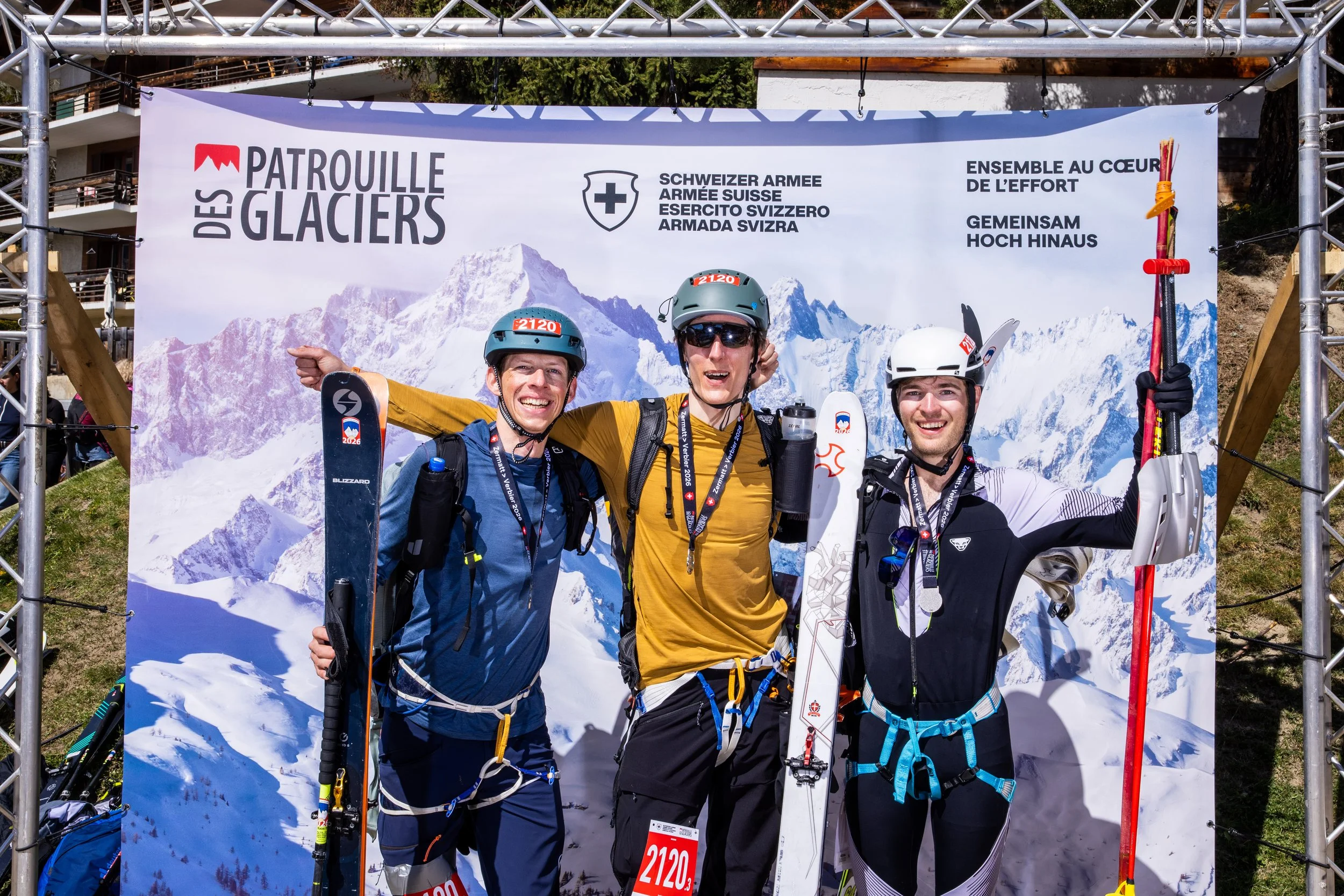
Our finisher photo, including Connor’s bamboo stick (official PDG photo)
I had been worried that Connor’s mum had made us start running too soon, and that worry had not been misplaced. We could see down the street for nearly 400 metres, with not a finish line in sight. Hugues and Connor didn’t seem very keen to keep jogging, but now that I had started, I felt we needed to carry on until the bitter end. Rounding a corner, I saw some fences at the side of the road and sensed the finish line was close. I saw a large inflated balloon forming an arch, but as I got closer, I realised it was simply a large advertisement for Gruyère cheese. We had to pass two more of these before my eyes finally fell on an arch with large letters reading “ARRIVÉE”. This was it, the finish line. As we ran the final 50 metres, we passed another team who evidently couldn’t be bothered to muster the energy for a running finish. Later, Hugues told me they apparently had not looked amused when we ran past them, mere metres before the finish.
16 hours, 19 minutes and 39 seconds. This was how long it had taken us to complete the Patrouille des Glaciers. Behind the finish line, we had to hand in the GPS tracker we had been carrying, and we were checked to ensure we still had our avalanche shovels and rope. Once everyone was satisfied, we received our finisher medals and had our photo taken. We definitely looked tired in it, but we still found the energy for a big smile, and Connor’s bamboo stick, which he had carried all the way across the finish, was etched into history as well. Behind the finishing zone, it was bustling with activity. Bags and skis were left on the ground everywhere, and people walked around with their medals and cold drinks in hand. At this point, I wanted nothing more than to get out of my ski boots, so I quickly made my way towards the sports centre, where I could collect my luggage I had dropped in Zermatt and get a shower.
Relaxing in our chalet in Verbier
Once I returned to my skis and backpack, Connor had already gone to his mum’s hotel room, and the rest of our group was at Alicia’s grandparents' chalet. Joining them turned out to be the last major challenge of the day for me. I walked through the streets of Verbier with my skis, now carrying not one but two backpacks, looking for the right bus stop. After waiting for close to an hour and trying to communicate with the bus drivers in broken English, I realised the connection Google Maps had suggested didn’t exist. I took another bus, which dropped me halfway up the hill, so I had to walk the rest of the way to the chalet. I also realised I hadn’t eaten anything since starting the final uphill towards the Col de la Chaux hours earlier. I had managed to avoid bonking for the entire race, but now I hit a wall. My luggage was heavy, and the sun's heat was getting too intense. I had to call for rescue. That rescue was Hugues and Misia, who walked down from the chalet to meet me and help with my luggage. The chalet was a beautiful little place, built from large logs and situated high above town. Here I could finally relax a bit and put my legs into a horizontal position. Alicia hosting us here was truly heaven-sent. It would’ve been quite the ordeal to make the long train ride back to Zurich now, after being awake for over 33 hours (disregarding the restless naps I took on Friday afternoon). In the evening, we all went for a big dinner at a restaurant just a five-minute walk from the chalet. The next morning, Hugues and Misia prepared crepes for breakfast before we jumped into the chalet’s hot tub, soaking our sore bodies in the warm water. Life felt pretty perfect in that moment.
Enjoying the chalet’s hot tub
Reflecting on the race, I can say it was certainly one of the toughest things I have ever done. But crucially, it was also something I didn’t have to do on my own. In the end, neither of us could have finished the race without the other. If Connor hadn’t pushed our pace at the start, we would likely never have made it past the checkpoint in Arolla, or even worse, not even made the very first one. And without Hugues’ determination on the skin towards the Col de Riedmatten, Connor and I would have given up long before we were actually out of the race. I was glad I was able to return that favour on the climb to the bootpack below the Rosablanche. Each of us had pulled their weight and more at some point during that race – and we didn’t even need a bungee cord for that. “Will you do it again?” Connor’s mum asked us when she took us out for lunch on Sunday, before we all had to return home. “Do I have to know the answer to that now?” I responded. And truly, I didn’t.