
Vent du Dragon
Descending the Midi Arête (photo credit Georgia)
May is a period of transition. It's the time when you can still go skiing, enduring long stretches of carrying skis to find fresh powder at high altitudes. Alternatively, it can be the beginning of simply enjoying some relaxed rock climbing in the warm sun. However, there's one more activity that May is well suited to: mixed climbing. And the place that embodies alpine mixed climbing is, of course, Chamonix! Georgia and I had organised a long weekend, hoping to explore some of the classic routes still in good condition. Generally, May is considered the off-season, as the town shifts from the ski season to summer. This meant we found an absolute bargain for an Airbnb, and our initial plans for camping were abandoned in favour of something that felt much more like a holiday than our usual mountain getaways. A holiday filled with cold, shivering hours on north faces, interspersed with extravagant breakfasts at our cosy little home base.
The gondolas of the Helbronner parked over the Valleé Blanche with Aiguille Verte and Les Droites in the background on either side
We spent our first day climbing the classic Chéré Couloir on the Triangle du Tacul as a warm-up. There was a strange comfort in squeezing into the first gondola up to the Aiguille du Midi. Shoulder to shoulder with others equipped with skis and ice tools, I felt an unspoken sense of camaraderie. The approach to our route was short, but I was excited to head down the Arête du Midi for the first time. We were relieved to see most people passing the Triangle, choosing to ski up Mont Blanc du Tacul instead. Eventually, we even overtook a party on the final uphill to the route’s base, arriving as the first team that day. This was our fortune because the others had to wait in the cold until I started following Georgia on the first pitch. It was somewhat dry and, given the conditions, likely the crux of the route. The next pitch, steeper with a short section at 85°, was so well picked out that it essentially resembled a vertical staircase. We still had a good time, even on the final pitch, which was still easier to climb. After rappelling, we had some free time before the last gondola, so we decided to climb the first pitch of the neighbouring route, the Perroux Couloir. A descending party told us that the lower sections were in decent condition, though the upper half becomes dangerously thin. The first pitch was an absolute pleasure, and I finally felt like I was properly mixed climbing. I placed only a single ice screw, finding plenty of protection in the rock. We chose to rappel after the first pitch to stay on schedule for the last gondola and climbed back up the Aiguille du Midi in a whiteout that, seemingly out of nowhere, engulfed the glacier just as we finished rappelling. The steep climb up the Arête du Midi felt much longer than that morning, but we eventually reached the lift station with plenty of time to spare – something which would not turn out to be characteristic for that weekend. Or, for that matter, me taking advantage of the Chamonix lift support in general, but I’m getting ahead of myself.
On the approach to the Triangle du Tacul
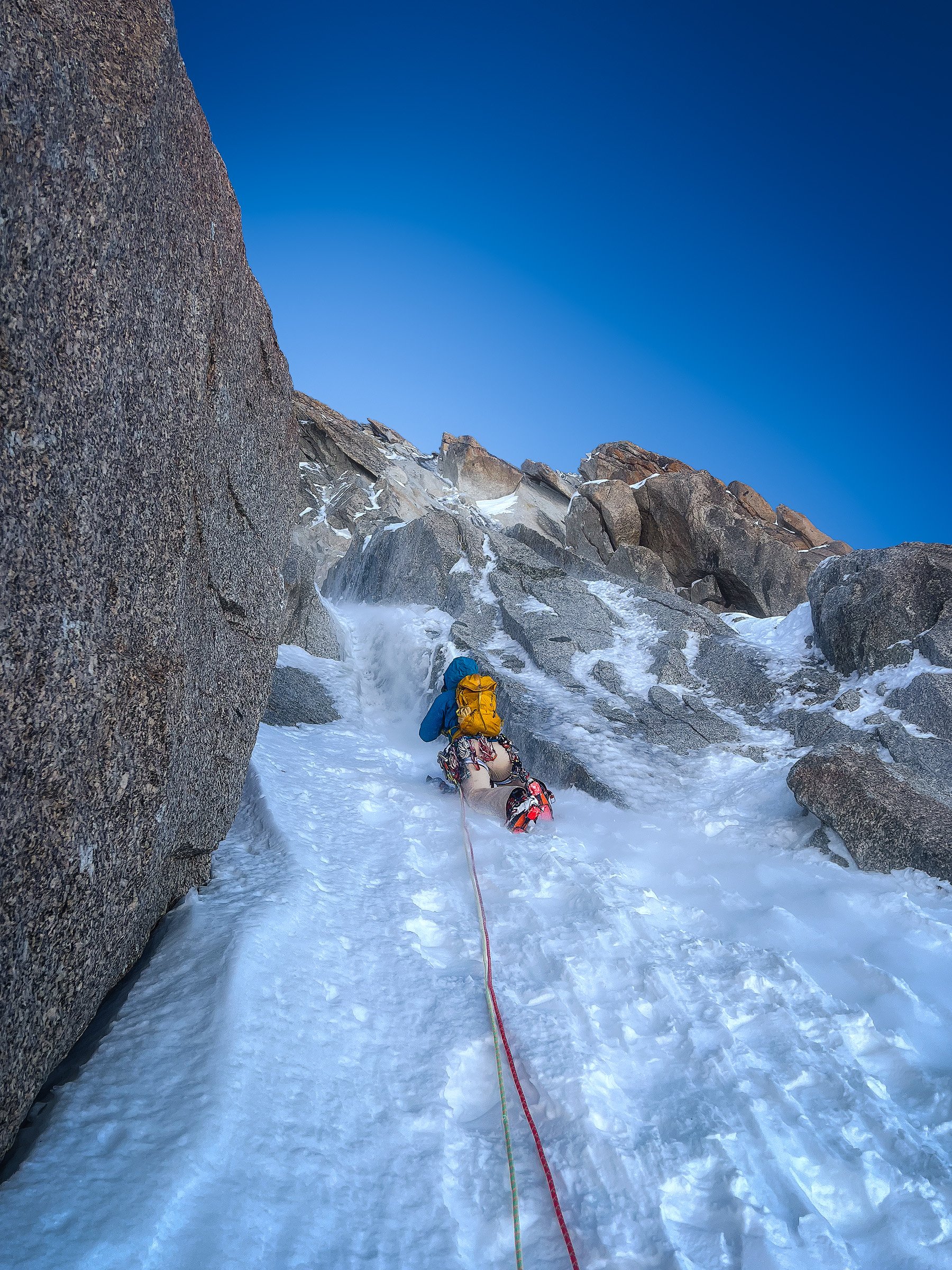
Georgia leading the first pitch of the Chéré Couloir
Following the first pitch (photo credit Georgia)
Setting off in the second pitch (photo credit Georgia)
Georgia leading the third pitch …
… with clouds of spindrift overhead
The slopes towards the summit, the climbing usually ends here
Rappeling the Chéré Couloir
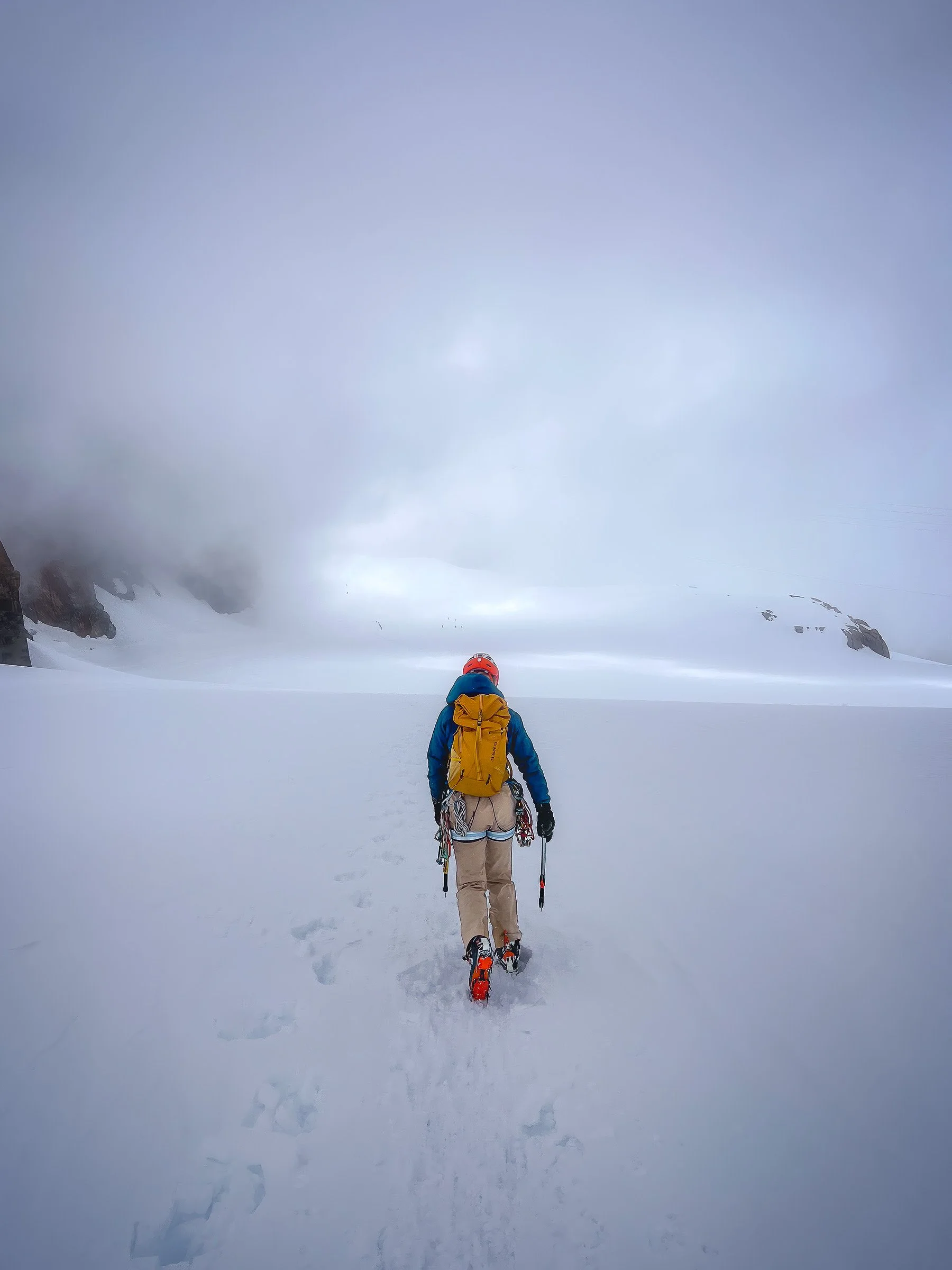
Heading back towards the Aiguille du Midi in the fog
We’ve had a fantastic time, and the first day was already a great success. However, we both agreed that for our next route, we wanted to step up the difficulty by a notch. Therefore, our choice for the following day fell on a climb on the northwest face of the Aiguille du Midi. It bears the elegant name Vent du Dragon, which translates to «Wind of the Dragon.» It also offers the advantage of a laughably short approach, even by Chamonix standards. After Georgia and I boarded another early gondola on Saturday, we walked just 30 metres from the ladder at the end of the Arête des Cosmiques to reach a rappel anchor, from which we could abseil down to the bottom of the Passerelle Couloir. From here, Vent du Dragon ascends back up the northwest face to rejoin the Arête des Cosmiques. Although the route is fairly accessible, the need to rappel into it makes it a serious objective, since there are no easy alternatives to exit the Passerelle Couloir. In the past, climbers would do a free-hanging rappel directly from the footbridge at the Aiguille du Midi to reach the couloir, under the watchful eyes of tourist crowds. Sadly, this infamous rappel has since been banned by the company operating the lift, hence the new line of rappels on the northwest face. They went smoothly, and we quickly descended into the abyss.
As we approached the base of our route, we began to get a sense of what it might be like to ski the Passerelle Couloir. Given the current snow conditions, it was likely to be quite challenging. But the gradient didn’t look outrageously steep, and in decent snow, I could see myself making careful turns on this terrain. However, the steep skiing experience in Chamonix would have to wait for another trip. “Are you okay soloing this?” I asked Georgia, eyeing the snow slope leading to some easier mixed terrain higher up, and she nodded. We had briefly checked some photos for confirmation and now knew we were below the correct couloir. I spotted some old slings wrapped around a rock about 20 metres higher and aimed to make my way there. After the initial easy snow slope, I suddenly found myself in mixed terrain that was perhaps a bit trickier than we had bargained for when soloing. With a precarious high step, I balanced on the slabby granite, covered in loose snow, reaching for the slings to secure myself. From there, I could throw Georgia a rope. She clearly wasn't convinced by my approach, especially since I had bypassed a perfectly good crack to build a belay. “I’m sorry,” I offered as I brought Georgia up. “Tim, that was sketchy and completely unnecessary,” she replied, looking shirty – and she was right. There was no real need for extended soloing, but I had been too fixated on that cluster of old slings.
Georgia climbing the first pitch of Vent du Dragon
Georgia took the first lead, navigating up a crack on the right-hand side of the gully where I was perched on the sling belay. The crack widened into a small dihedral, and it wasn’t exactly an easy start; finding protection in the snow-covered rock took some time. It would probably have been simpler to hug the gully’s left side, which appeared to carry significantly more ice. Eventually, Georgia fought her way out of the initial rocky section onto a snow slope, where she could progress much more quickly. The belay was meant to be on the left side of the gully, and she traversed through the snow, searching for signs of human passage. She encountered a few short mixed steps as she climbed higher, but still couldn’t find anything resembling an anchor. As she approached the end of our ropes, she eventually had to set up an anchor herself to bring me up. I followed her swiftly, trying to make up some of the time lost to route-finding. Georgia had built her belay on a ramp leading to a small snowy col. Once I climbed over it, I saw a bolt and some old slings just 10 metres further on. However, as I glanced around, I realised this was already the belay before the prominent dihedral that forms the crux of the route. Between our soloing at the beginning and using the full length of our 60-metre ropes for Georgia’s lead, we had already completed the first two pitches. Georgia quickly joined me at this belay, which we reinforced with a piton to avoid relying solely on the single bolt and weathered sling.
We both looked at the upcoming pitch with some scepticism. “Are you sure you want to lead this?” Georgia's question was certainly justified. “Well, at least it doesn’t look completely dry,” I replied, trying to reassure myself more so than Georgia. The dihedral did hold some ice – it actually looked quite thick in the beginning – but the higher our gaze went, the thinner the ice became. Below the roof, where the dihedral peters out, there was worryingly much rock to be seen. Perhaps I was falling into my usual pattern of optimism, but I decided I wanted to give this a try. There was possibly a sense of finally wanting to measure myself against a proper Chamonix mixed climb, and in a grim and definitely also stubborn spirit of determination, I was prepared to accept whatever this next pitch would throw at me. As I started from the belay and moved towards the beginning of the dihedral, I was on the lookout for good placements for protection before heading up the corner, where protection on the thin ice was sure to be sparse. I found a decent crack where I could place a cam and a nut, which I equalised before entering steeper terrain. The ice down here was indeed very well formed, and I could move swiftly, even managing to place a good ice screw, which gave me some reassurance before venturing into the more challenging terrain ahead.
Climbing the lower sections of Vent du Dragon (photo credit Georgia)
As the ice grew thinner, the only solid spot for my foot was within the crack in the corner at the back of the dihedral. I balanced on my right foot while my left foot was placed precariously on the thin ice, where I soon scraped the rock beneath every time I tried to gently kick my front point in. I reached high with my tools, searching for any purchase inside the crack that would let me momentarily trust my weight on the fragile footholds to my left before shifting my right foot upward, finding another solid hold deep within the crack. I had placed a green cam on the right wall of the dihedral, but as I climbed higher above my last piece of protection, no other points of protection presented themselves. Still, I felt reasonably secure; my right foot jammed inside the crack, pressing against the wall to my right with my back. My progress was slow, but I never felt close to falling. That sense of security became more fragile when I was about 6 or 7 metres above that green cam. Still, I forced myself to keep a cool head and continued climbing steadily until I discovered a crevice in the rock where I placed another, very welcome, cam. I was approaching the large overhang at the end of the dihedral, where I could at least momentarily stand more relaxed in the snow and thoroughly assess the upcoming section.
“This might be pretty hard, even to follow,” I shouted to Georgia. I was momentarily considering whether I should continue climbing, even though I wasn’t confident that bailing would be substantially easier. For this next section, I had to climb around the roof I was standing below, and the rock where I wanted to find some footholds was covered in a couple of millimetres of thin verglas. Not enough to be structurally useful, but just enough that I kept slipping with my crampons as I tried to dry-tool this section. I had managed to place two very secure cams in the roof; otherwise, these next couple of moves would have exceeded even my appetite for bold climbing. With my right tool, I managed to find a good hook, but as I pulled up, I failed to find any purchase higher up. “Scrrrrtch!” With an unpleasant sound, my front point popped, and I was hanging from my arms, my feet unable to find any foothold. Holding onto my right axe, I slowly shuffled down until I was standing on the snow platform below the roof again. Climbing this thing proved to be quite tricky and delicate. I took a moment to compose myself. I now had two options: leave some gear and descend to Georgia, where we would need to find another way to get back up the Aiguille du Midi, but the time lost would undoubtedly mean missing the last gondola at 5 p.m. The other option was to muster some courage and give this another shot. “You can do this; just really think about where you place your front point,” I thought to myself. The decision was made. This time, I took more time and carefully inspected the rock with its thin veneer of ice before committing my front point to an almost non-existent depression. Once I was satisfied, I placed the good right hook with my axe and pulled up again. I locked my right arm, my elbow almost touching my stomach, and reached as high as I could with my left axe. Miraculously, my foot hadn’t slipped yet, and I felt relief wash over me as my left ice axe sank into some solid styrofoam snow. I pulled higher, wriggled my right axe out of the crack it was hooked into, and placed it next to my other axe in the snow. I pulled up even higher; my left front point left the semblance of a hold it had been placed on, and my feet were now both dangling in the air, but it didn’t matter anymore. With just my arms, I pulled myself over the bulge where an old sling, left in place, helped me aid the final move to stand upright.
The ice got thinner and thinner the higher up you climbed
Climbing the icy smear in the dihedral (photo credit Georgia)
I was catching my breath while standing there, not daring to look ahead after just fighting my way up the previous section of climbing. “Well, that was probably some of the hardest climbing I’ve done in the mountains," I thought to myself. But the pitch wasn’t finished, and eventually I had to face the next part. Fortunately, it wasn’t as strenuous, but rather very awkward and uncomfortable, as I had to crawl on all fours beneath an overhang that prevented me from standing upright while I traversed left to reach a short section of vertical ice, about two metres high. I constantly felt like I was being pushed off the mountain, and the fact that I hadn’t been able to place any protection since clipping the old insitu-sling didn’t make it any more reassuring. I was glad to sink an ice screw into the bulge of solid ice before attempting to climb it. It was a little awkward, and when I reached the top of the ice pillar, I couldn’t see my feet anymore. Once I had climbed this final obstacle, however, the terrain became easier, with plenty of opportunities to place protection in the rock. I had been climbing for over an hour at this point and also felt I must be nearing the end of my ropes, so I began to look out for a belay. I moved up a small gully where old footprints assured me I was on the right track. But once I reached the end of the gully, where a dead end meant climbing some mixed moves to gain another ramp, I decided this was probably as far as this pitch was meant to go. With no signs of an anchor in sight, I built a belay in a good crack to bring Georgia up.
Setting off from the belay I built after the crux pitch – the next anchor was just behind the rocks (photo credit Georgia)
After some helpful belaying, she finally stood beside me, even more impressed with my lead than she had been while watching me climb. "I saw your feet dangling in the air, but it was somehow still more challenging than I imagined it,” was her assessment. I then had to climb a small boulder blocking the end of the gully, which was easier with my gloved hands than using tools. Afterwards, I took a few steps on an easy snow ramp to reach the belay before the final pitch. It turned out the previous pitch was longer than I thought, though the dry conditions probably made the boulder exit from the gully appear less straightforward than usual. I quickly belayed Georgia through this short section so she could join me at the belay. It was nearly 3 p.m., and with the last lift at 5 p.m., time was tight, but I remained optimistic we could finish in time. It would depend on how tricky this final pitch was. I quickly consulted the photo of Georgia's guidebook, and then started, aiming to move more swiftly through this last section.
Georgia following
“Damn, how is this even harder!?” My curses echoed silently in my head. Georgia couldn’t hear me; I was about 40 metres above her, standing beneath a massive overhang at the end of a snowy ramp. The start of the pitch had gone well enough – a steep but short ice column led onto a gully with enough ice to make climbing relatively easy. I then left the gully to traverse around a boulder, ascending into another gully. This one had less ice and more of the thin ice veneer I had encountered earlier, which made the climbing feel very insecure. Thus, I decided to jam my feet deep into the crack running up the gully, which made for very uncomfortable climbing as I shuffled upward, but at least I felt stable on one foot. After exiting the second gully, I was faced with easier terrain, where I saw what looked like footprints in the snow. These, together with an old sling and a fixed friend, guided me onto the snowy ramp I had just climbed. This turned out to be a mistake. I was now sure I was off route, having missed the spot where the pitch was meant to traverse left. To make matters worse, the section of climbing I now found myself beneath looked far trickier than it had from below. I paused to consider my options: either downclimb and try to rejoin the route, or see if there was a way upward. I sensed that I must be close to the top and felt confident that if I could get past this overhang, I would soon reach the Arête des Cosmiques.
Starting the final pitch (photo credit Georgia)
I wasn’t entirely sure whether my decision to press on would turn the, at this point, mostly frustrating route-finding error into an actual grave mistake, but part of me longed to see if I could find a way out of the situation I had put myself in. One that led forward, not backwards. To climb this overhang, I would have to use the smooth granite wall to my right. I could barely discern any usable footholds, but at least the rock here was completely dry. There was one crucial feature I could make out, which would prove essential: inside the roof I was standing below, there was a small chokestone. If I could just manage to put a sling around it, it would provide the crucial piece of protection I was lacking at that moment (my last piece was a screw in less-than-ideal ice, more than 7 metres below). On top of that, I was already planning in my head how I could use the sling to aid my way out from beneath the roof and into the more vertical section of rock that followed the smooth granite slab to my right. Up there, I could see what I thought were pretty decent hooks. It all depended on these next couple of metres.
Georgia toping out my “alternative extit”
I climbed as far up the snowy gully as I could, perched right beneath the roof and barely able to stand upright. Reaching out high, I fiddled with a sling, but I couldn’t get around the chokestone. I stepped back and composed myself. Then I took off my gloves and, with more dexterity, managed to sling the chokestone and clip my ropes. I inspected the granite slab and discerned a tiny edge, no more than a couple of millimetres, but that was all I needed. I placed my front point on it and, bracing myself before committing, pulled myself up with the help of the sling. It was an awkward balancing act, but standing on the razor edge of the granite, I was able to reach out with my right hand, my left still gripping the sling, to hook over the edge of the granite slab. “Yes!” I thought – the hook was good, and I quickly climbed onto the slab, where I stood on better footholds. I had managed to climb the roof, but the pitch was far from over. I could see a short snow slope of no more than 10 metres leading towards a ridge, which I was now certain marked the top. However, to reach it, I still had some steep ground to cover. The snow here was very loose, and every time I tried to stand up, I sank back again. My tools scraped the snow, but found nothing to hold onto. I paused to consider this section for a few minutes, hesitant to commit my weight to the unstable snow. The sling I had clipped was now already some metres below, and any fall could send me tumbling back down the gully I had just escaped. Eventually, I decided to use a thin flake of granite to my left, which I grasped with my bare hands, pulling myself high enough to stand somewhat more securely in the snow. I dug my way upward, and although progress was slow and tiring – with one step back for every two forward – I finally reached the crest of the ridge. I was on top!
To my relief, I saw I was only a few metres from a well-used footpath that ran along the Arête des Cosmiques. The rope was very taut, indicating I had likely used up our 60m ropes. I called Georgia to let her know I only needed a few more metres to reach a ledge where I could set up a belay. We started simul-climbing, with me gradually descending the ridge to reach the Arête des Cosmiques. The rope drag was immense, but it meant the rope safely belayed Georgia until I found a crack, where I built a belay. “Do you know when the last lift is?” I looked around to see where the voice had come from, then realised we weren’t alone after all; a girl in her mid-twenties sat beside the path, with a rope leading around a corner where her partner was climbing out of sight. We wouldn’t be the only ones missing the last lift that day. It was now clear we wouldn’t make it back in time, as it was already past 4:30 p.m. “It’s at five; you're definitely going to miss it,” I replied to the climber who had pried my knowledge of the timetable. She and her friend appeared slow. They took nearly as long to pitch out a section of the Arête des Cosmiques as it took Georgia to follow my ‘alternative exit’ for Vent du Dragon.
The final steps along the Arête des Cosmiques (photo credit Georgia)
Georgia and I moved unroped along the Arête until we reached the slabby crux. I was surprised to see the two climbers I had met still climbing this section; it had probably been nearly an hour since they had passed me while I was belaying Georgia. But we were no longer in a hurry, as it was clear we had missed the lift. So we waited patiently behind them. Georgia now took the lead, and we moved quickly across terrain that felt laughably easy after the challenge we had just faced. The crux slab can still feel a bit insecure, but the numerous footholds drilled into the rock by Chamonix guides for our crampons make possible what would otherwise be an insurmountable obstacle for many beginner mountaineers. As we climbed behind the two girls, we could follow a trail of their belongings and recover a Totem cam that had got stuck, as well as their walkie-talkie, which they had dropped. Waiting at the belays, we saw little point in overtaking them. Instead, we started chatting, learning that the duo was on holiday from Canada and had begun climbing the Arête des Cosmiques (a route that should take an experienced party no more than four hours) at 11 a.m. that morning. When we arrived back at the ladder leading down from the terrace at the Aiguille du Midi, it was half past seven, eleven hours after we had started our rappels.
Georgia fittingly expressing how we both felt in that moment
The lift station felt eerily deserted as we entered its hallways. We dumped our gear on the floor and sat on the benches, too exhausted even to remove our harnesses. It didn’t take long, however, for the two staff members stationed at the lift that night to come and see who the poor souls were who had missed the last lift. Word had spread about the two women on the Arête des Cosmiques who had been expected back hours ago. Looking at me and Georgia, it was clear we weren’t who they were searching for, and they were talking hysterically on the phone until they encountered the two Canadians coming down from the terrace. Between the two men guarding the station this evening, one seemed rather impassive towards the four mountaineers stranded up here. The other, however, showed a bit more compassion and brought us foam mattresses, blankets, and even a cup of hot broth. It felt like sipping from the fountain of youth, and I felt the energy re-enter my body as I drank the salty liquid. Sitting on the benches, I reflected on the climb. It had undoubtedly been ambitious to attempt this route in these conditions, and part of me wondered if I had bitten off more than I could chew with these last two leads. In the end, I managed to climb them, but I wondered whether I wasn’t perhaps falling victim to outcome bias. The fact that I had veered off route on the last pitch certainly didn’t make me look very competent. “Do you think I was in over my head?” I asked Georgia, seeking an outside perspective. “You certainly are bold,” was her reply, leaving the rest up to interpretation. There is undoubtedly a fine line between being bold and being reckless, and I was left uncertain how much I had crossed that line that day.
These were the thoughts swirling in my mind as I gazed out from the large panoramic windows lining the hallways beside the toilets where we would spend the night. Outside, I watched the surrounding landscape being bathed in the golden hues of sunset. Although I just wanted to lie down, the stunning display of colours drew me back onto the terrace, where I didn’t know which way to look. All around, the view of the Mont Blanc range, illuminated by the last rays of the sun, was a sight to behold. I had borrowed Georgia's small point-and-shoot camera and snapped away frenetically. There was an icy wind blowing, and my fingers soon began to feel numb. Georgia joined me, similarly awestruck by the spectacle unfolding before us. But the biting wind meant she was soon heading back to the sanctuary of the lift station, while I was still too captivated by the spectacular colours all around. Eventually, though, my fingers could hardly operate the camera’s small buttons anymore, and I went back inside as well. It was a weird feeling to know that only our (or rather my) messing up had allowed us to witness this gorgeous sunset – perhaps a worthwhile bargain?
We then settled into our bedroom, the only place heated throughout the night: the toilets, where we lay on the tiles. The sleeping pads and blanket made everything significantly more comfortable, and we managed at least a few hours of rest. Georgia’s friend and local Chamonix mountain guide Luke had shared a little secret about how to turn off the motion sensor of the toilet lights, so mostly the loud snoring of one of the Canadian girls was an obstacle to sleep. It certainly wasn’t the most comfortable night I’ve had in the mountains, but it wasn’t the worst either. A good level of acclimatisation meant the altitude wasn’t too problematic; the arguably thin sleeping pads were more of an issue, but I didn’t feel too sorry for my hipbones, since sleeping on the ropes – which we could now use as pillows – would have been even less comfortable.
Georgia getting snuggled in at our toilette bivy
We woke the next morning, having dozed through the surely stellar sunrise, and packed to catch the first lift down at 7:15 a.m. It felt strange walking through the streets of Chamonix again, looking back up at the Aiguille du Midi, where we had just spent a long, adventurous day climbing and a long, arduous night sleeping. The main thing on our minds now was a big breakfast. We had only packed food for the climb, so our dinner last night had been a meagre selection of leftover bars and nuts. All morning, we had scoured Google Maps for brekkie options and now hiked through town, still wearing our gear and sweaty clothes. We stuffed ourselves with avocado toast and breakfast burgers. Afterwards, we felt a bit more normal again. When we returned to our Airbnb, we showered and lounged in bed for a while before deciding that a nice multipitch rock climb in the afternoon would be just what our sore bodies needed for active recovery. Therefore, we concluded our short getaway to Chamonix with some excellent pitches of granite near the small village of La Châtelard. “So, when do we go back?” was the only question that remained once we had boarded the train back to Zurich the next morning.