
The north ridge as seen from the approach (from this perspective, the Grand Gendarme in the centre of the image appears almost at the same height as the Weisshorn summit on the right)
It had already been two weeks since I climbed the Breithorn traverse in a day, and remembering the strong headache with which I had to descend to the Klein Matterhorn, there was certainly a bit of apprehension when I approached the Cabane de Tracuit with Maurice at the beginning of August for an attempt to climb the Weisshorn via its aesthetic north ridge. Could I still benefit from the acclimatisation I gained on the Breithorn, or would I be in for another day of pounding headaches? But the forecast was looking too auspicious – it promised to be the first weekend of really good weather in almost a month – to forego an opportunity at another long, arduous, but rewarding tour in the mountains of Switzerland. Maurice and I still vividly remember our adventure traversing the three peaks of Grand Combin last year (including a summit bivy above 4000 metres), and we were happy to team up again on very short notice to make the most of this weather window.
Unusually for Switzerland, we experienced delays taking the buses into Zinal, which we realised were caused by the Sierre-Zinal trail race that Saturday. The tiny village of Zinal was bursting with the race festivities, but we quickly left the noise behind us as we ascended the steep path towards the Cabane de Tracuit. We made the approach in just over three hours and arrived with still plenty of time to spare before dinner despite our delayed start. At the hut, we learned, not surprisingly, that we wouldn’t be the only ones attempting the Weisshorn tomorrow. Several parties had already been on the route that day. From the hut, you can see the entire north ridge. Some snow still clung to the Weisshorn’s west face, but from what we could see, the ridge itself looked pleasantly dry. And I was hopeful the fresh snowfall from last week had by now consolidated.
Maurice leading the first bits of climbing after the Weisshhornjoch
Overall, I was feeling quite optimistic about the conditions. It was already my second time trying this route; my last attempt had been thwarted by unforeseen heavy rain that drenched us on the climb up the Bishorn, and we arrived with soaked boots in a cold whiteout making turning around an easy decision. Now, one year later, I was hopeful for redemption. My biggest question mark, however, remained how much margin I had in fitness and in dealing with the altitude. Tomorrow was sure to be a long day (our plan put us on track to arrive at the Weisshornhütte around 5 p.m.), and unlike the Breithorn traverse, the descent would be a mission in its own right. During dinner, I made sure to load up on as much pasta as I could stomach, and soon after, Maurice and I went to bed, trying to get all the rest we could before our 2 a.m. alarm.
We stepped into a warm night as we left the hut around half past two. The landscape was illuminated by a full moon so bright we could’ve ditched our headlamps if we'd given our eyes enough time to adjust to the silver light beaming from the sky. On the glacier, the snow was slushy and soft; a couple of times, I broke through small crevasses, enough to swallow my foot but not big enough to pose a real threat. Several parties were already ahead, and we followed the glow of their headlamps. With everyone leaving around the same time, we were sometimes right on the heels of the party in front of us. Every now and then, someone slowly overtook the party in front of them. But everyone was quiet as we ascended the slopes towards the Bishorn. In these morning hours, we all kept to our own thoughts, ruminating on the challenges ahead and trying to swallow any trepidation that might arise. As we climbed higher, a cold wind picked up, steadily increasing. Suddenly, the night didn’t feel so warm anymore. The horizon was still pitch black; only in the moonlight could we make out the silhouettes of the surrounding mountains. The wind chill intensified the closer we got to the Bishorn, and in a sheltered spot just before the summit, we stopped to hurriedly don more layers. It was just after 4:30 a.m. when we stood on the summit of the Bishorn in the biting wind. Under the glow of the moon, we could now get our first proper look at the north ridge of the Weisshorn. The Grand Gendarme somehow looked much closer than I’d assumed, while the firn ridge after it seemed interminable.
The party in front of us getting ready for the short 20-metre rappel at the start of the proper climbing
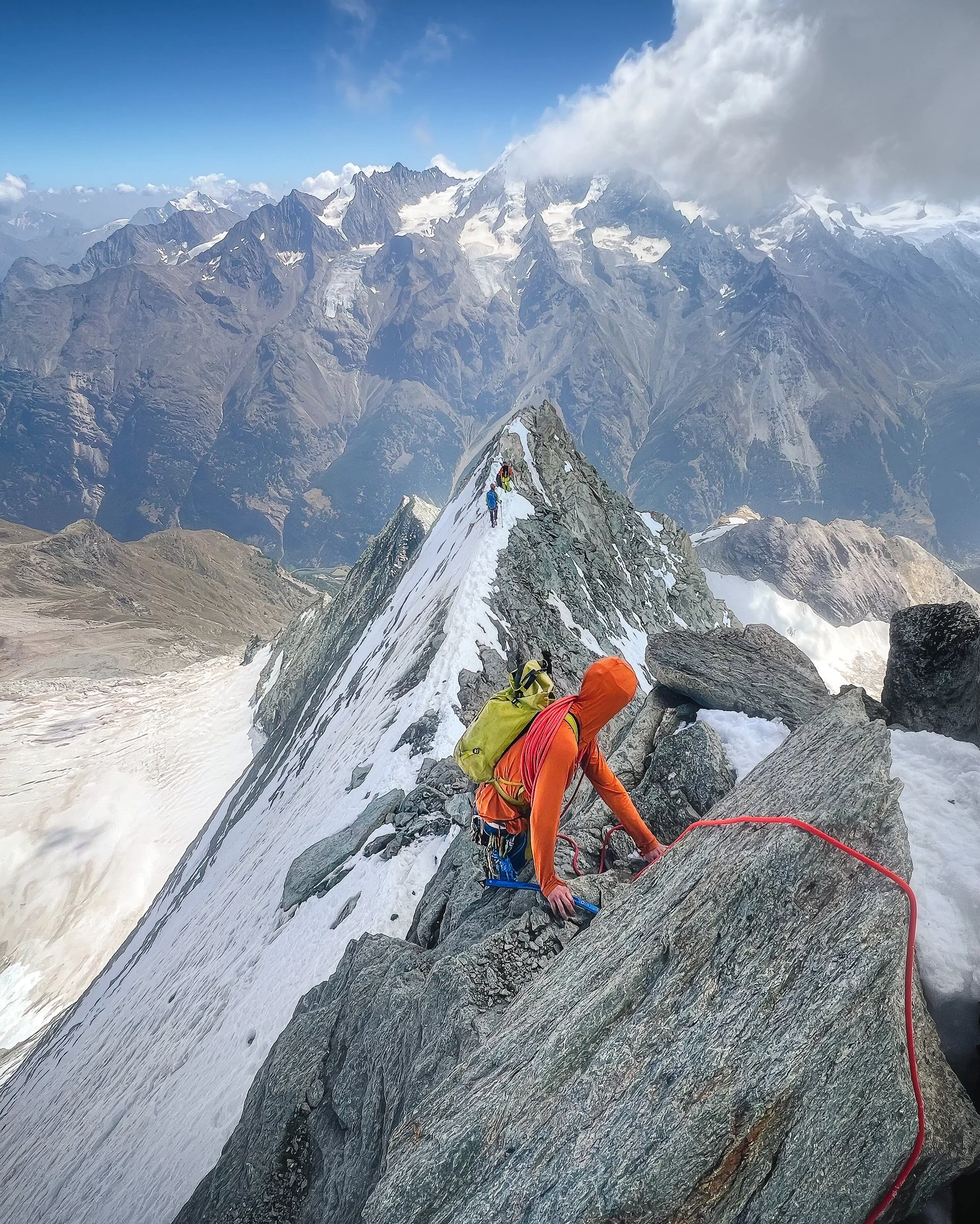
Maurice and I enjoyed our first summit of the day for all of thirty seconds before we started descending into the Weisshornjoch, unfortunately sticking to the mountain's western side, where the wind continued to howl relentlessly. We hoped the strongest winds would be refined to the morning hours and continued, now better equipped to deal with its freezing grip, in down jackets and windproofs. Sunrise was still almost an hour away. The path was well-tracked, and in the distance, I counted the headlamps of now fewer than four other parties, the first of which was already approaching the end of the firn ridge. A rocky section broke up the firn ridge and gave us a first taste of what lay ahead. Maurice led the way through the mostly dry rock, and afterwards I took over to climb the final bits of nevée, which became quite steep toward the end. We were now close to p. 4203, which marks the start of the proper climbing along the generally good rock on the Weisshorn north ridge. The climbing begins with a 20-metre rappel, and we could see the party ahead of us queuing up. We found a wind-sheltered spot on the eastern flanks of the ridge and took our turn waiting for the rappel to free up. We used this opportunity for a small breakfast break, during which we watched the sun finally creep over the horizon. The red glow of the morning sun hit the clouds flowing over the Weisshorn summit in the distance. A pretty sight, but the quick movement of the clouds showed just how strong the wind was blowing up there; I was already dreading the walk along the final, exposed stretches of the ridge.
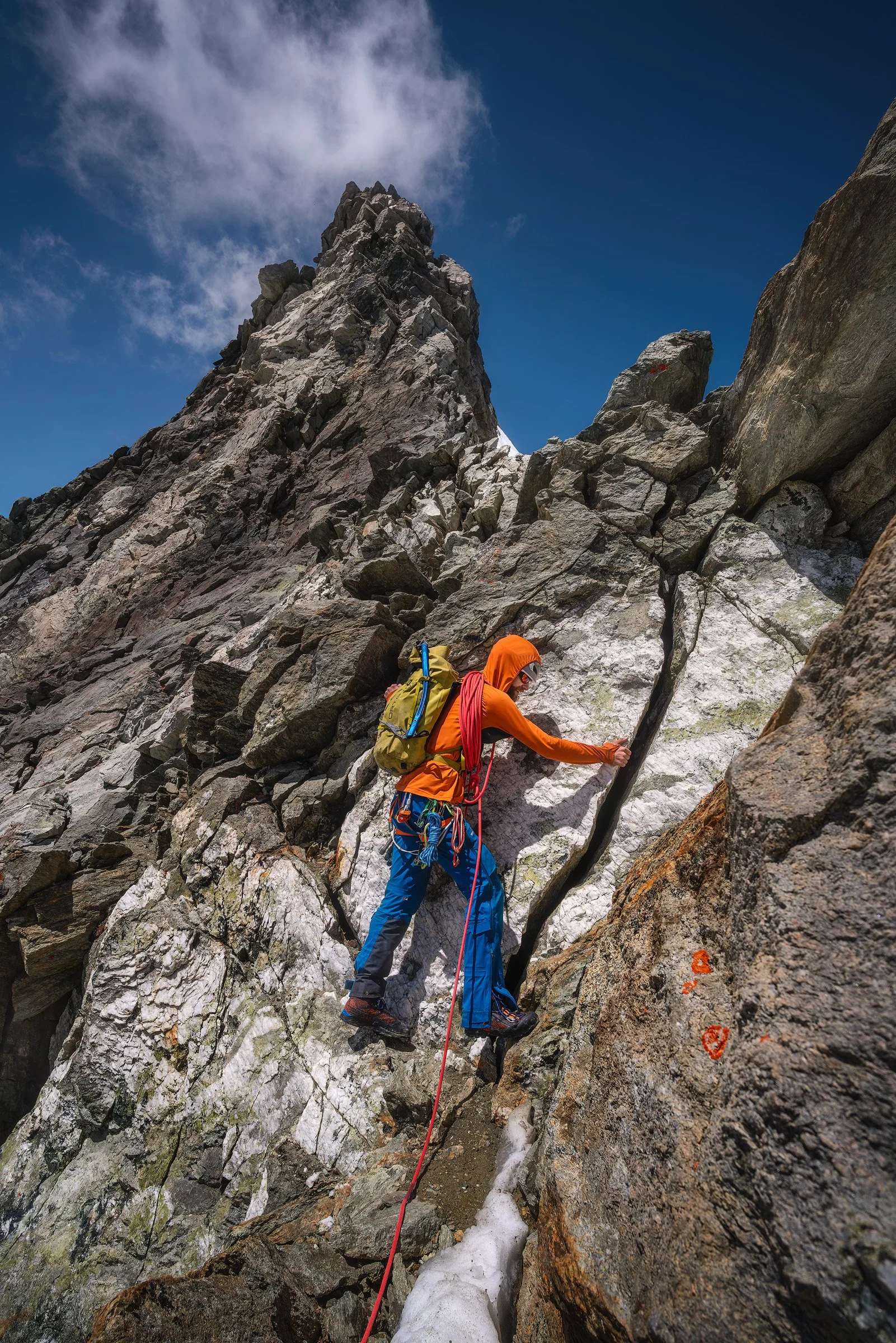
As we continued along the ridge, the first rays of sunshine had yet to gain much strength and did little to warm us, so we did our best to keep moving. After the first rappel, a short, horizontal, easy scramble brought us to a second one. We continued moving together, staying close to the ridge line and swapping leads once after I ran out of gear. The climbing was never particularly hard, though there were a few short, awkward moves. At one point, we overtook a party that seemed to have strayed off route. They were cursing in Italian, and though I couldn’t understand them, it was evident they were quite irritated with each other. The exposure along the ridge was never crazy, but consistent enough to leave you weary at every moment, offering little opportunity to relax. The rock was mostly dry, though some patches of snow remained, and we climbed everything in our crampons to avoid losing time putting them on and off. In that way, we climbed over and around a number of rocky outcrops, and before we knew it, we were standing below the steep 30-metre pitch at the bottom of the Grand Gendarme. It constitutes the crux of the route, rated 4a, and looks quite imposing. It must have felt quite intimidating for the first ascensionist, who climbed this route in 1898, during the time of hemp ropes and before the invention of crampons or modern mountaineering boots. We had to wait for another party, and I used the opportunity to make sure I stayed on top of my hydration and nutrition. I still felt quite good, and the altitude hadn't started to give me any trouble yet.
The Bishorn catching the first morning light
Shortly before reaching the Grand Gendarme
The crowds gathering on the Bishorn summit
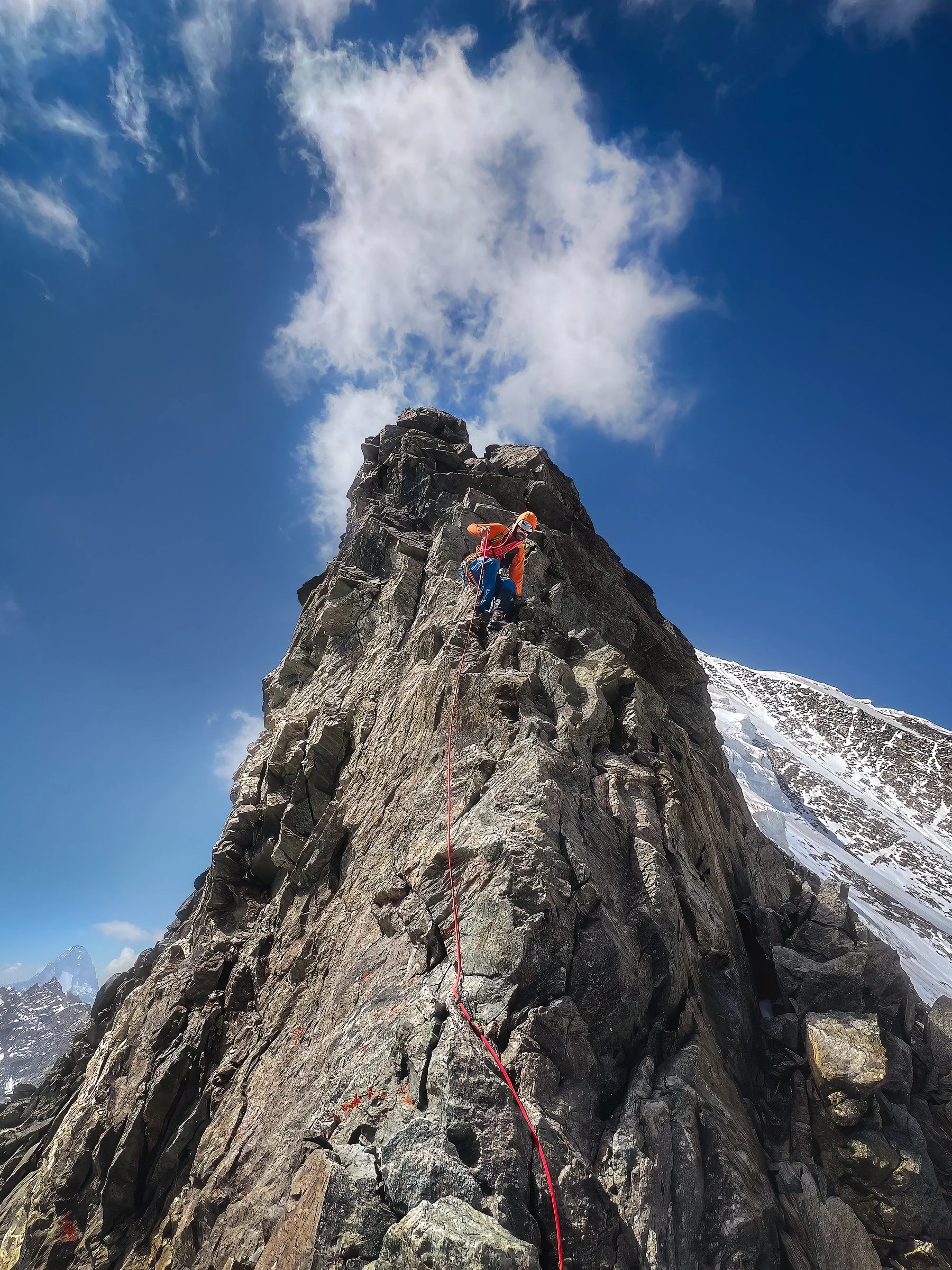
Below the Grand Gendarme
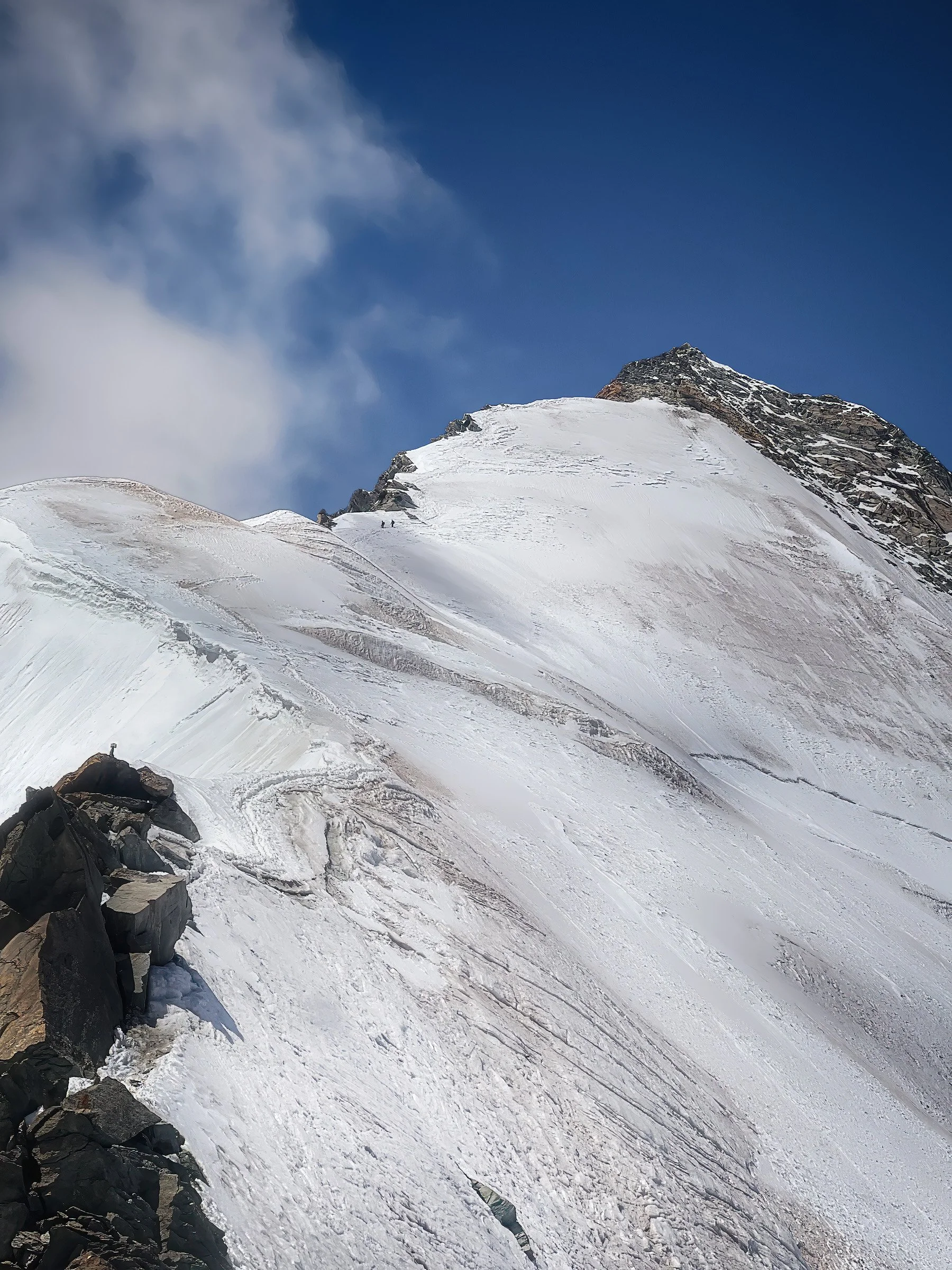
I took over the lead for this amazing bit of climbing. The rock was completely dry, and although I remained in my crampons, we were sheltered from the wind, and I could climb without gloves. The climbing felt steep and athletic, but there were plenty of juggy holds with good rests in between, and I didn’t find it particularly strenuous. I could simply enjoy climbing such a cool pitch in such a wild place. Maurice followed me and then continued leading the horizontal traverse below the Gendarme. We chose not to climb it and instead focused on keeping on schedule to reach the summit of the Weisshorn. I didn’t see anyone climbing the Gendarme that day, which would surely be a different affair if it were included in the UIAA’s official list of 4000m peaks. There was still quite a bit of scrambling, including some airy, exposed steps, but we eventually climbed down to the start of the final firn ridge. Half a kilometre of beautiful, sharp arête of glistening white snow runs towards the summit of the Weisshorn, only 200 vertical metres higher. We could already see the summit cross reflecting the late morning sun in the distance. The path was quite narrow, and in places you could barely fit two feet side by side, but last week’s fresh snowfall had consolidated, and the many parties before us meant we simply had to follow in their tracks. The final obstacle was the edge of a big crevasse that cuts the ridge, but there was an obvious way to climb around the steep Bergschrund by entering the mountain’s western flank. Here, the wind had stripped the snow, and we had to front point for a couple of metres, but we still felt confident enough not to bother with ice screws, although a slip here would have been very serious. We quickly climbed back onto the ridge, realising from the tracks we could’ve done so much earlier.
From here, the summit seemed almost within reach, and the rest of the ridge provided no more obstacles. At 10:50 a.m., just over 8 hours after setting off from the hut, we reached the rocky summit of the Weisshorn. There, we met the party we'd been waiting for below the Grand Gendarme. They were just starting their descent while we enjoyed a brief break, including a (squished and soggy) summit sandwich for me. I felt elated, and the views of the surrounding mountains were spectacular, but I didn’t let myself celebrate too much. I knew the descent would provide its own challenges and require considerable energy reserves. After 15 minutes on top of Switzerland's seventh-highest summit, we embarked on our descent. What followed was no fewer than 3300 vertical metres of downhill until Randa. Up until now, my legs had felt reasonably fresh, but after only the first couple of minutes of descent, I could sense the suffering ahead as my quads started burning. The first part of our descent followed along the nevée on the east ridge of the Weishorn. This was significantly less exposed than the razor edges of the north ridge, and we could finally start to relax mentally. It was approaching noon, and the snow had already softened. Here, on this side of the mountain, the wind died down, and we could now get a first impression of how hot this day actually was; the 0-degree isotherm was forecast to be above 4900 metres. We were half walking, half sliding down in the soft snow, sometimes slipping in the slush and scratching the rotten ice beneath with our crampons, but generally the track was still in good shape and made for a quick descent.
Maurice about to transition from the final bits of rock onto the firn
At the beginning of the firn ridge, which turned out to be less steep and exposed than it looks from a distance
Generally, a decent path made for easy walking on the ridge, and it didn’t feel nearly as interminable as it had looked from afar
The final metres toward the summit!
The first metres of descent down the east ridge
When we reached the end of the firn, we removed our crampons as the rock looked completely dry from here on. The climbing was generally easier than on the north ridge, the rock quality a bit better, and the exposure more mellow, so we could enjoy the scramble despite our tired legs. We stayed as close to the crest as possible while foregoing a couple of short rappels in favour of downclimbing. A beautiful giant slab of quartz briefly distracted us from the flashbacks to the interminable descent from the Grand Combin last year, where we similarly had a long ridge to descend with seemingly no end in sight. Eventually, however, we reached p. 3914, from where the descent turns south, leaving the east ridge to follow a rib flowing down towards the Schalliglacier. We could already see the Weisshornhütte as a tiny speck in the distance, still over a thousand metres lower down. Many cairns now marked the way, but we still had to stay alert not to stray from the zig-zagging path, which was increasingly dusty as the rock became more brittle. Around 3550 metres, we reached a big cairn that marks a 20-metre rappel, which looked like it could also be downclimbed. We opted for a quick abseil, after which we reached a snowy shoulder from which the descent continues along a rocky ridge, which we left around 3400 metres to the west, entering a snowfield where we could basically just slide down to p. 3144. Here, we followed a winding, steep path along a waterfall that flows over the slabby rock above the glacier. We had read about how tricky it can be to downclimb these slabs when they are wet, so we opted instead for a final rappel. We found a single, but new-looking, piece of cord slung around a big boulder. The boulder didn’t appear attached to the mountain, but it looked big and heavy enough to provide a sufficient rappel anchor.
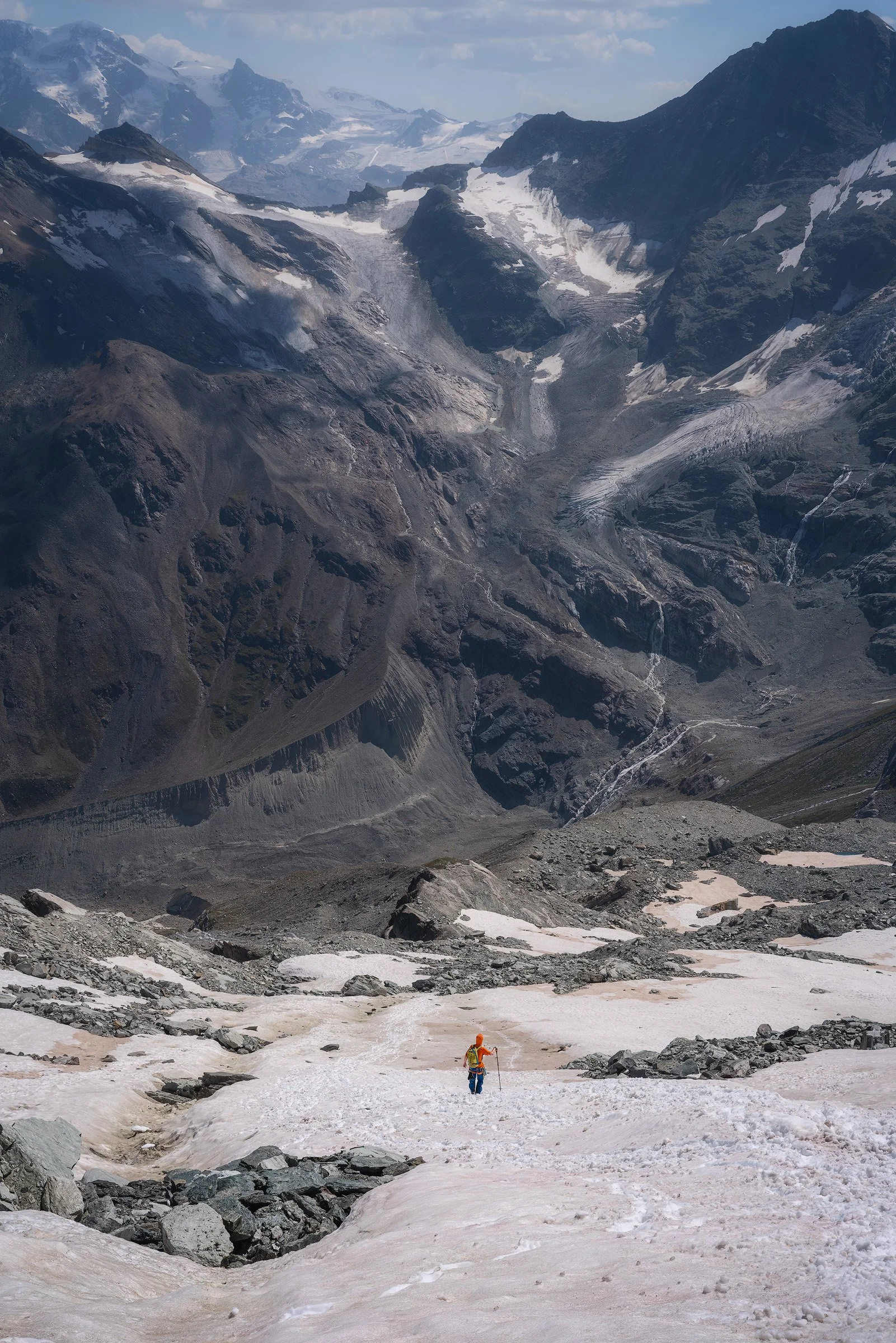
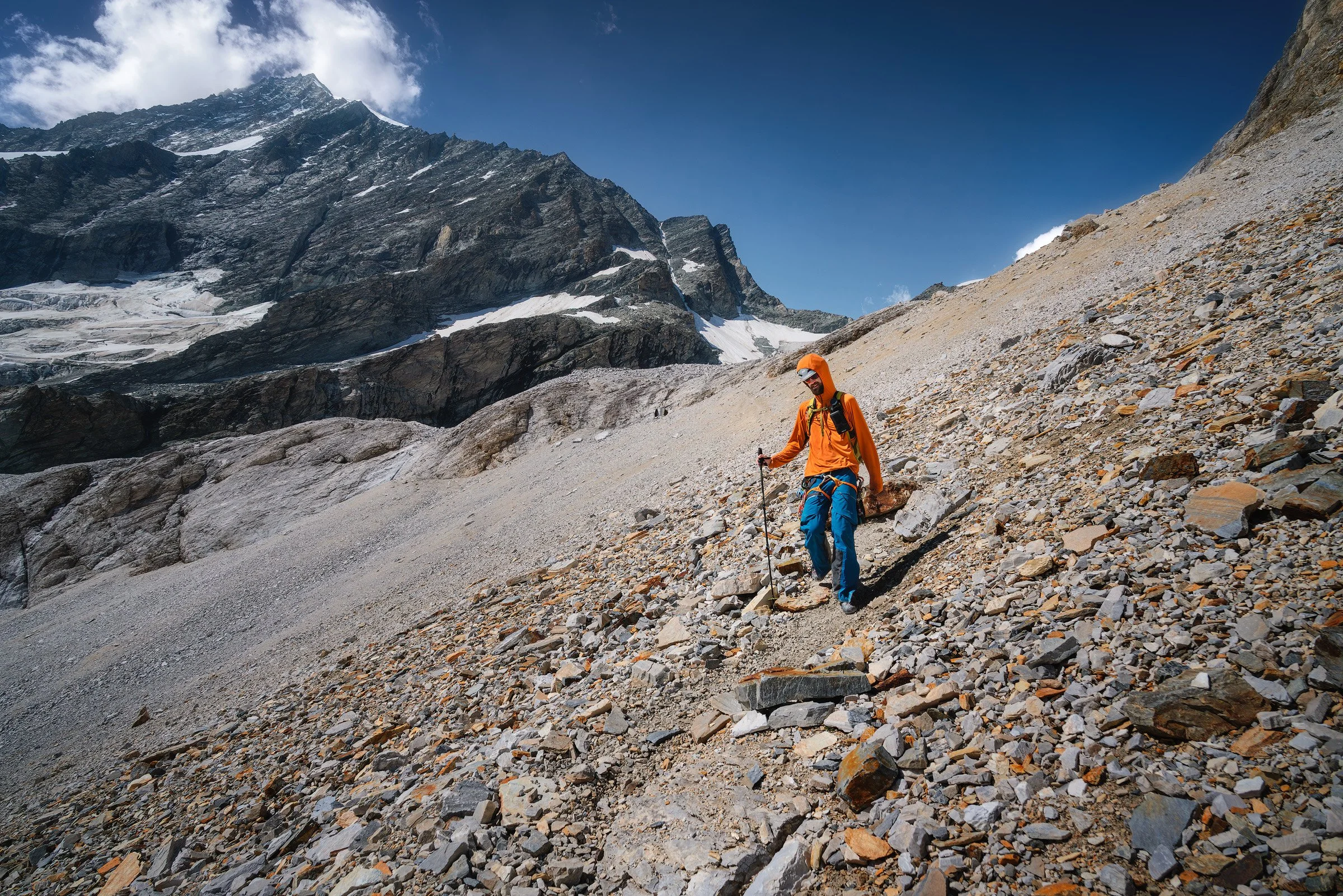
The Schalligletscher was a sorry sight to behold as we traversed its dry… well, corpse seemed the only adequate way to describe its state. Huge boulders were strewn amid its black ice, and the whole thing had the impression of scorched earth on a battlefield. But it was only a short way to reach its eastern perimeter, and then we were at last out of the technical difficulties for good. We had a few uphill metres across some gravel-covered, polished rock; it was unlike any other type of rock I had come across in the mountain and looked smooth like marble. We then reached the hiking path, which led us to the Weisshornhütte in a quick 20-minute stroll. All the while, looking back, we saw the entire east ridge of the Weisshorn looming above us in the distance, and it seemed improbable that the summit was only a couple of hours away. It seemed even more unlikely that, on its opposite side, we had come all the way from the Bishorn just that morning. We arrived at the hut shortly after 4 p.m., thirteen and a half hours after setting off from the Cabane de Tracuit. We enjoyed some drinks at the cute little hut and lounged in the grass for a while. Only another 1500 metres of descent remained to reach Randa. Fortunately, the trail was easy and steep, so we could lose the elevation quickly. My legs somehow didn’t feel too bad, and the half-hour rest seemed to have done them good. Although that feeling waned with every metre downhill, giving way to the numb pain of enduring muscular demand, I was happy to say that while certainly tired, I didn’t feel at my limit, still having some vigour left, and after only two hours, we walked into the train station at 7 p.m.
A friend picked Maurice up to spend the rest of the week rock climbing around Switzerland, while I hopped on the train back to Zurich, savouring the feeling of returning to civilisation after a long, successful tour in the mountains. While editing my Strava post, one curious little detail caught my attention: Maurice’s and my last adventure – the traverse of the three peaks of Grand Combine – wasn’t only more or less a year ago. It was exactly one year ago, August 10th 2024. It seemed our yearly tours together had turned into some sort of tradition.