Aguglia di Goloritzè
Approaching the Aguglia di Goloritzè in the morning light
Saturday – 8:26 a.m.
The air was calm, and it was warm. Very warm. It was Saturday morning. Our route was still in the shade, but higher up on the steep limestone tower we were climbing, the sun was starting to peek around the corner. I sincerely hoped we would be fast enough to escape it. I was about to start the first pitch of Easy Gymnopedie, the easiest route to the top of the Aguglia di Goloritzè, a 150-metre-tall tower made of grey limestone perched right next to some of the prettiest coastline Sardinia has to offer. In our bid for a quick approach that morning, we had missed the critical turn towards the Aguglia and continued along the path to the beach. We would have been the first to arrive that day. A series of steep stairs, guarded by polished wooden handrails, led down the final metres, where a lone guy waited, ready to collect our ticket (the beach was apparently so popular that a ticket system had been put in place to control its access). We realised our mistake and retraced our steps, passing some hikers on our way back who could now enjoy having the beach all to themselves, at least for a couple of minutes. Soon we discovered where we had missed the narrow path leading us towards the base of the Aguglia, where a name tag on the rock quickly marked the start of our route. I had already read that the start of our route was notoriously polished, and looking at the steep wall that guarded the first metres, I could see why. A big V-shaped fissure looked like it offered a positive handhold and a way to avoid having to put too much trust in my feet. But to reach it, I had to stand on a small pebble on the ground, utilising all the reach I had. As I grabbed the incut edge, I was surprised by how bad this positive hold felt. To reach higher, I now had to place my foot on a large flat foothold, but as soon as the rubber of my climbing shoe touched it, I felt it sliding. It was like glass. But I saw no other option and committed to standing up. I had not yet clipped the first bolt when my foot popped. Thankfully, I had only been a metre above the ground. Now I was back where I had started, standing right next to Charly, who appeared not exactly thrilled after seeing how my first attempt had gone. “There goes my onsight,” I joked, already preparing myself for another attempt. I was determined not to let this experience get into my head, and on the next attempt I placed my foot very carefully on the glassy foothold once more. This time it stayed. I stood up, pulling on the big V-shaped hold from which I could finally clip the first bolt. The next couple of moves followed along a finger crack, which felt about as polished as everything else I had touched so far. For being only graded 6a, this first pitch certainly felt like a bit of a cold start. I used all the reach I had to grab some incut holds high up, and once I reached some big positive jugs, I basically did pull-ups and avoided standing on my feet like the plague. I felt like a boulder bro who had been dropped into the wilderness to climb his first multipitch, never having set a foot outside a climbing gym. Thankfully, the climbing got significantly easier (albeit quite runout) after that intro boulder, and I quickly reached the belay to bring Charly up. Unlike me, she couldn't reach past the most polished sections and struggled quite a bit on this pitch. I really hoped the friction of the rock would improve on the next pitch – the crux of the entire route. But I’m getting ahead of myself…
The orange granite of Capo Testa catching the first morning light
Monday – 5 days before
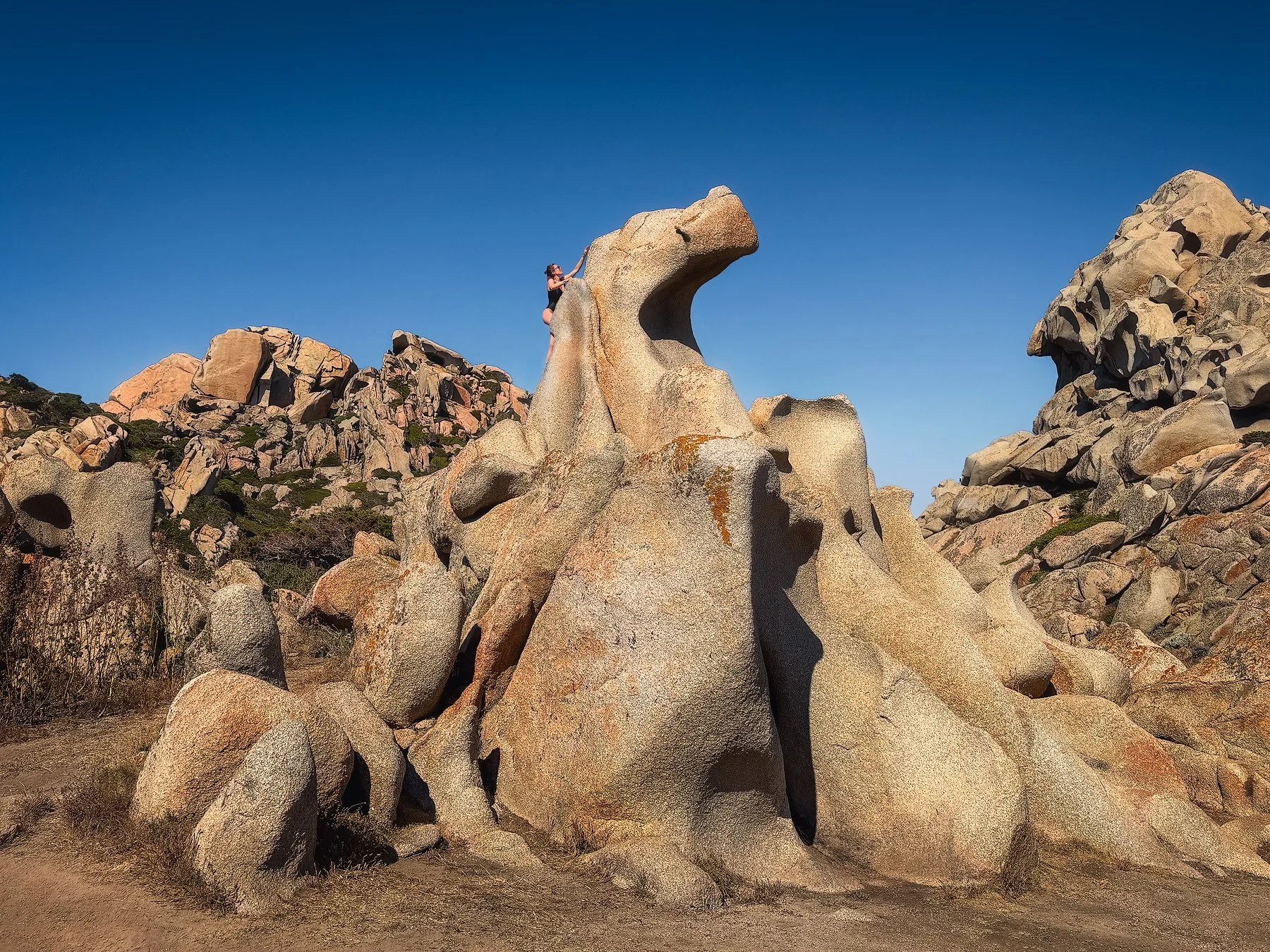
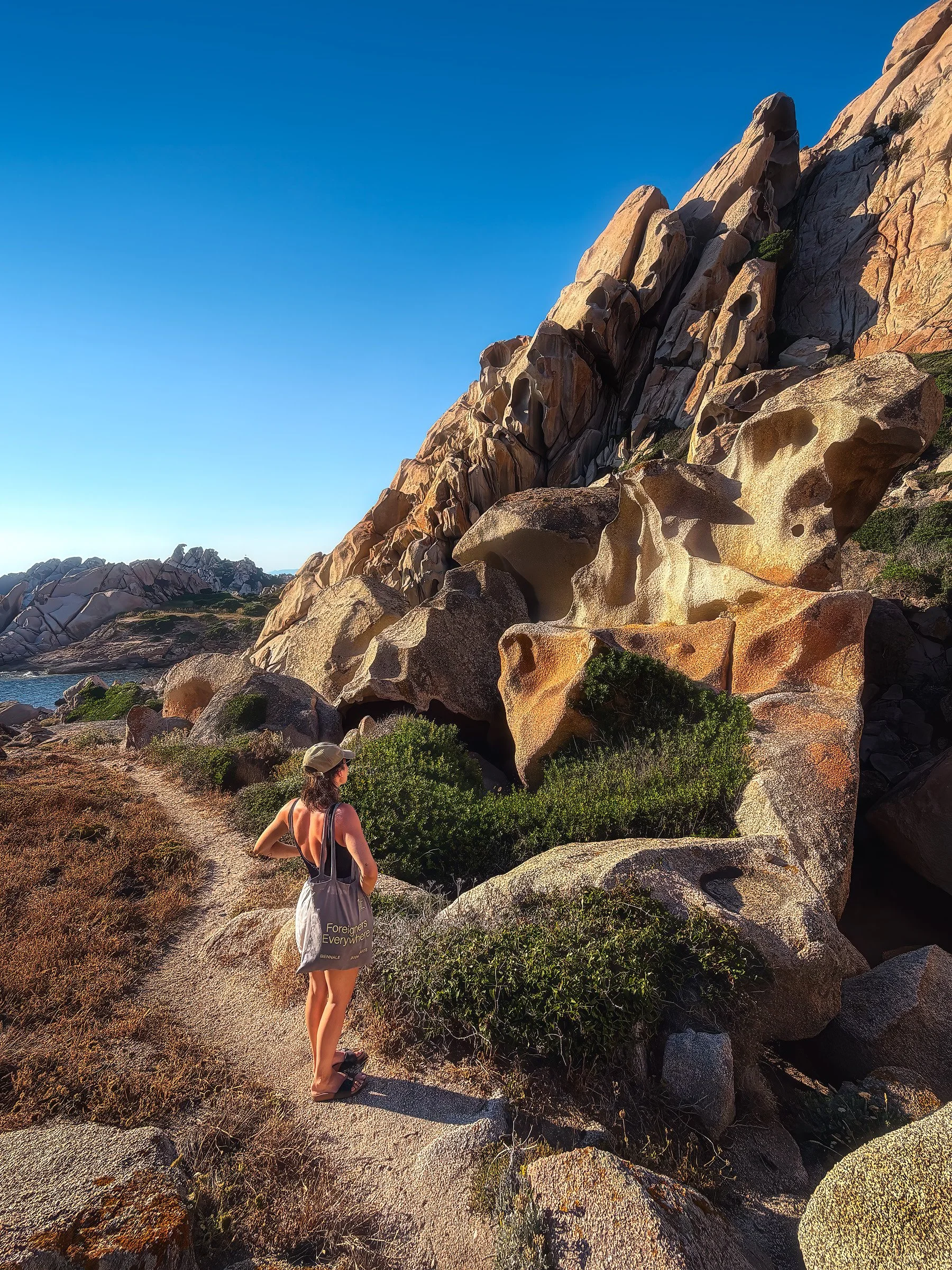
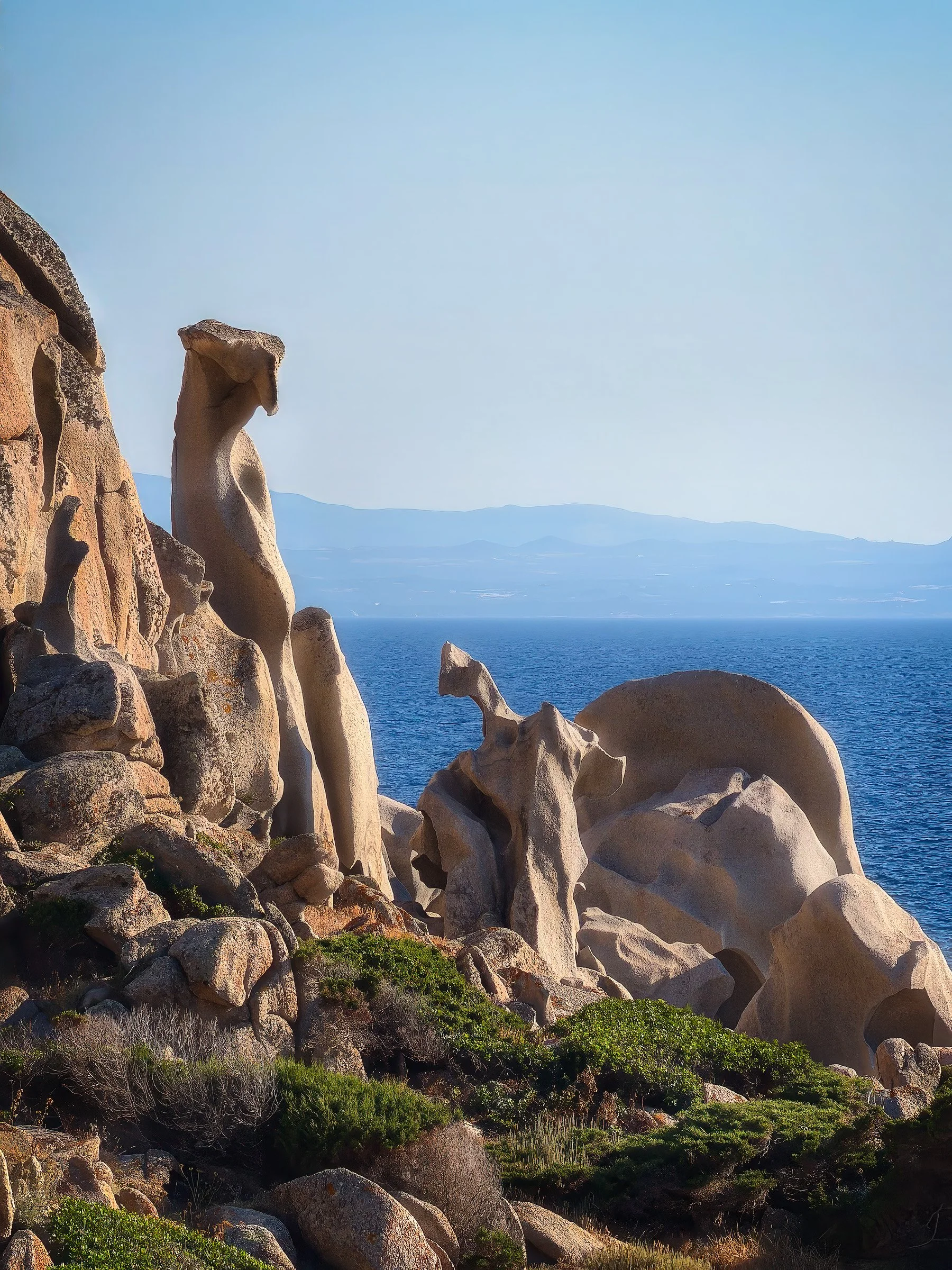
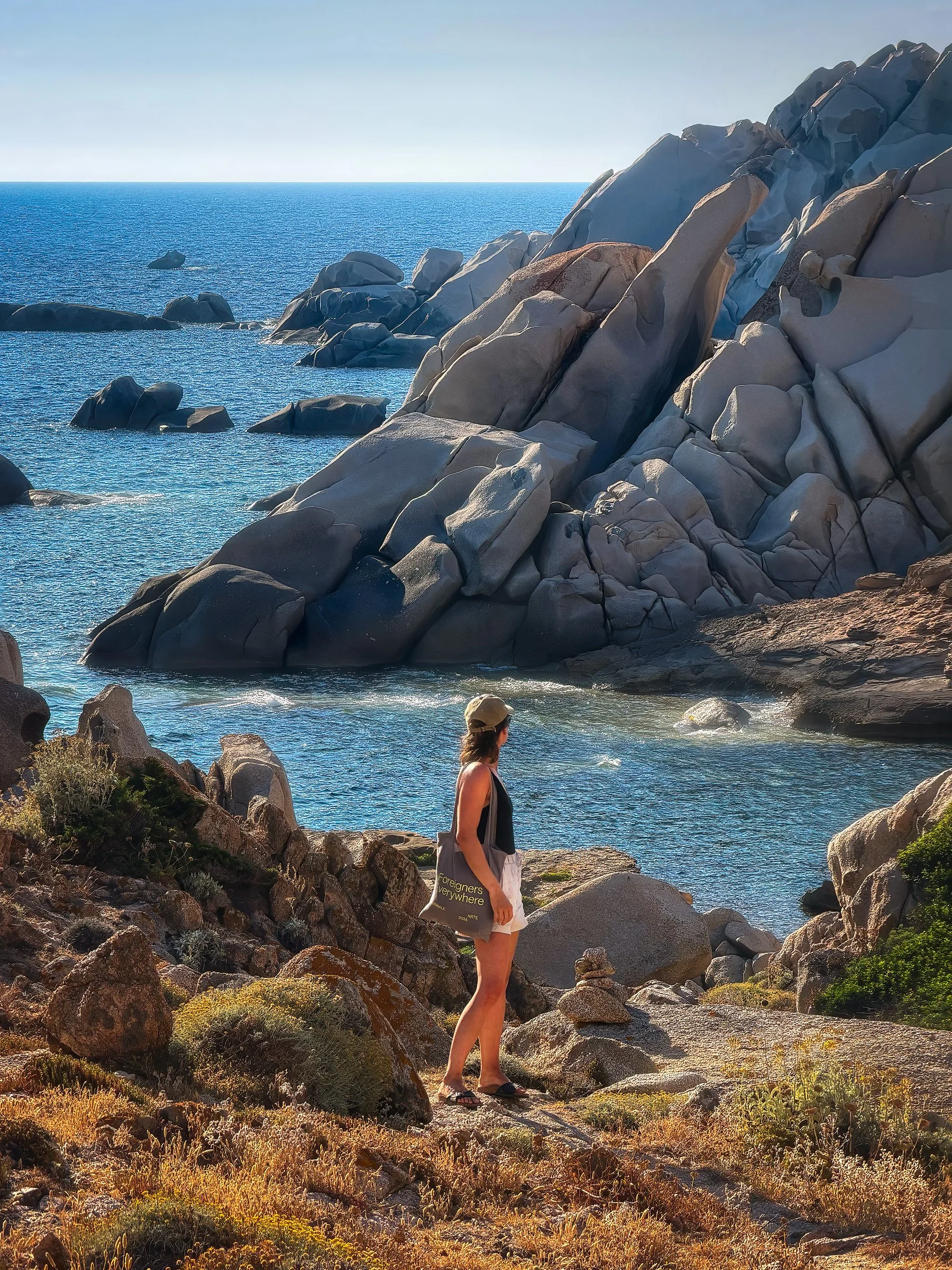
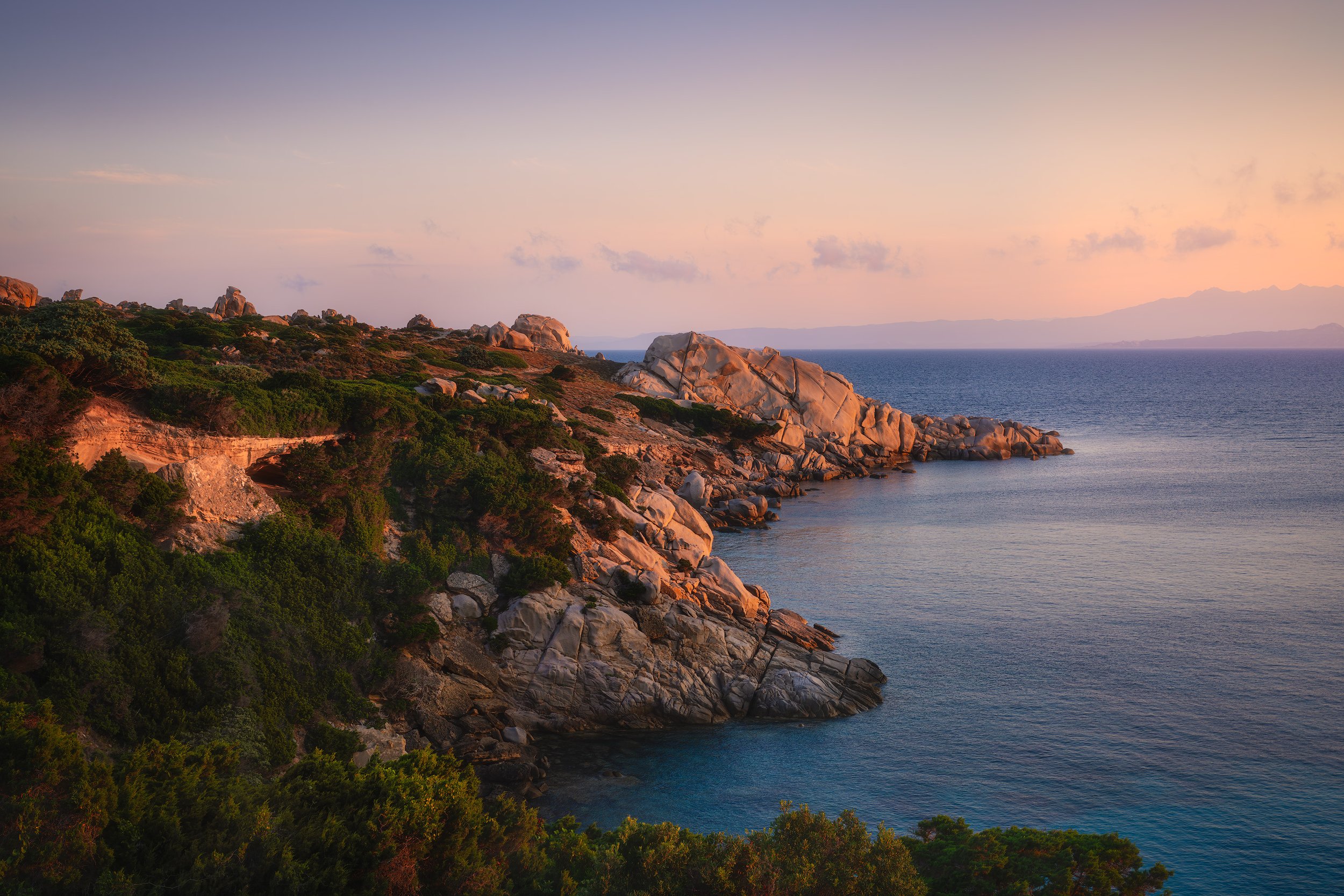
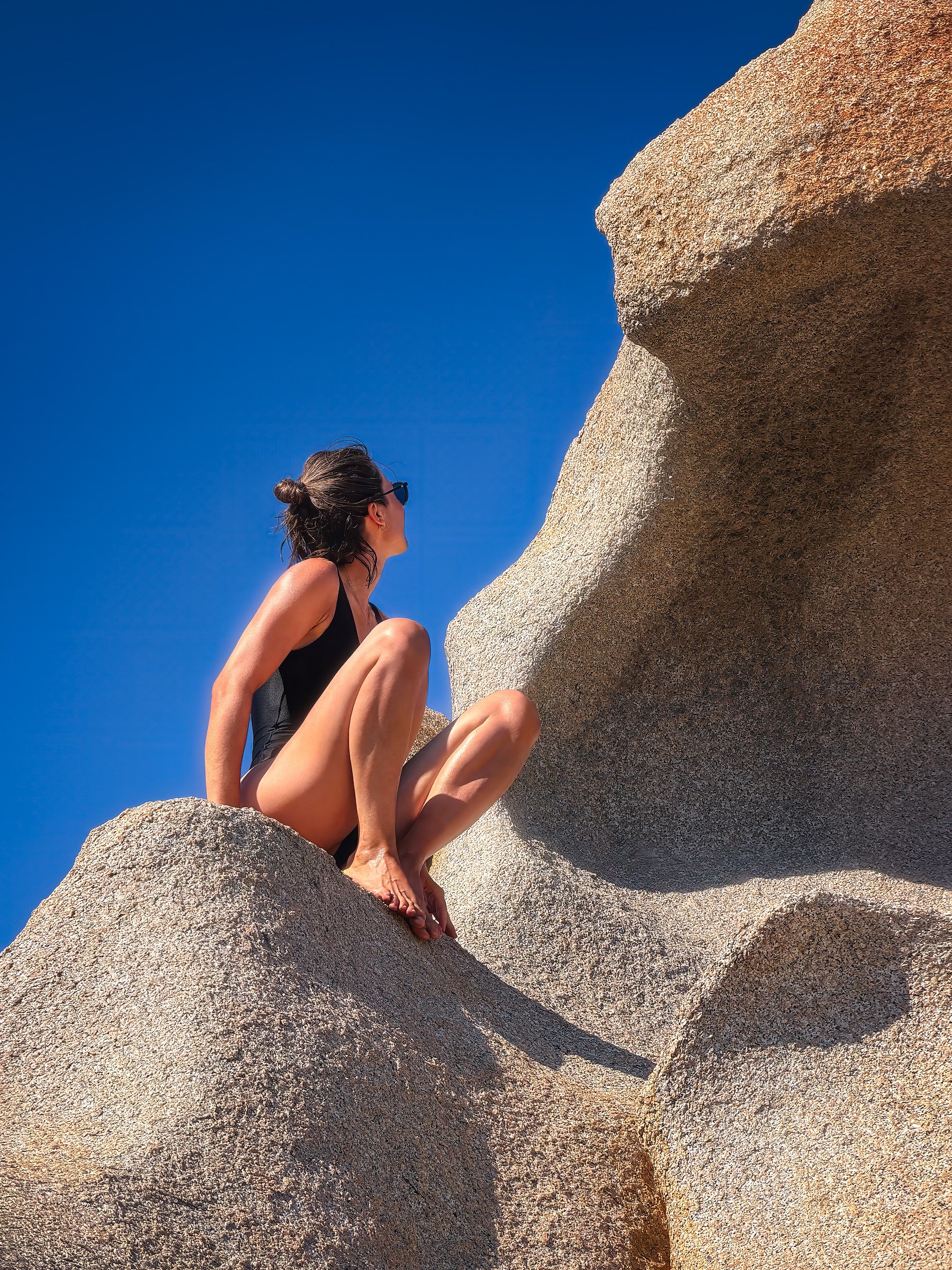
It was July, and Charly’s and my decision to come to Sardinia for a climbing holiday during the hottest time of the year was questionable at best. It was going to be my first climbing holiday outside Switzerland. So far, I had only made extended weekend trips to places within Switzerland or on the border with France and Germany. Now I was about to embark on a week-long trip to climb on the foreign rock of Sardinia. Unfortunately, on top of our trip’s debatable timing, we were somewhat unlucky as we arrived right at the peak of a heat wave that held the entire continent of Europe in its grip. Temperatures exceeding 40 degrees had been measured in Paris the week before, so, in a sense, it didn’t matter much where one chose to go climbing; everywhere conditions were equally poor. Charly had actually spent a week climbing in Corsica, where she could escape into the somewhat cooler mountains. But she had already told me tales about running out of water on multipitches and endless descents under the burning afternoon sun with mouths dry as sandpaper. Our original plan for Sardinia had involved lots of seaside multipitching. Wisely, we had already detached ourselves from all fixed plans and were ready for any not-so-slight adjustment to our itinerary. There was one place we couldn’t miss, however: Capo Testa. Pictures of the unique rock formations here were partly what had sparked our interest in Sardinia in the first place. And it was a convenient place to start our trip, as it was right next to the little coastal town Santa Teresa Gallura, where Charly picked me up with her van, Caravaggio, after taking the ferry from Corsica. So, on our first day, we explored some of the most striking coastal rock formations I have seen. They were truly otherworldly. Granite flowed in curves and shapes that seemed to stem from the mind of a biomorphic artist or to exist only on some alien planet. Obelisks that resembled petrified birds stood next to blobs of granite so smooth they seemed to have been carved by the hand of a leviathan. There were a couple of routes to climb here, but seaside corrosion has left the bolts badly deteriorated, so we decided not to risk our luck. Still, as climbers, our hearts skipped several beats as we hiked around the coastline to explore this seemingly endless paradise of some of the most beautiful rock I have ever seen. We ended up doing a little bit of barefoot bouldering, and I even made my (technically) first excursions into the discipline of deep water soloing as I clambered around on some of the seaside granite. But after a day under the relentless sun, we quickly decided we needed some way to escape the heat. Thankfully, a friend of Charly’s had recommended a sport climbing area that promised shady canyons and deep gorges where one could escape the scorching summer heat: Ulassei.
The slabby start of the second pitch of Easy Gymnopedie below the small roof that constitutes the crux (photo credit Charly)
Saturday – 9:28 a.m.
I could sense the sun making its way around, ready to eventually turn the higher pitches into a searing inferno. Right now, however, all I could afford to think about was the next couple of moves. I was below a small roof on the second pitch of Easy Gymnopedie, scanning an area of less than 10 square centimetres on these thousands of tons of rock, trying to decide where to place my foot. After my experience on the first pitch, I had a hard time trusting the friction of my climbing shoes on the polished rock. Some bits were so shiny I felt I could probably see my reflection in them if I got close enough. My hands held on to oddly shaped, unergonomic features carved by millennia of water droplets. They cut into my skin, but I didn’t mind the pain. At least these were sharp holds, giving me confidence to stay on the wall. Although in the back of my mind, I was worried about pulling too hard on these protruding flakes for fear of breaking them. But I couldn’t think about this now. I placed my foot and gently shifted my weight onto it. It held. I was slowly creeping closer towards the small overhang. A couple of metres below me, at the belay, Charly was shouting words of encouragement. I felt the support in the tone of her voice, but paid no attention to the exact words. There couldn’t be any distractions now, since I knew that once I reached the overhanging terrain, the lactic acid accumulating in my arms would have me quickly running out of time. I examined the next section of the wall, identified what I thought to be the best hold on that roof, and started climbing towards it. With every move, I gained more confidence in my feet, and I actually started to enjoy the climbing. Perhaps the roof wouldn’t even be as tricky as I thought. I reached up, and my left hand clenched around a good hold. I shuffled my feet around, tried to reach higher, but there was nothing. I came back down, awkwardly switched hands on the jug that was barely big enough for one hand, and searched to the left for anything that would let me climb higher. Still nothing. I could see the terrain getting easier, only a few metres higher. If only I could climb these next couple of moves, I would be able to recover my forearms, which were starting to burn. I became painfully aware that I was now living on borrowed time. I needed to find a solution, and do so quickly.
The Cave of Dreams in Ulassei
Tuesday & Wednesday
After arriving in Ulassei, Charly and I had originally planned only two nights, but we ended up staying for four. The cool air in the canyon was simply too good a respite; a little oasis in the summer heat. And even the campground here – a mere 10-minute walk from the crag – was situated at a respectable 400 metres above sea level, offering nights significantly cooler than the first we had spent near the ocean. It also helped that the climbing was very enjoyable. We spent almost all of our time climbing in the Cave of Dreams sector. With every metre we descended into its depths, the air grew colder, sinking to the bottom of this gorge and offering relief from the heavy, humid air hanging over the rest of the island. Here, we found endlessly featured rock with large tufas flowing from the bulging bellies of large, slightly overhanging walls made of yellow and pink limestone. This was very different from the kind of limestone I was used to in Switzerland. It certainly took some getting used to. In some places, large assortments of conglomerate were wedged between the limestone. Big chunks were stacked atop one another, like a house of cards that was just waiting to tumble should one remove as much as a pebble from its base. But climbing on it, this conglomerate felt surprisingly solid, even though neither Charly nor I could ever fully shake the feeling of being just on the verge of breaking a hold, making for a strange but exciting climbing experience. On the first evening, we had the entire crag to ourselves, but the next day we shared the canyon's cool air with a crowd of other climbers. The echoes of everyone's cheers reverberated off the limestone walls as we watched one climber send his 8a project, shortly before his friend joined him on the send train. We, of course, stuck to more achievable goals. I sent two 7a routes, but Charly, in particular, was pushing her limits, projecting a 6c+ that I felt was only marginally easier than the adjacent 7a. She was able to send the route in two parts on top rope in her first session. How quickly she made progress on this route was all the more impressive, considering she skipped an entire number grade; her hardest outdoor send to date was a 6b+. It was impressive, but not surprising. From climbing in the gym, I knew how strong Charly was, and seeing her start to transfer that strength to outdoor rock, I knew it was only a matter of time before she would push into higher grades.
Charly reaching the belay of the crux pitch
Saturday – 9:55 a.m.
“Fuck!” I was running out of time. Lactic acid was building up in my forearms as I switched my hands back and forth on the one good hold I could reach. Above it was just a blank slab of grey limestone. I shuffled my feet around, trying anything to gain a few more centimetres of reach, but the polished footholds below the small overhang were marginal at best, and I was still supporting a lot of my weight with my arms. “Come on,” I thought to myself, “you can figure this out!" Eventually, I had no choice but to commit to a series of awkward moves that took every bit of strength left in my arms. Far out left, some plants growing inside a diagonal crack promised a usable cavity in the rock. I switched my hands one last time, held onto the big jug with my right hand, locked my arm to my chest, and reached out, not knowing what I would find, but aware that there was no turning back. I simply didn’t have the energy to reverse my moves. With my arm almost fully extended, the fingers of my left hand clawed a dusty side pull behind the shrubs. I moved my feet higher, almost blind, as I could barely see around the roof I was climbing. I had no choice but to trust that the rubber of my climbing shoes would stick to the rock as I slowly let go of the safety of the big jug in my right hand. There was no way I would be able to stay on the wall now if my feet slipped. Locking off with my left arm, I slowly crept upward, where I could see a big flake promising to be the victory jug that would mark the end of this boulder problem. I felt a huge sense of relief wash over me as I finally grabbed it. This was it; I had climbed the crux of our route, albeit in a manner that was as powerful as it was inelegant and not at all replicable for someone shorter than I. The rest of the pitch was straightforward, and a final small roof climbed significantly more easily than it had looked from below once I discovered the big juggy holds on an arête to the left. Charly, as I had feared, struggled quite a bit on the roof boulder, and any of my tall-person-beta that I tried to shout down was obviously quite meaningless to her. Once she joined me at the belay, she was visibly frustrated, and I hoped the climbing would now finally become less polished and more enjoyable.
The Guglie di Niala in the morning light
Thursday
Charly and I had enjoyed the shaded sport climbing deep in the canyons of Ulassei, but now we decided to try multipitch climbing after all. The Guglie di Niala was only a 30-minute drive away and promised shaded north-west-facing climbing, which made us hopeful we would find pleasant conditions there in the morning. So we got up to an early start and made the drive at sunrise. A gravel road brought us almost to the base of the climb. A short 15-minute hike along a path that was not always well defined (some bushwhacking was involved) led through the forest to the base of two spires. There were supposed to be two routes here: the one we planned to climb, and the other, which started with a short 4c pitch. So when I spotted a line of closely spaced bolts up a steep vertical wall, I immediately assumed this was our route I Tacchi a Spillo. This turned out to be an erroneous conclusion, but it would still be a while before we discovered our mistake. This first pitch was actually quite nice, apart from the odd loose hold – just before the anchor, I broke off a flake while pulling on some underclings. Fortunately, the pitch was slightly traversing, and the fist-sized piece of rock flew well to the side of where Charly was belaying me. The difficulties seemed consistent with the expected grade of 6b for the first pitch, and it was very well bolted, so I still assumed we were climbing I Tacchi a Spillo as I belayed Charly up.
The next pitch followed a short dihedral that looked imposing from below but climbed much easier. Just as I stepped off the belay, however, before I had even clipped the first bolt, I broke a small foothold. Luckily, the rock quality improved slightly as I climbed higher. But I couldn’t completely shake the fear that another hold would break, which was amplified by the fact that this time the belay was right below the pitch. I was seriously concerned and put all my focus on not sending any more rocks down to Charly. A shame, since the pitch actually offered fantastic 3D climbing and overcoming the dihedral required every technique in the book, from stemming to laybacking and even some face climbing. At the top of the pitch, I climbed onto a small ledge where I tested every hold multiple times and eventually committed to pulling on the dry branches of some bushes, which seemed the most solid structures to me. The second pitch of I Tacchi a Spillo was also supposed to be a 6b, but this last pitch had felt significantly easier. The next pitch was supposed to be a 6a+, and Charly decided she wanted to give it a go on lead. But almost immediately after starting to climb, the moves got much trickier than they had looked from below. After Charly had to abandon her lead attempt and I started climbing myself, I quickly realised this pitch was in fact much harder than we had assumed. This was certainly not 6a+. I hung the rope at one point and managed to fight my way through climbing that suddenly felt far more exposed and adventurous than any of the previous pitches. The bolts were few and far between; the rock was often covered in a layer of clay that crumbled beneath my grip. It felt like no one had been climbing here for a long time. Once I reached the belay, I saw there was another pitch waiting for us – as if I needed more evidence we were on the wrong route.
This final pitch was much less steep, and even though I didn’t know what I would come up against, I decided to venture further into the unknown to at least bring us to the summit of whatever pillar we were climbing. Fortunately, it was quite easy, but this last pitch went through some of the loosest rock I have climbed, and I was constantly worried about causing serious rockfall. “Be careful, there is a lot of loose stuff,” I shouted to Charly. She tucked even closer to the small roof beneath which she was belaying me. I was happy to at least find a solid anchor at the top. The summit was just small enough for us to sit and enjoy the views, which were spectacular, and I was glad I had climbed this atrocious last pitch. Even though we were now in the sun, it was windy enough that we actually had to put on some additional layers. After rappelling back to the base, we quickly found the start of the other two routes, and after consulting any topo we could find, we realised what we just climbed had to be an unknown route simply marked as “project”. Well, that figures…
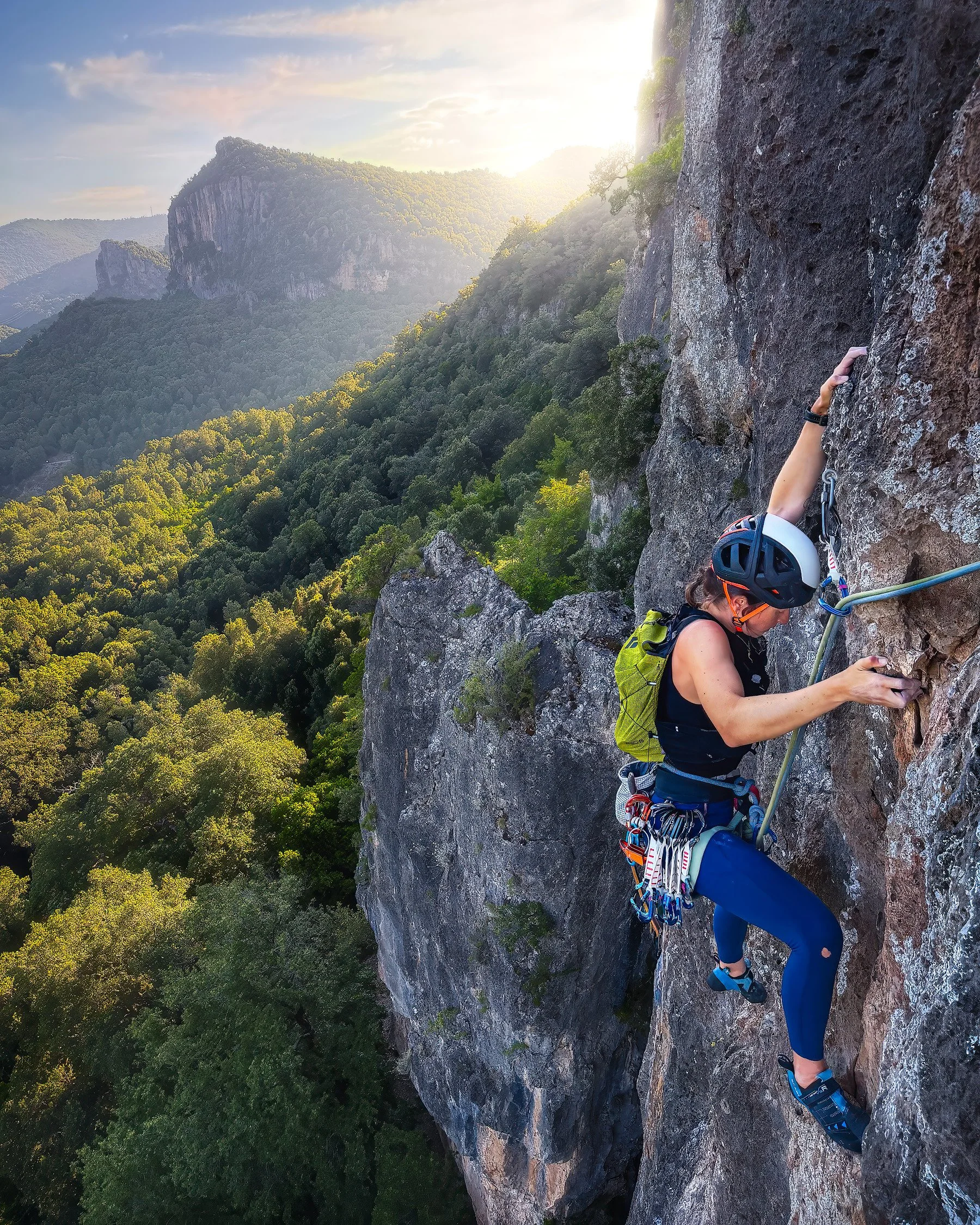
Charly following the first pitch of what turned out to be an unkown route, marked simply as “project” in the single topo we could find
Charly in the final pitch of our unkown route
Enjoying the views on the small summit
Charly following the second to last pitch of Easy Gymnopedie – an airy 6a
Saturday – 10:31 a.m.
I had just climbed the crux pitch of Easy Gymnopedie; now I was up against a 6b, the second-hardest pitch. It started on a slightly less-than-vertical wall, offering nice crimpy face climbing. The distance between the first and second bolts was quite large, but an old peg eased the leader's mind along the way. Still, if that piton should rip, a fall would surely send me back down to Charly, who would be powerless to prevent me from hitting the ledge she was belaying me from. The climbing followed a thin finger crack, where I backed up the piton with a small #0.2 cam, the only piece of trad equipment we had brought. A few moves higher, I could finally clip the second bolt. The climbing was technical and a lot less physically demanding than the previous pitch. Importantly, it was also a lot less polished, and the rock offered plenty of friction for the rubber on my shoes. After 12 metres, the wall’s angle eased off, and I scrambled along easier ground towards a big ledge, where a final boulder guarded the way towards the next belay. Climbing it felt awkward, and I had to put myself in a really small box, frogging on a good ledge halfway up the boulder. Thankfully, some nice jugs waited for me, and I pulled myself over the ledge onto easier ground. As Charly followed, she had trouble removing the cam I had wedged just a little too deep into the thin seam in the rock. I felt bad as she had to sit in the rope to remove it, thwarting her efforts to climb the pitch clean, which was a shame since the climbing style finally suited her. But Charly redeemed herself by making short work of the roof boulder that had given me some trouble.
The next pitch began with a couple of easy ledges before reaching a steep wall. This was probably the most exposed bit of climbing so far. I felt the air drop away beneath me as I looked down towards the beach, two hundred metres below. It wasn’t very difficult, around 6a, and the holds were obvious and mostly good, but moving between them still required deliberation and some finger strength. It was just the right level to be engaging while offering me the chance to stop at any moment, take in the exposure, and revel in climbing in such a unique and scenic environment. As I reached the next anchor, I saw that the final pitch was still in the shade; we had made quick progress, and I was hopeful we would top out before the sun turned the rock here into a burning furnace. Charly also appeared to be enjoying the climbing up here a lot more. She even felt confident enough that she wanted to lead the final 5c pitch and take us to the summit.
Exploring the S’Ogliu Ermanu creek
Thursday Afternoon
After our, let’s say, interesting multipitch adventure on the Guglie di Niala, we treated ourselves to lunch at a small, family-run restaurant a little way up the road from where we had turned off. It was still a very windy day, and we spent the rest of the afternoon exploring the aquamarine waters of the S’Ogliu Ermanu creek. It offered a welcome respite from the bathtub-like temperatures characterising the Mediterranean Sea at this time of year. Swimming in the cold creek, I was actually a bit disappointed by the unusually cool afternoon and overcast skies, which eventually made this little oasis in the forest feel a bit chilly (Charly didn’t even end up taking the cold plunge, satisfied with just dipping her legs in the nippy water).
When it came to discussing our plans for the next day, part of me was keen to go back to the Guglie di Niala and try one of the routes we had wanted to climb that morning. Charly, however, still seemed put off by the loose rock and sceptical that the rock quality would be significantly better on a different route. Eventually I came to understand she was actually very interested in returning to the canyons of Ulassei and giving the 6c+ she had tried before another proper attempt. Once I realised how much she was motivated by the drive to push her sport climbing limits and glimpse the potential that was waiting to be unlocked, I was more than happy to scrap any ideas of further rogue multipitching adventures and accommodate Charly’s wish for more sport climbing. And after all, I had a score to settle with the 6c+ myself. Back at the campsite, the evening even brought a bit of rain, and it cooled down further, which neither Charly nor I minded in the slightest (Charly had already brought out her warm duvet on the first night we had moved to the higher elevations of Ulassei). I looked forward to a cool night’s sleep and was very excited for more of Sardinia’s spectacular limestone sport climbing the following day.
An airy view of Easy Gymnopedie’s final pitch (photo credit Charly)
Saturday – 11:49 a.m.
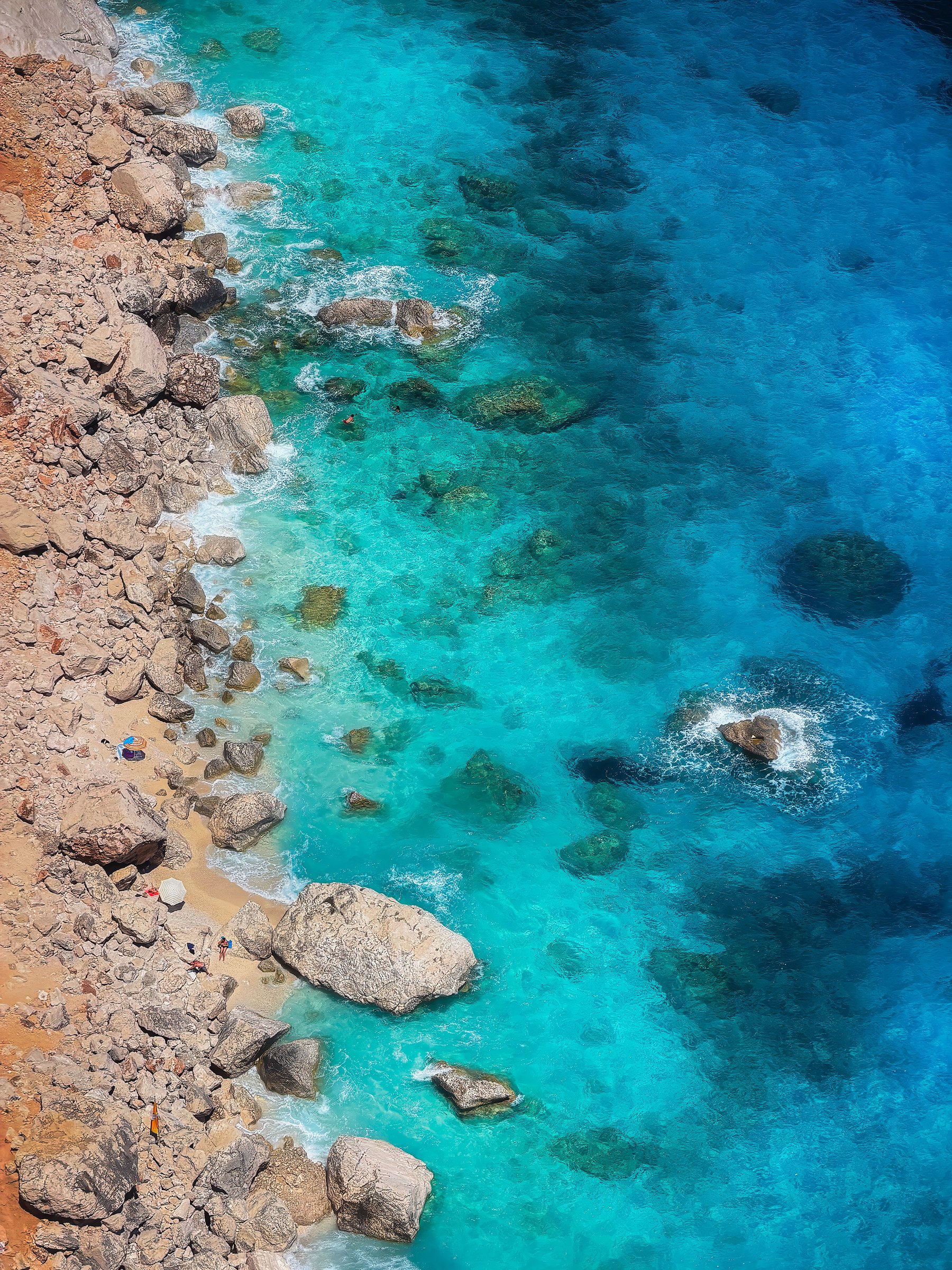
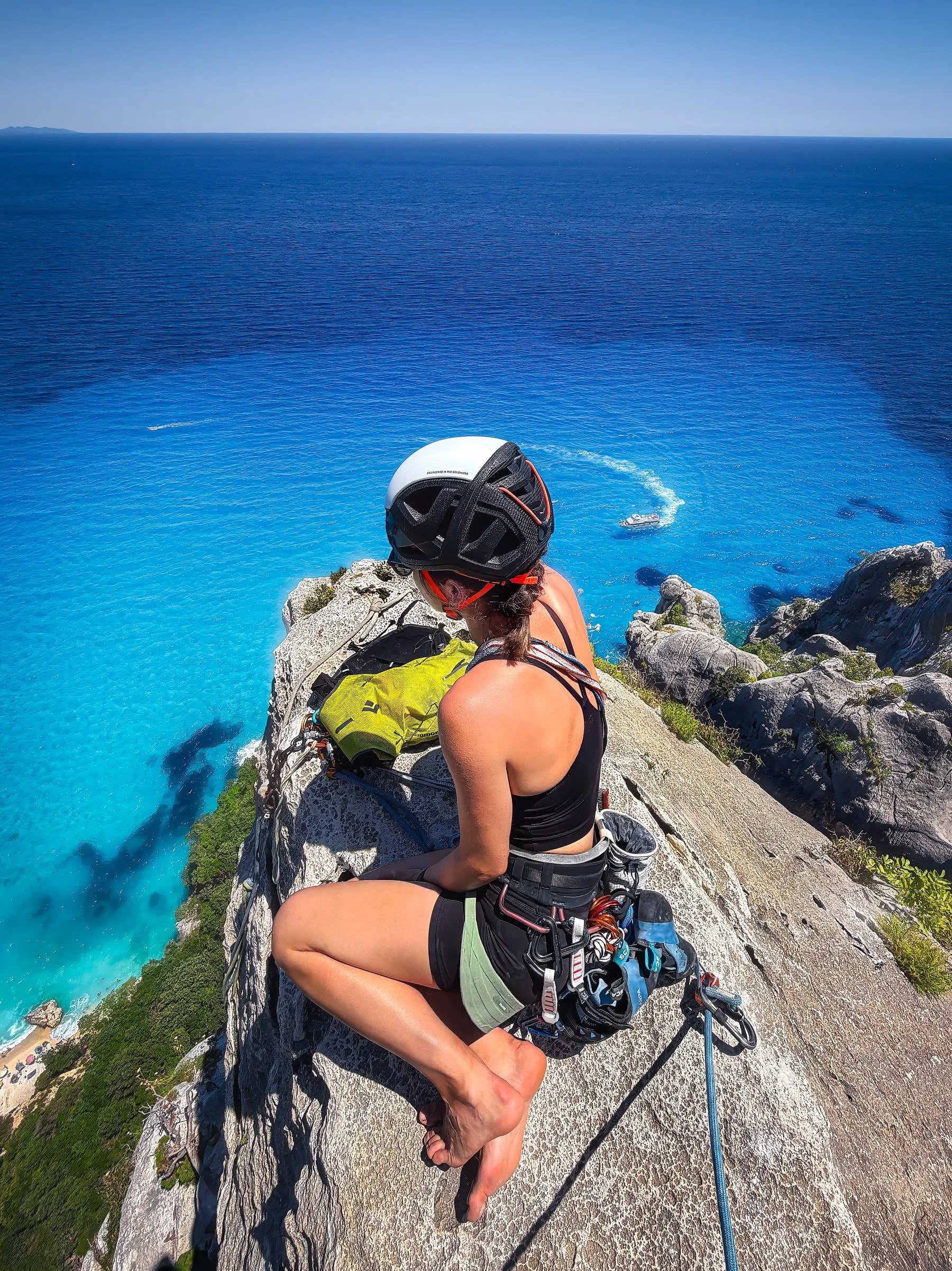
Charly and I inspected the next pitch very closely. A line of closely spaced bolts led left across a blank but gentle slab. It was impossible to tell how hard this section was from afar. It might be 5c; it might be 6c or even harder. In the topo, this final pitch looked like it went fairly straight up, not at all the line these bolts followed; we were confused. “I can see a belay down there,” Charly said. She had started climbing a little to inspect the situation further. “Then this is probably a different route,” I replied. “I guess yours are the bolts straight up.” She looked at the line I indicated with some scepticism. The bolts were definitely farther apart than Charly would’ve liked, but she didn’t let herself be deterred and slowly ventured upwards. This final pitch turned out to be the slabbiest of the entire route, as the wall’s angle eased towards the top. On those grounds, it certainly wouldn’t be Charly’s first choice as a pitch to lead – she harbours a distinct distaste for slab climbing – but the friction on the rock up here was good, and little by little she overcame her apprehension and carefully climbed towards the halo of the sun behind the pointed summit of the Aguglia in the distance. When I joined Charly at the belay, she was not yet at the summit but was standing beneath a short 3-metre wall guarding the highest point of the Aguglia di Goloritzé. We left most of the rope coiled and ready for abseiling at the anchor and climbed the last metres onto the summit. It was a truly spectacular place which we had entirely to ourselves – it would have been, in fact, impossible to share the summit with anyone else, as it was just large enough to accommodate Charly and myself. Up here, we were now fully in the sun, but a nice breeze kept us cool as we took in our surroundings. Down below, we could make out the famous beach Cala Goloritzé, which by now had become littered with dozens of tiny colourful umbrellas. In the crystal-clear ocean, we could make out the tiny specks that were people snorkelling or enjoying swimming in the surf. And in the distance, plenty of small boats carved white strips into the blue water. The ocean's colour created a gradient that flowed from radiant turquoise near the shore to vibrant azure, and even deep, saturated navy where the coral reefs absorbed the sunlight. And to the south of our pointed summit, more sea cliffs were catching the midday sun, creating a striking display of light and shade on the sinuous, grey limestone – all set against the luminescent cerulean waters in the background. I could have spent an eternity taking in these views.
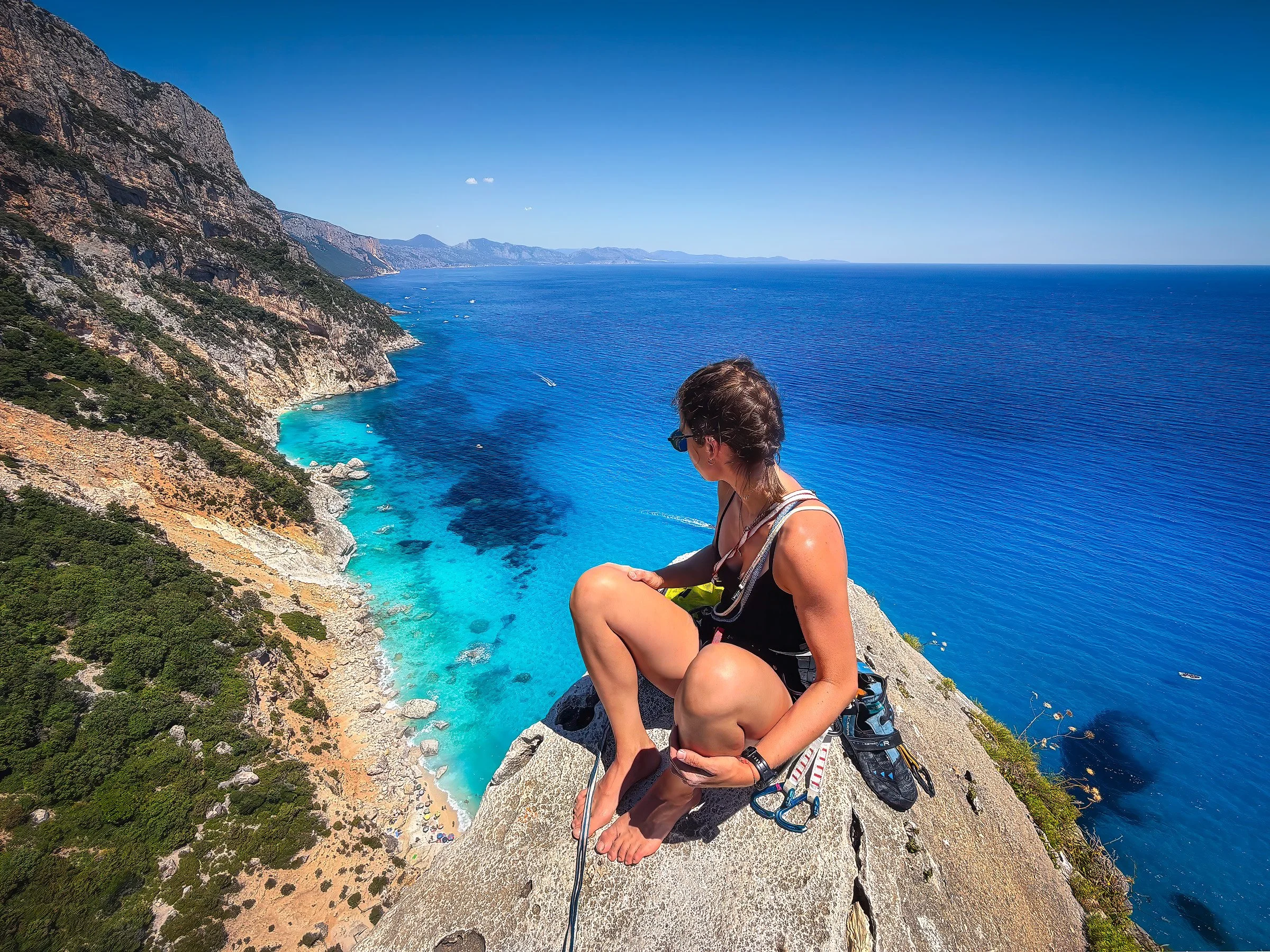
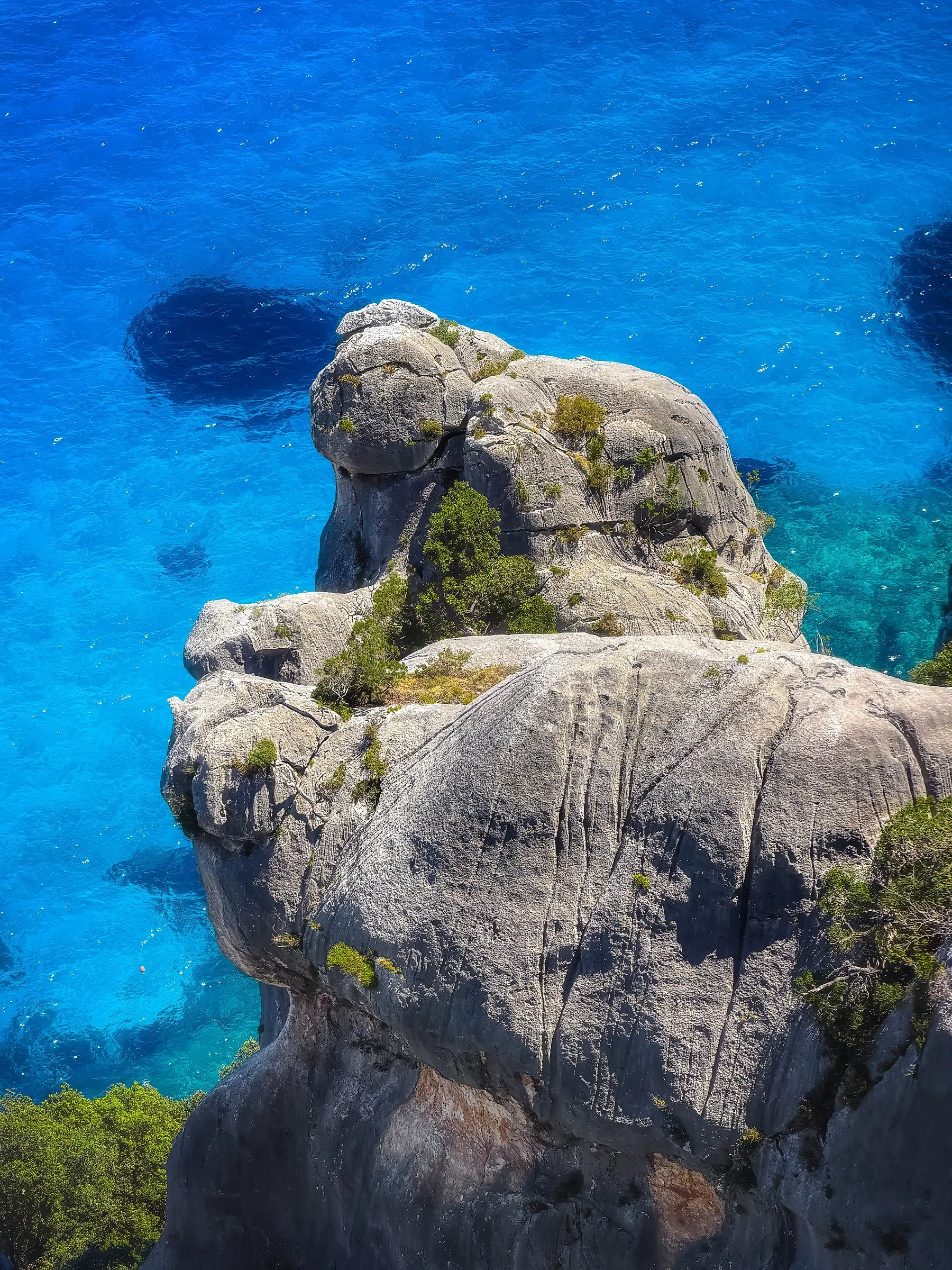
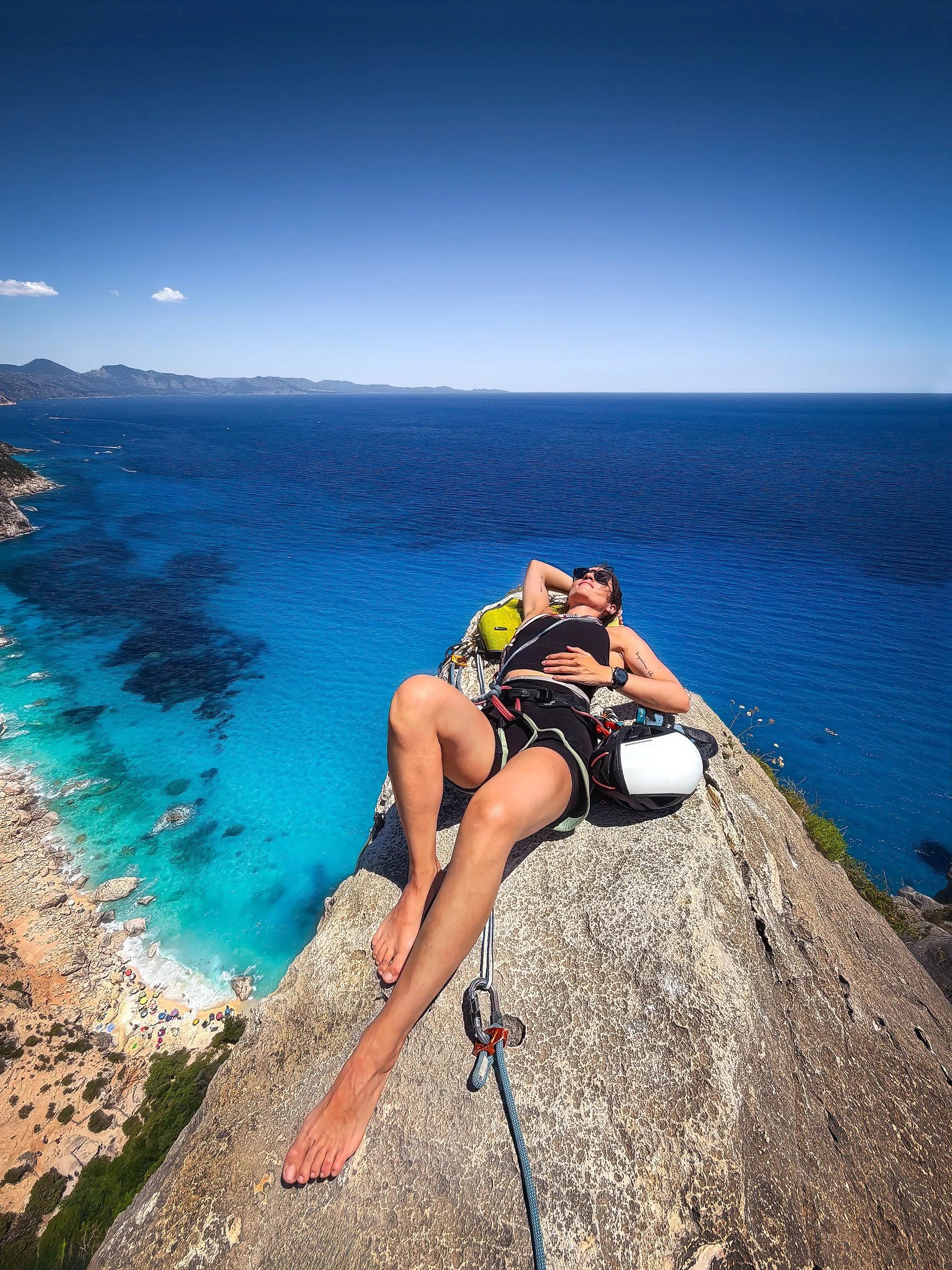
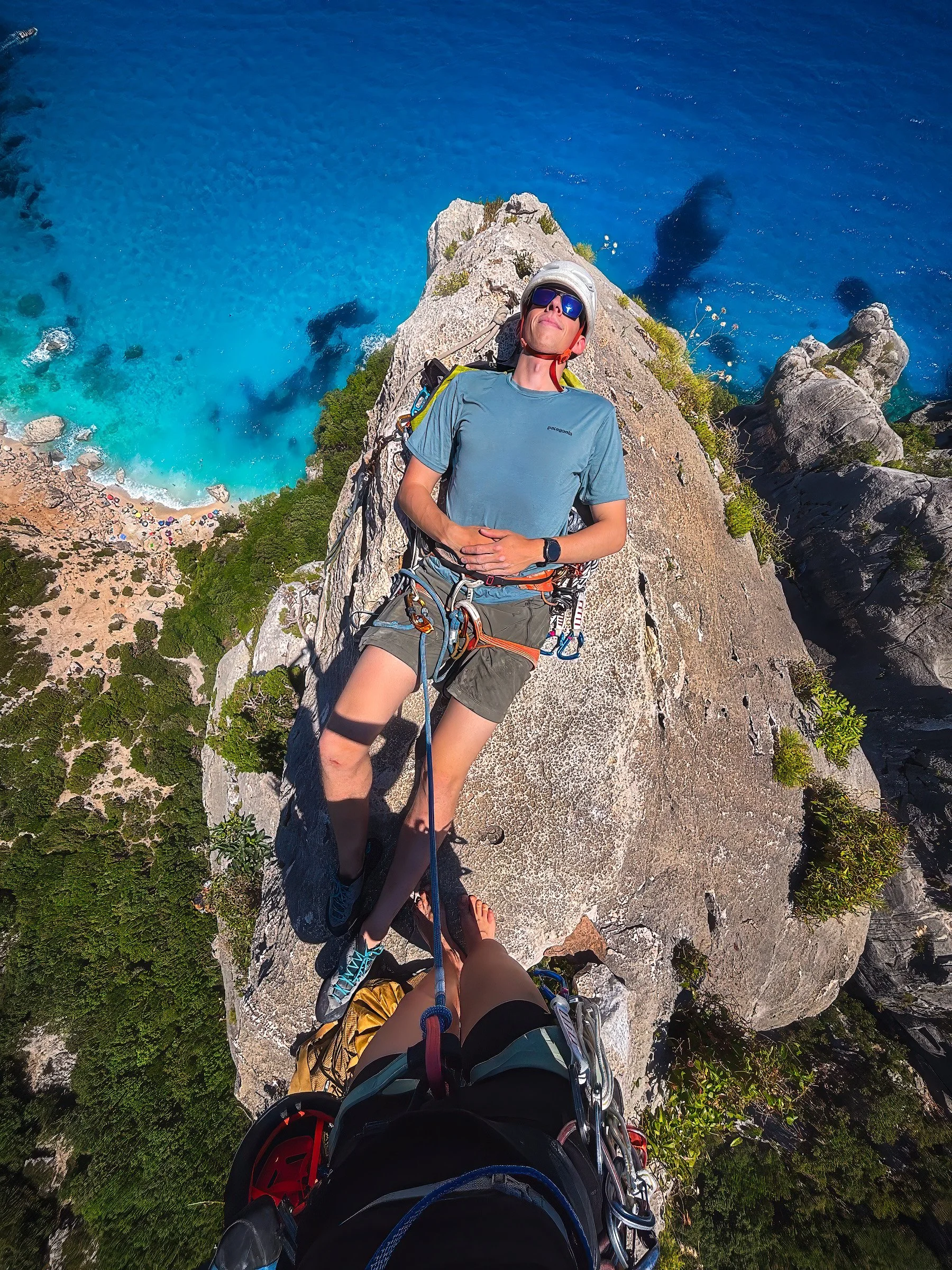
A cool and foggy morning at the camping in Ulassei
Friday
“I am feeling cold.” I hadn’t expected these words to cross my mind during my holiday in Sardinia in July. But on the morning after our multipitch (miss)adventure on the Guglie di Niala, a thick fog lay over the campground in Ulassei, and during breakfast I wore my puffy jacket, which had so far lived unused in my luggage. It was so chilly, in fact, that Charly and I were worried it might be too cold to climb in the canyon. Thankfully, our worries were unfounded: the fog lifted once the sun rose behind the mountains, and when we entered the shaded walls of the Cave of Dreams, we found the temperatures to be similar to the previous days. After a warm-up climb, I started putting the draws in the 6c+ and afterwards sent it on my first proper go of the day, though I had to put up a bit of a fight and almost slid off the flat crimps after sticking the crux. While coming down, I extended some of the quickdraws, trying to anticipate where Charly might want to clip, while also brushing the holds and adding some hopefully useful tick marks. I tried to optimise everything as best I could to give her the best shot at a proper lead go. Charly climbed smoothly through the already tricky and bouldery intro section of the route, after which she utilised the following rest for a long time before continuing to climb. She approached the crux and was still looking fresh, but the draw I had extended for her was still too high to clip comfortably before entering the hardest moves of the route. She took several attempts, downclimbing after each to try and get some rest, and after she finally clipped the draw, it was clear she didn’t have the energy anymore to climb through the crux. However, she did manage to climb the route after resting in the rope for a bit, and it was clear to me that this route was well within reach for Charly if she had time for another session or two working the route. Unfortunately, we had to abandon our camp in Ulassei that afternoon, and so Charly had to leave her project unfinished. But just the fact that she had made progress so quickly on a route that was more difficult than anything else she had tried outdoors was a success in and of itself. Despite being disappointed not to send, Charly seemed rightfully pleased with herself for getting out of her comfort zone.
One of the overly curious donkey at the Su Porteddu campsite being told off by Charly (the kitchen knife did not have to be used)
Under the scorching midday sun, we then made the drive to Su Porteddu, a small campsite at the start of the trailhead for the Aguglia di Goloritzè. After Capo Testa, this was the other major spot on my itinerary I didn’t want to miss. This pointed limestone spire, perched beside the translucent waters of the Sardinian coastline, simply looked too good to be true. It is a magnificent rock formation that has already drawn climbers like Alexander Huber, who made a free solo ascent of the route Easy Gymnopedie in October 2023. This is the easiest route to the tiny summit of the Aguglia and would be our objective as well. Easiest doesn’t mean easy, though. Some even suggest 6c for the crux pitch. Still, as the most accessible option to stand atop this acicular limestone formation, it attracts most of the climbing traffic; hence the rock is notoriously polished, as I would soon discover. Thankfully, the route scales the Aguglia’s west face, meaning it stays in the shade for much of the morning. This would hopefully allow us to climb a route right by the sea despite the hot temperatures.
Once we left the main highway, the road to the campsite wound up sharp switchbacks, climbing the rolling hills along Sardinia's eastern coastline. We drove through an arid landscape featuring parched trees and acanthus bushes as far as the eye could see. At the campsite (really more of a big parking area with some toilets and a shower to be able to call itself a campsite), we set up for the night and prepared for an early start the next morning. Our dinner preparations were briefly interrupted by curious donkeys, who needed to be told off firmly by Charly before they left us alone. We enjoyed some of the delicious tinned artichoke and tuna we had bought in one of the many well-stocked Italian supermarkets before heading to bed for an early night, our alarms set to be at the trailhead once it opens at 7:30 a.m. sharp.
Rapelling from the Aguglia di Goloritzè (photo credit Charly)
Saturday – 12:42 a.m.
We probably spent close to half an hour on the summit before deciding it was time to start our descent. We had enjoyed the views all to ourselves, except for a brief interruption when a helicopter passed by, with tourists inside waving cheerfully at us. It must have looked unlikely, with two humans perched on this tiny summit, where the walls fell so steeply to either side that it must have seemed impossible from afar that anyone could reach it. We were clearly a major attraction and felt a bit like animals in a zoo, but we waved back nonetheless. The chopper left as quickly as it had appeared, leaving us once more with the distant crashing waves as the only sound. Just as we abandoned the summit and climbed back down to where our ropes were piled, another party caught up to us. We had seen them starting to climb as we had just finished the first pitch, and they had always remained at least a full pitch below us. It appeared they had even slowed towards the top, which was understandable as they had to climb the final pitch in the sun, making me all the more glad for our early start.
For rappelling, the topo recommended an adjacent route, but since the entire tower was equipped with dozens of routes and we had 60-metre half-ropes, I didn’t worry much about which side I went down. I tossed the ropes and rappelled into the slightly overhanging face, where I could marvel at some of the harder routes that went up the steepest parts of the Aguglia. I came across an old anchor equipped with two bolts, connected by a weathered piece of webbing. I watched the ends of my ropes, still dangling another 20 or so metres below. As I traced the multiple lines of bolts running down this face, I couldn't make out another anchor. But I was confident I would come across something usable, and I zipped down further on my ropes into the unknown. Sure enough, hidden beneath a small roof, I found another anchor and secured myself. I had almost stretched the entire length of our ropes in this free-hanging rappel, making for a quick and efficient way down the tower. Unfortunately, the next rappel did not bring us to the ground just yet. From a large vegetated ledge, we had to rappel another 20 metres off a cluster of slings wrapped around a tree, with loose rock and branches catching the ropes, resulting in a big tangled mess that basically negated any time saved on the previous rappel. Eventually we sorted out all the tangles, and a quick (but painful) 5-minute barefoot scramble over sharp rock brought us back to where we had stashed our bags.
It was just after 1 p.m., and we spent the rest of the afternoon lounging on the (crowded) beach at Cala Goloritzè. The swell had increased so much that by then hardly anyone was in the water, and Charly and I preferred to keep our dip to a minimum, staying away from the big crashing waves that now rolled onto the beach. It was satisfying, however, to lie on my towel with a direct view towards the imposing sea spire we had scaled just a few hours earlier. I enjoyed the quiet satisfaction of having chosen a hobby that let me experience this place in such a starkly contrasting way to most everyone else who had made the long, sweaty hike down to this coastline that day.
The crowded beach of Cala Goloritzè with the Aguglia in the background
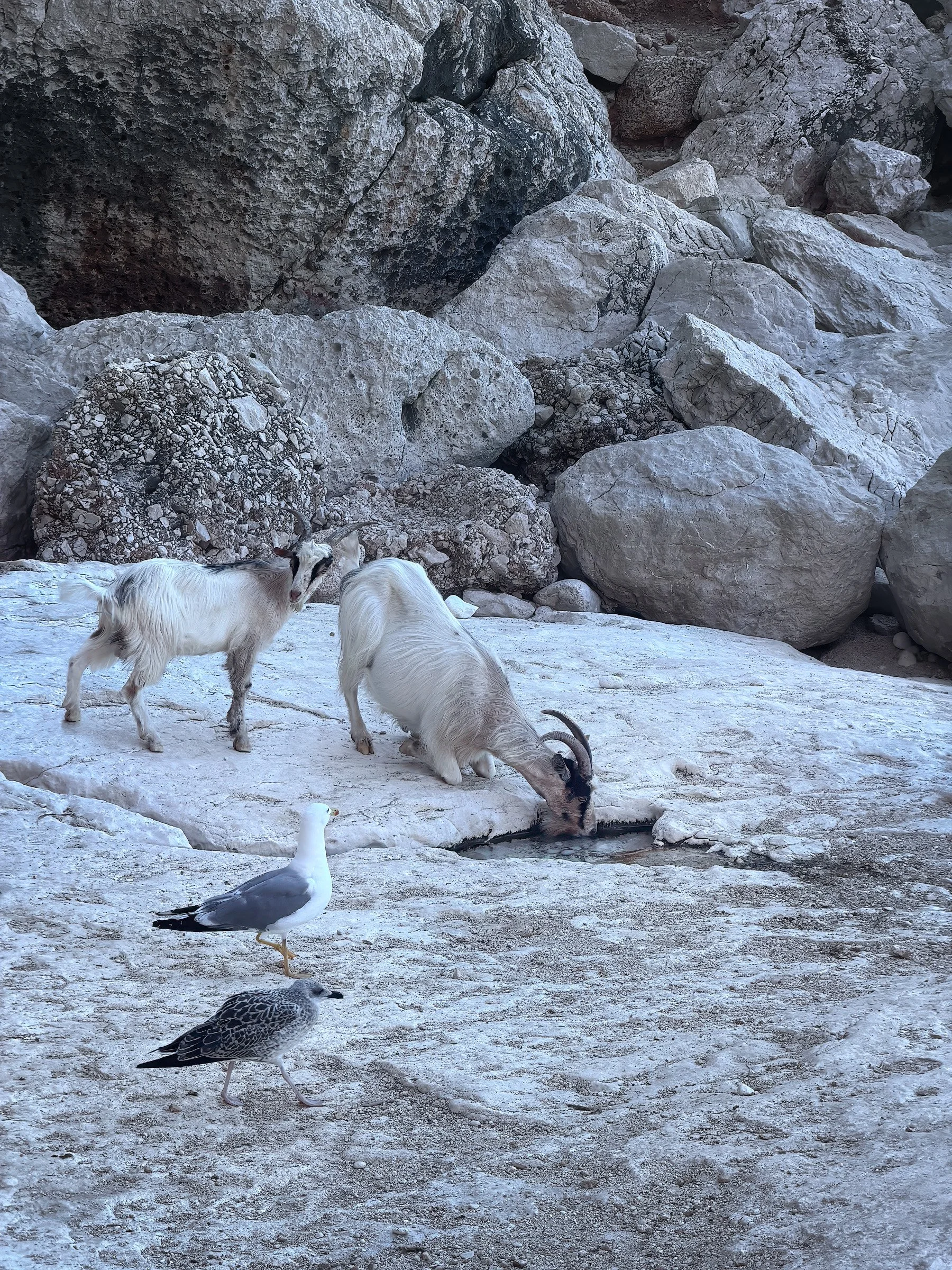
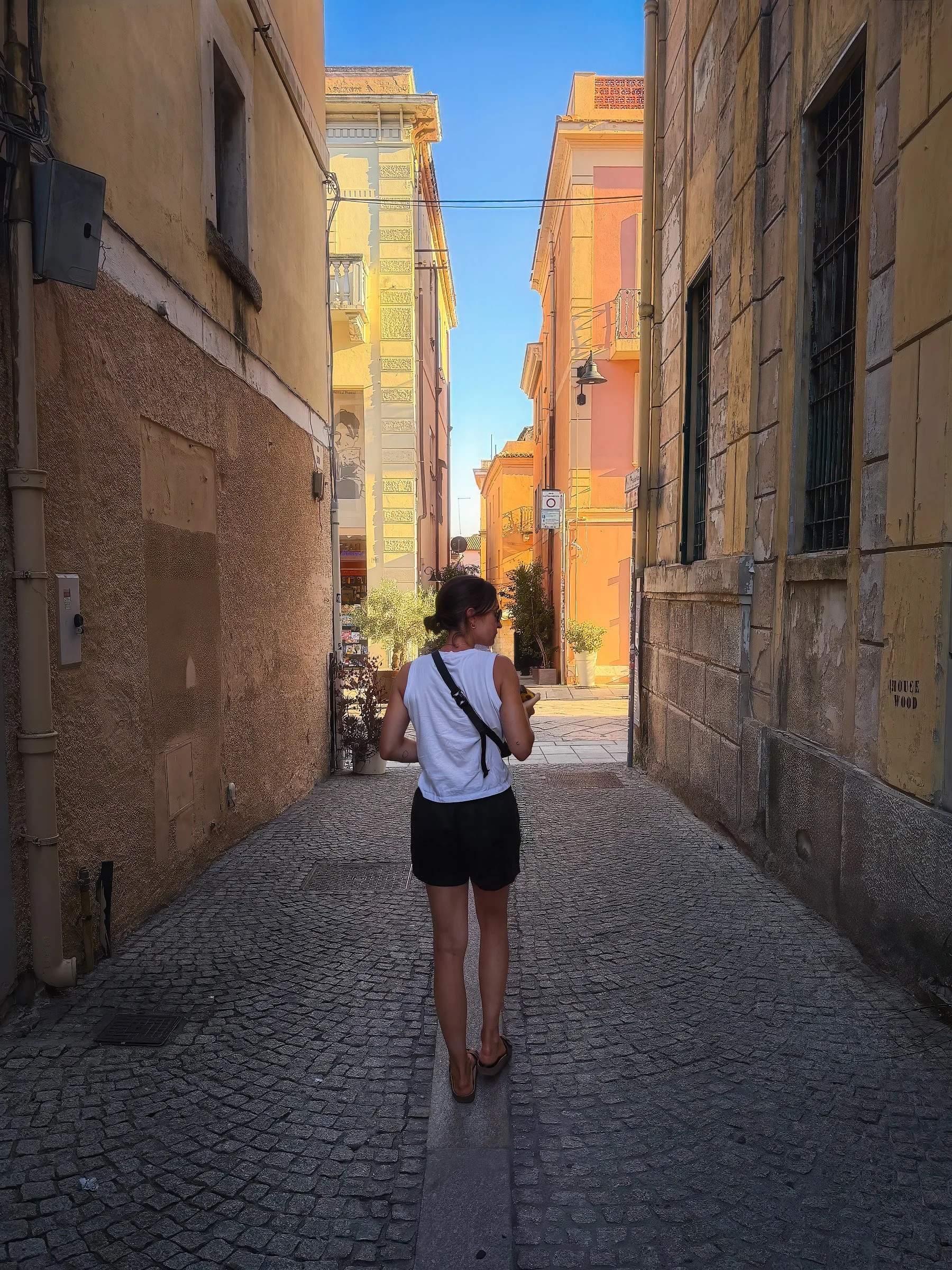
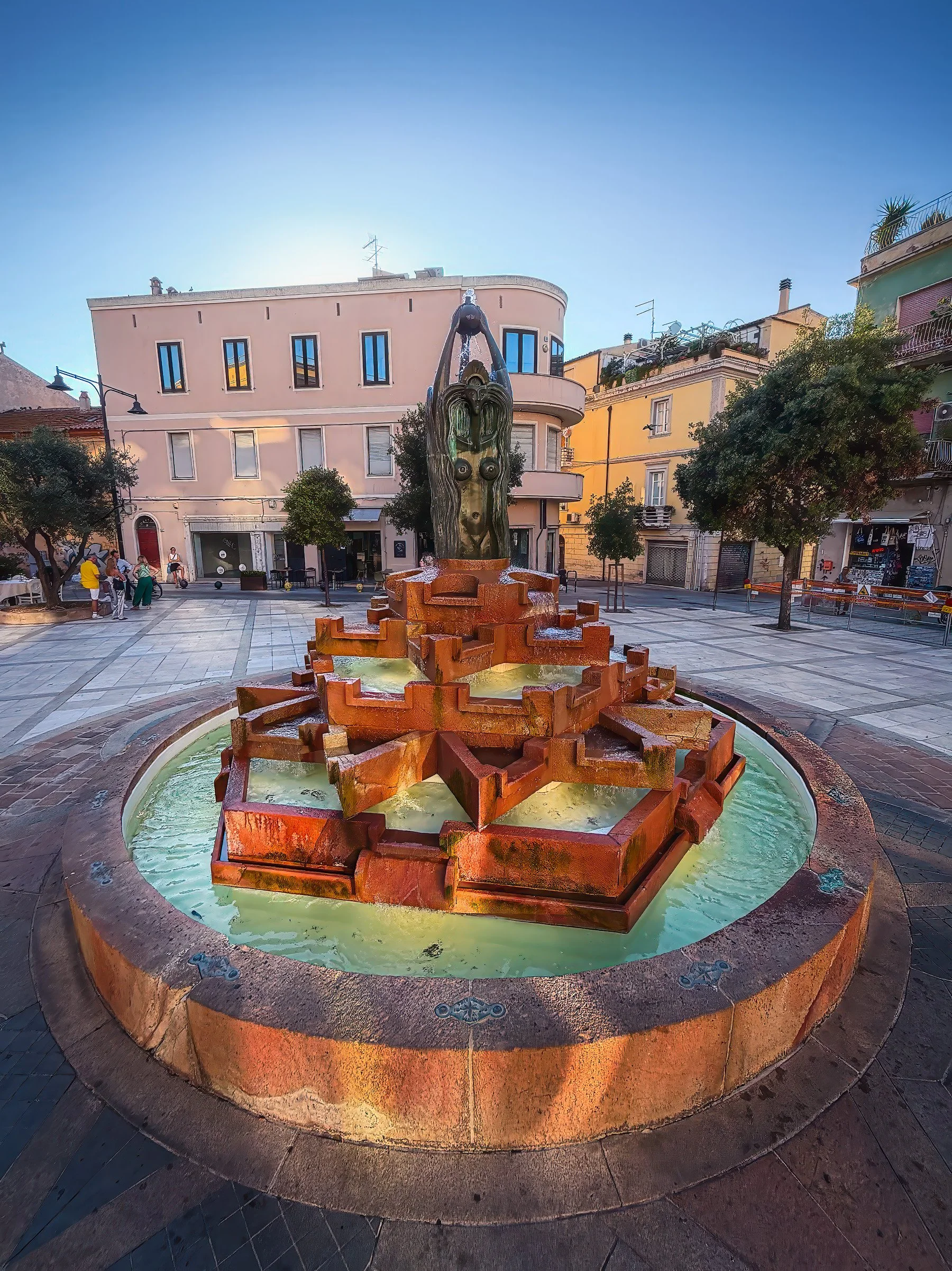
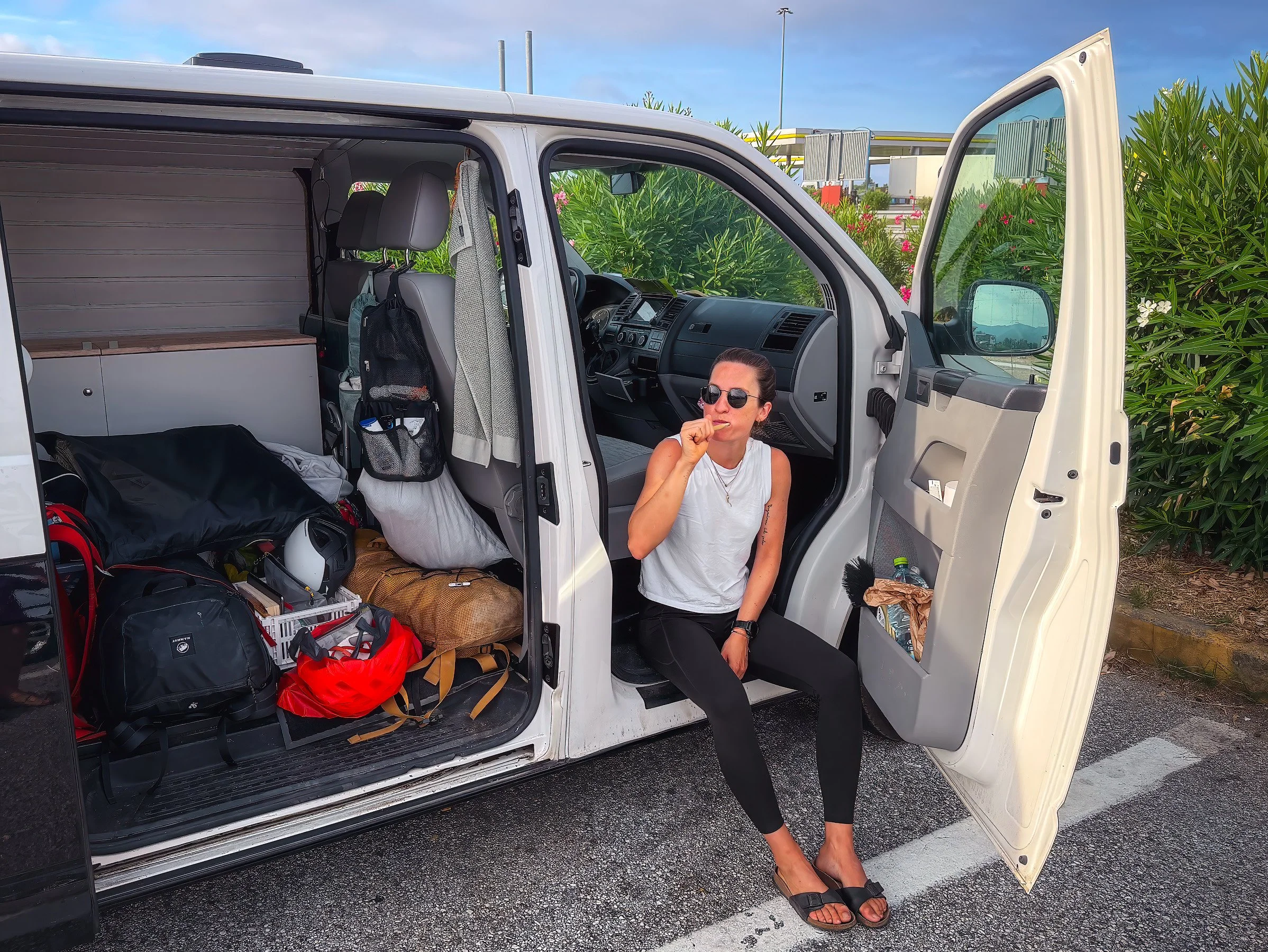
By 5 p.m., everyone had to vacate the beach, and as we packed up, some of the goats that roamed the forests along this coastline appeared on the beach. There were small pools of freshwater nearby, which they could finally drink from without being disturbed by the crowds of tourists. For the hike back to the campground, we had to ascend almost 500 metres; it was a sweaty affair, even now in the afternoon, when many parts of the forest offered some shade. The next day we had to make a two-and-a-half-hour drive to Olbia, where our ferry would set sail that evening, taking us to Livorno on the Italian mainland, from where a 6-hour drive would take us back to Zurich. Along the way to Olbia, we stopped at a supermarket so Charly could stock up on the excellent selection of gluten-free pasta. We first spent some relaxed hours at a beach on the outskirts of Olbia, where I took a final dip in the lukewarm waters of the Mediterranean Sea. Afterwards, we strolled around Olbia for a bit, exploring the streets and treating ourselves to gelato and Fritto Misto.
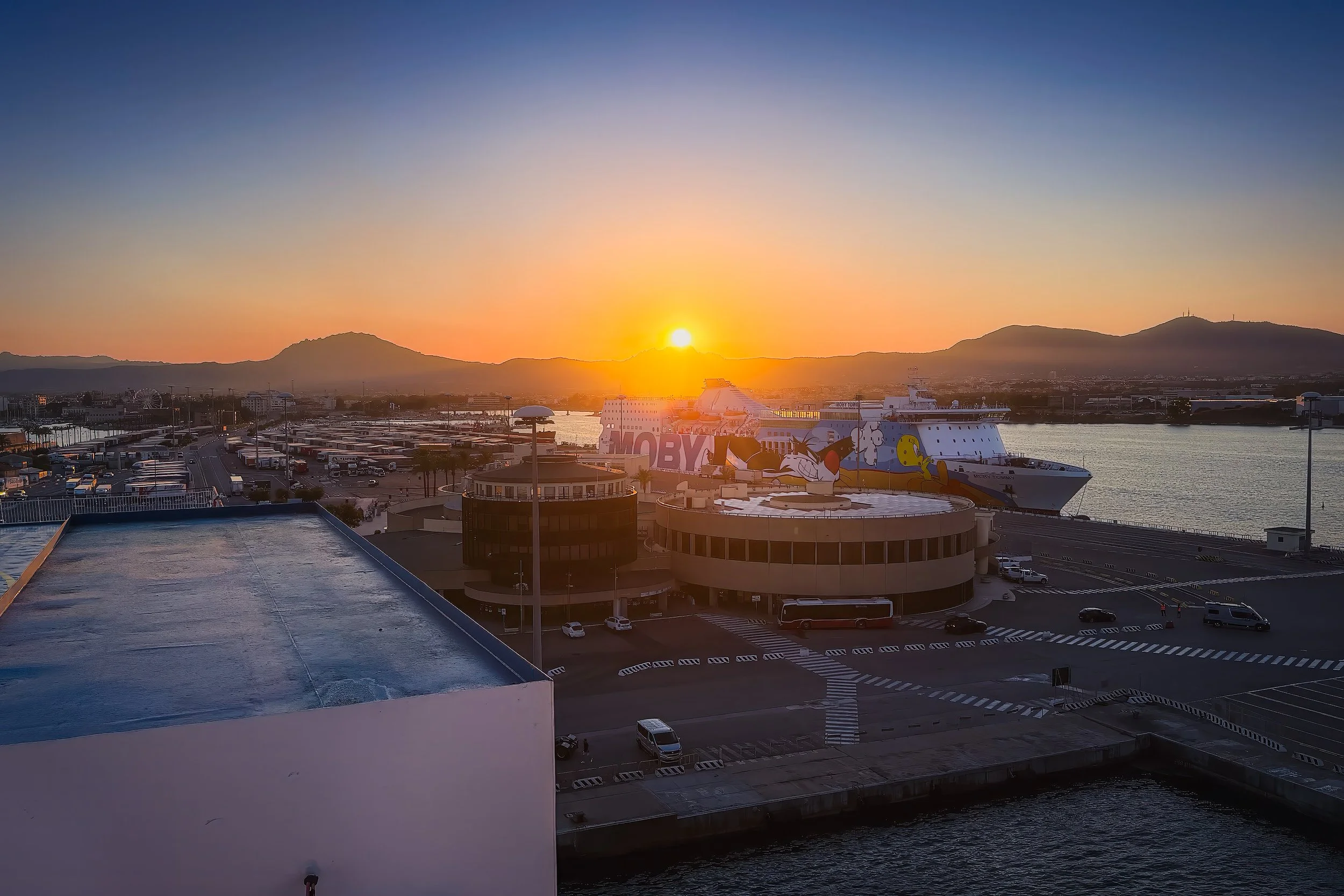
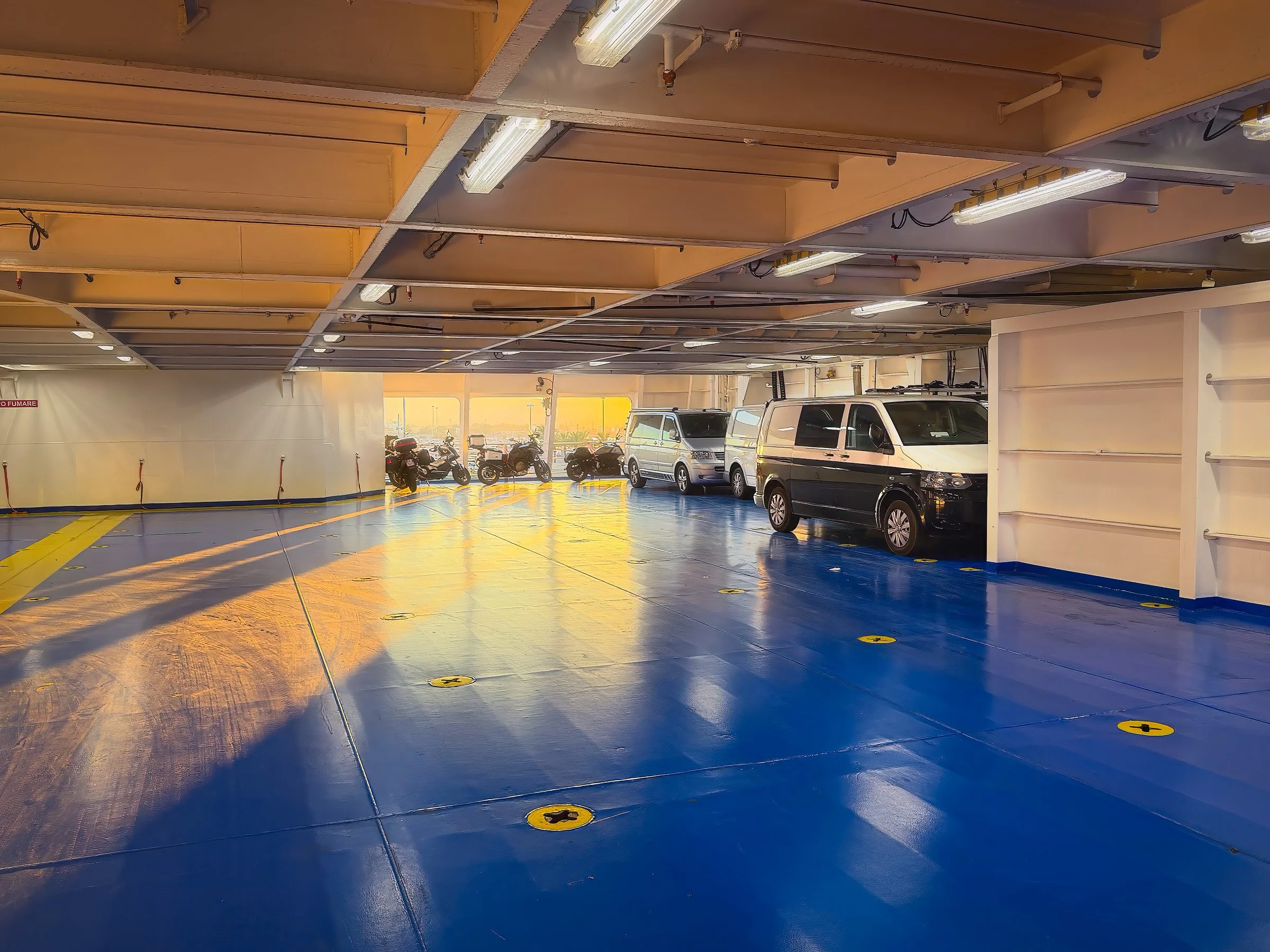
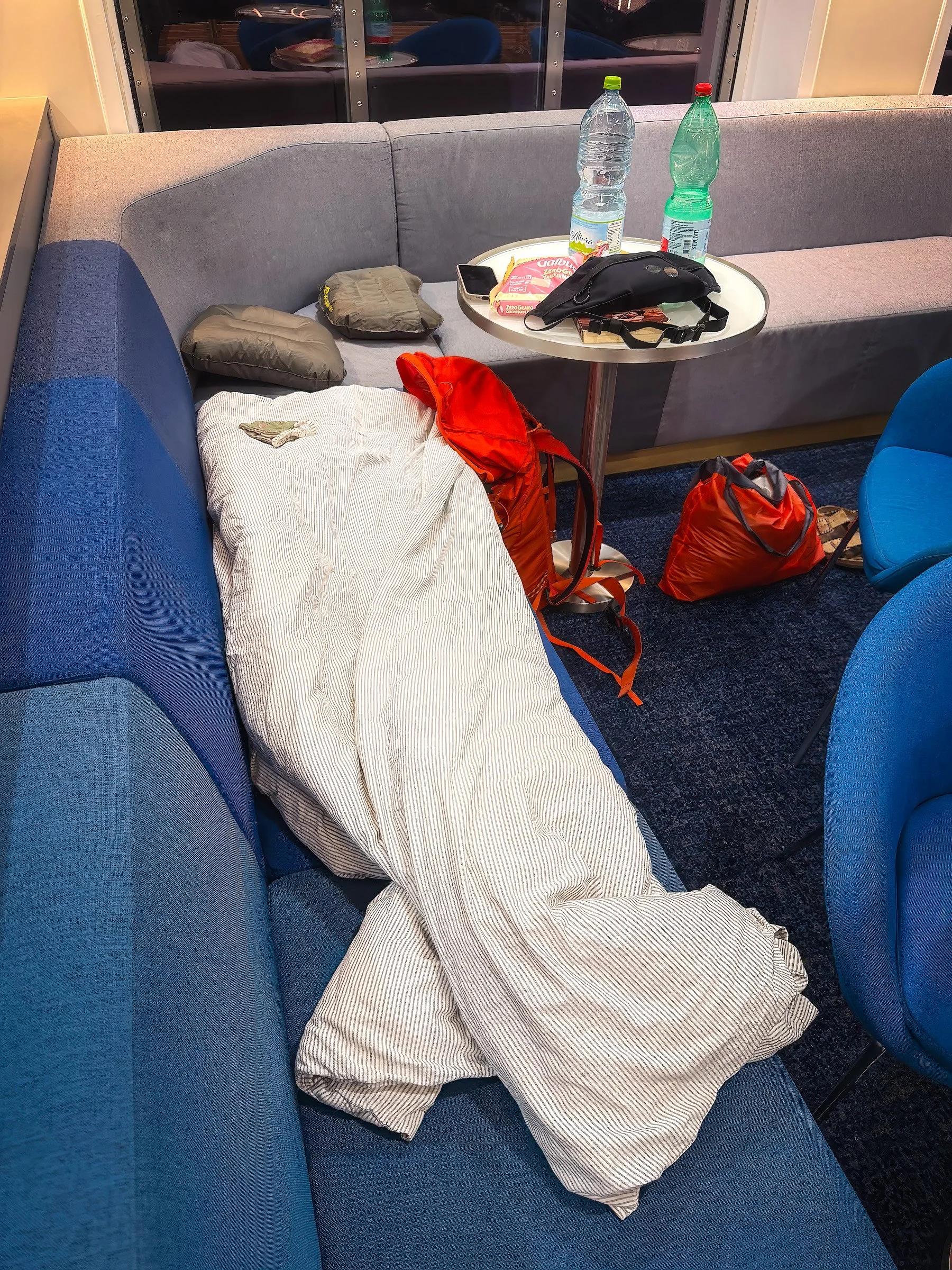
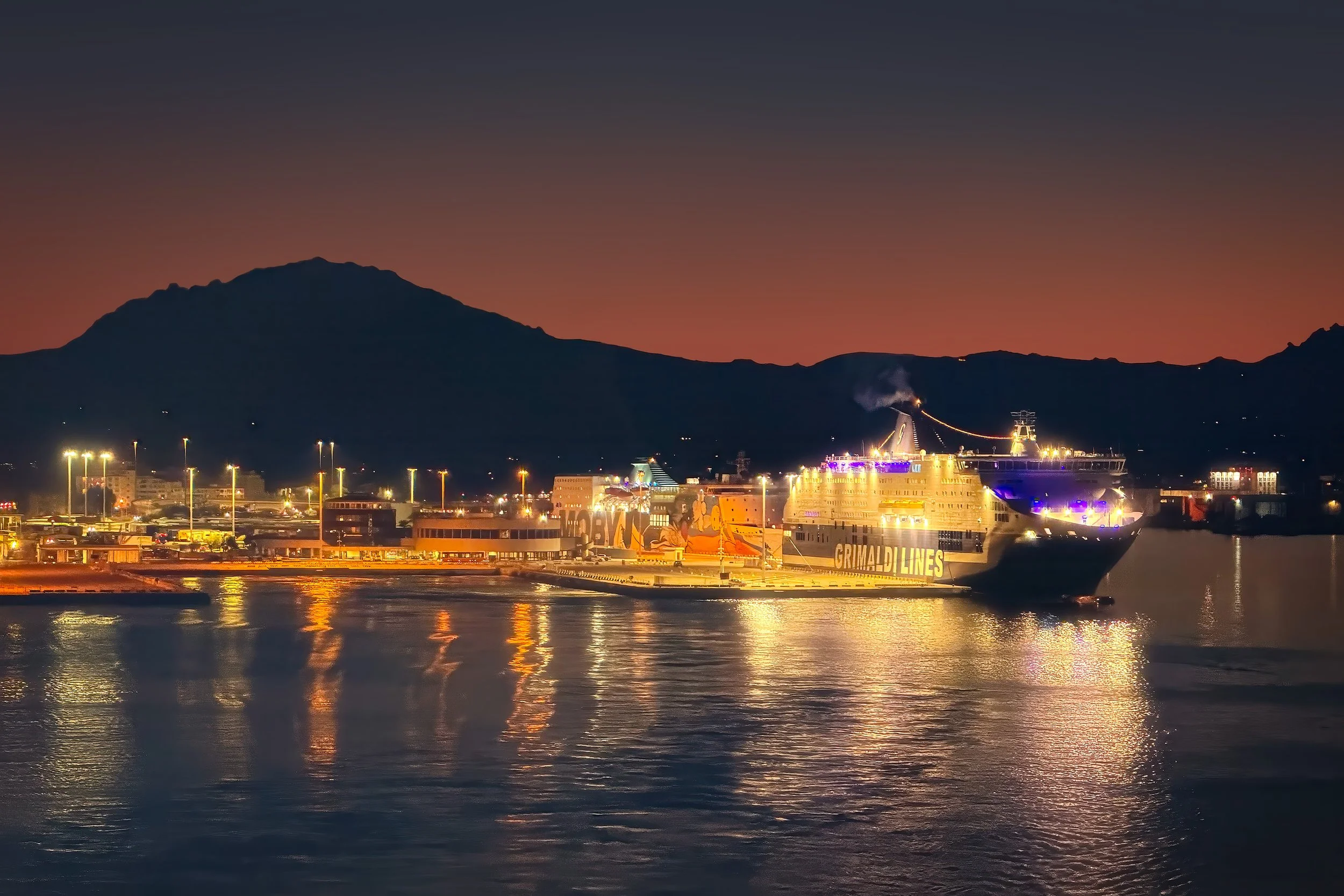
As evening approached, we drove to the port of Olbia, where several giant ships were docked. Everyone was ushered to our respective ferries, and we slowly made our way into their cavernous bels size was truly difficult to wrap your head around, and I wondered how many cars and people it could fit. From the deck, it felt like standing atop a skyscraper, with a view overlooking the entire city of Olbia. In a flash of genius, Charly had grabbed her duvet from the van, and when it came time to settle in for the night, she set up a cosy nook for herself. For the overnight journey to Livorno, we had opted to save money by not getting a cabin, but it was obvious very quickly that we were in good company. All across the ferry, people set up their makeshift camps, some even with large air mattresses. I had to make do with my small inflatable pillow and regretted not bringing a sleeping mask. It was certainly the worst night's sleep (accompanied by a dinner consisting of probably the worst French fries I ever had) of the entire trip, but it was over soon enough, and a quick coffee stop at the nearest petrol station after leaving the ferry did the trick to wake me up.
The only thing that remained was the six-hour drive through Italy into Switzerland. As we drove further north, the washed-out colours of the desiccated Mediterranean landscape slowly regained saturation, the other cars’ passing manoeuvres became incrementally less impudent, and the flat expanse of the Po Valley eventually gave way to the familiar mountainous sight of the Alps' southern flank. I tried to stay awake and keep Charly company on the long drive, but as we wound along the meandering roads of southern Ticino, I started to drift in and out of consciousness. It had been a long journey, and I don’t mean just the cruise on the ferry. Thinking about it, this holiday had been the first time I had been climbing for 6 days in a row. And although some of the days had been rather relaxed, I still felt the cumulative fatigue deep in my bones. But I also drove home already longing to be back. There was something about the simplicity of just turning up at a campground and making it your home for a couple of days, with the only questions “Where do we climb today?” and “What do we eat?” As I gazed out the window and watched the midday sun reflect in the glistening waters of Lake Lugano, I knew one thing for certain: This first climbing holiday would not be my last.