
Wondering how we still ended up with so much gear despite our best efforts to remain lightweight
May 1st is Labour Day. It’s a public holiday, and in 2025, Charly and I used the long weekend for a ski-camp-climb trip to the Furkapass. We had camped in the shadow of the Hannibalturm, enjoying its amazing granite pitches in the heat of the May sun, having the entire mountain to ourselves, before being rained off on our last day, resulting in a long, soaking hike out via the Furkapass road. Now, exactly one year later, Charly and I wanted to repeat this way of starting the alpine climbing season – minus getting drenched, preferably.
Our objective of choice this time: the Zervreilahorn. From the north-east, it appears as a large, isolated pillar, its top seemingly carved off in a clean horizontal slice. Ever since I first laid eyes on it, it has reminded me of the famous Devils Tower in Wyoming and can arguably be described as one of the most aesthetic and unique geological features in the Alps. Its rock offers some of the best gneiss climbing in Switzerland, and after a short visit last autumn, mostly dominated by bad weather, I couldn’t wait to return. Last year, we had to rely on careful forecast monitoring in the weeks leading up to our trip to guess whether we would find snow-free, climbable rock at the Furkapass. This year, however, our objective offered a convenient, very 21st-century way to check conditions: the webcam at the Zervreila dam. With its help, we confirmed the south-facing rock was mostly snow-free, and with a forecast promising some sunny days, our plans were set.
Gearing up on the parking lot (photo credit: Charly)
We headed off early Friday morning in Charly’s van, only slightly delayed by a detour because I had forgotten my ski boots at home. On the drive into Graubünden, the sun stood brightly in the sky, and we were optimistic about the climbing conditions. The road up to the car park at the Zervreila restaurant – nestled on the hill below the giant reservoir dam, which curved above like a huge wave frozen in time – showed no signs that winter had reigned at these elevations only a couple of weeks ago. We started to feel optimistic we could keep going, past the restaurant, to the car park at the trailhead. But a couple of metres beyond the restaurant, we hit a dead end. A huge lump of snow, evidently piled up by the snowplough clearing the road, blocked any further progress and higher up we could even see some patches of snow remaining on the tarmac. We had no choice but to turn around and park next to the restaurant, where we spread out our gear and prepared for the arduous hike in with our heavy packs.
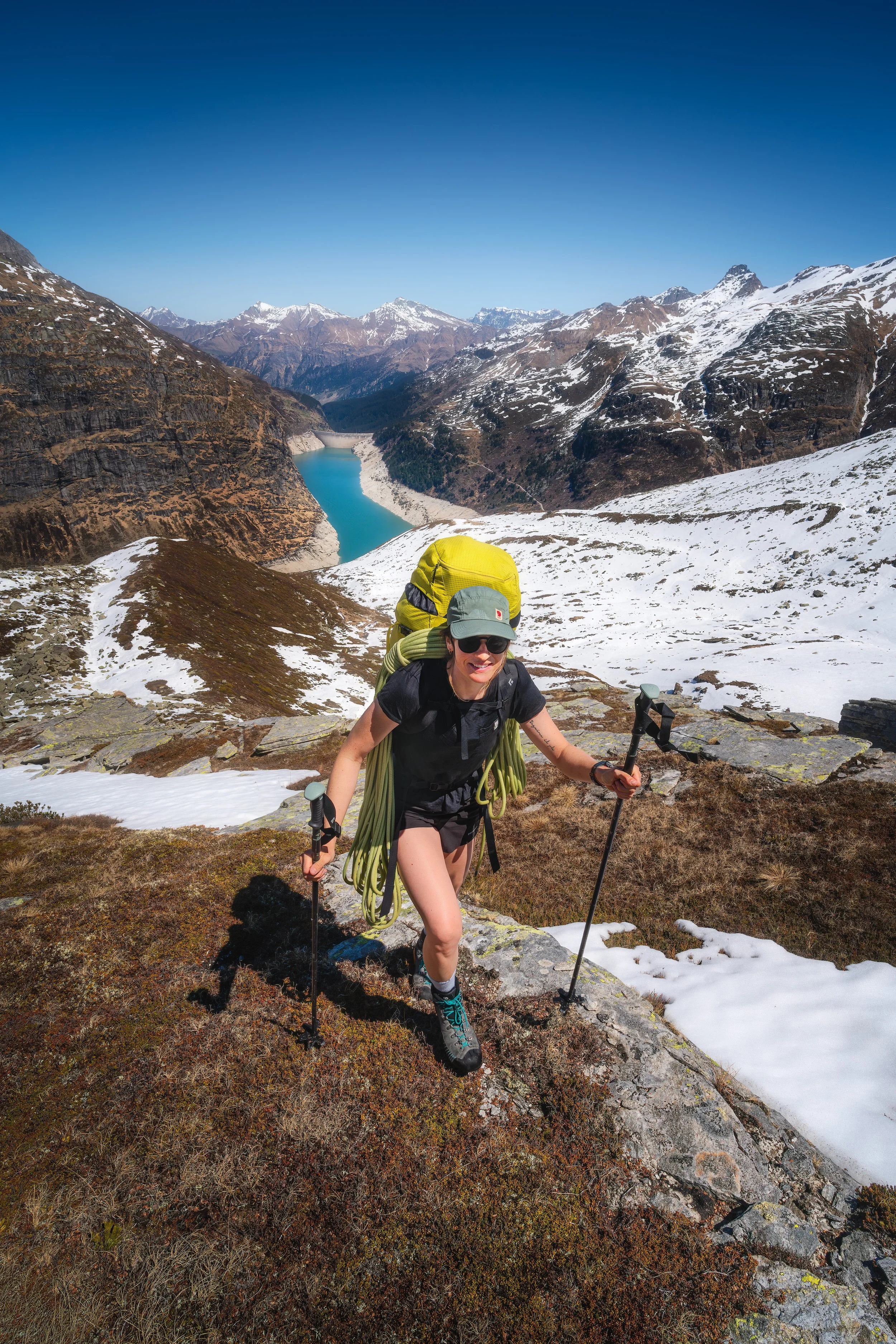
Back home, I had weighed my backpack, which clocked in at around 17 kilos. Now, with the addition of a rope, my skis, and ski boots, the weight jumped to around 26 kilos, not including most of the climbing gear I couldn’t fit into my backpack and therefore had to carry on my harness, which I was already wearing for our approach. All in all, I was hauling more than 30 kilos of gear, food, clothing, and ski and camping equipment. Charly’s backpack was similarly unwieldy; she struggled to shoulder it without my help, and when we looked at each other with our giant, misshapen packs, we couldn’t help but laugh, knowing full well the suffering we’d endure for the next couple of hours. Humour seemed to be our only coping mechanism. As we started hiking up the road and climbed over the pile of snow that had blocked us from going further with the car (a balancing act in our current attire), we passed a couple of day hikers on their way down from the dam who eyed us curiously and were evidently amused by our bulky backpacks. I, in particular, must have been a funny sight to behold, as my 35-litre backpack was nowhere near big enough to fit everything I was carrying, so I had to strap as much as I could to the outside. I must’ve looked draped like a Christmas tree.
On the trail (now without skis) after traversing along the lake (photo credit: Charly)
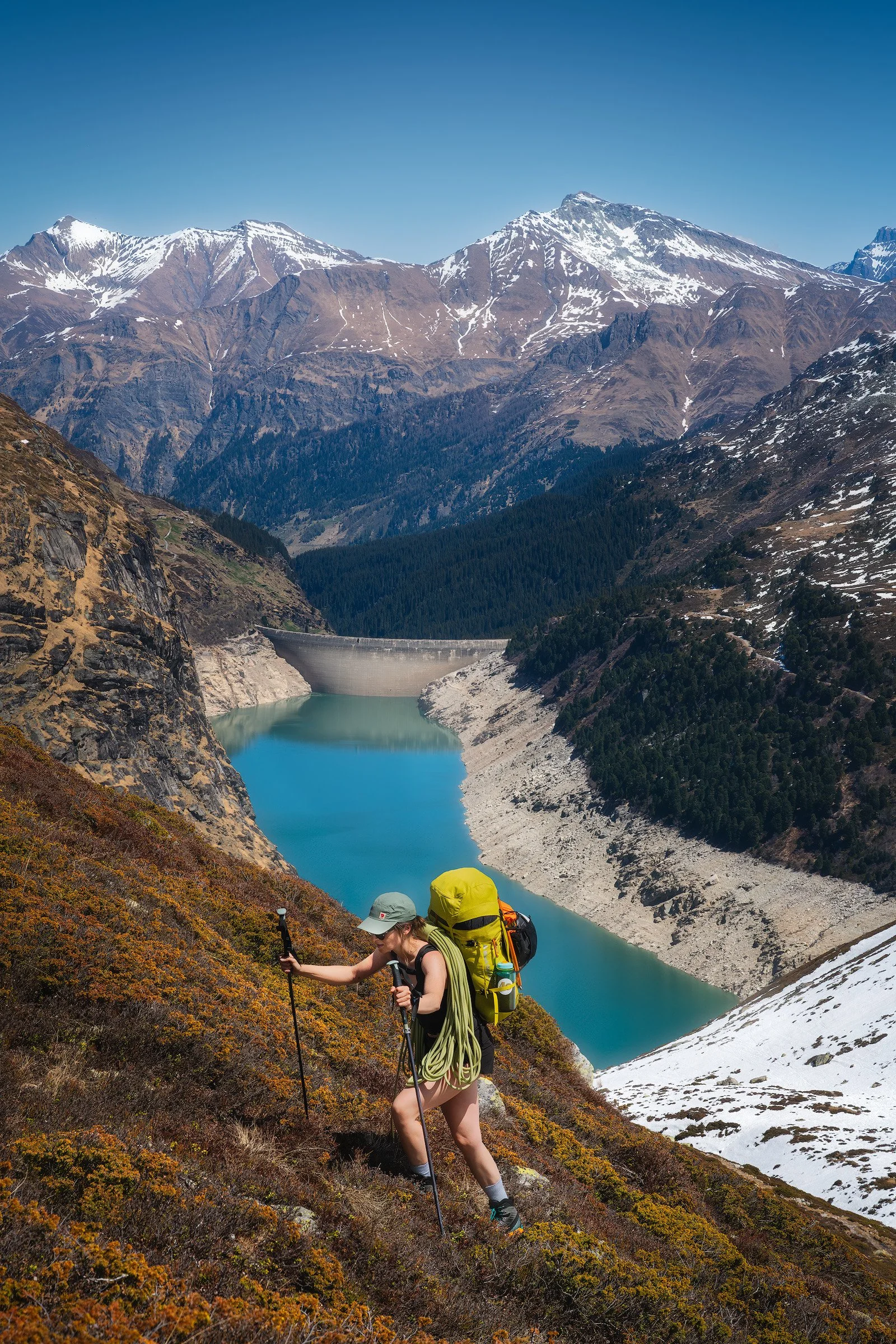
The trailhead was not even 2 kilometres away, but by the time we reached the end of the paved road, I already had to set my backpack down to rest. It seemed we had not learned anything from hauling our heavy packs up to the Furkapass last year, and despite thinking we had improved our strategies and packed more efficiently (this time around, I didn’t carry an entire fondue pot, for a start), I felt a distinct sense of déjà vu. Last year, we had been lucky enough to find a hitchhike up the Furkapass road, but this time no one would save us from our misery. From the vantage point at the trailhead, I could trace the path down to the big barrier lake, hugging its shore before ascending the opposite side up a steep slope toward the formidable pyramid of the Zervreilahorn. It was a long way to go, but what worried me more was the fact that there was decidedly little snow to be seen. In fact, it looked like we would have to carry our skis all the way along the lake, only able to start using them for skinning halfway up the slope on the other side. “Do you think we should just leave the skis here?” I asked Charly. She was certainly somewhat heartbroken at the idea of leaving her skis behind, but it didn’t take long to convince her. Inspecting the approach from afar and zooming in on photos I'd taken, it quickly became clear there might be no skiable terrain until we reached our camp at the base of the Zervreilahorn. So, with heavy hearts, we hid our skis behind a small nearby church and continued our approach.
As we made our way down the gentle path that usually led to the shores of the lake, we debated the obvious question: Where was all the water? The shoreline was probably 100 metres lower than it had been, and dust-covered slabs dominated the entire perimeter of the lake, usually deep underwater. It seemed strange that the lake should be so dry at the beginning of May, when, as we assumed, the snowmelt should already have raised the water level significantly. Perhaps there simply had been too little snow this year? Maybe higher energy demands meant greater-than-usual demand for the hydroelectric power generated by the dam? Or maybe we simply underestimated how much more meltwater the mountain snow still held. In any case, we ejn, and I made a mental note to recheck the webcam over the summer to monitor future changes in water levels. As we continued hiking, I was just glad the weight of my backpack, while still heavy, now felt like something I could endure for a couple more hours. In all honesty, I didn’t know how I would have made the approach if I had to carry my skis, and once we started up the steep hiking patch on the other side of the lake, I realised I would have dumped my skis here at the very latest, regardless of any prospect of spring skiing higher up.
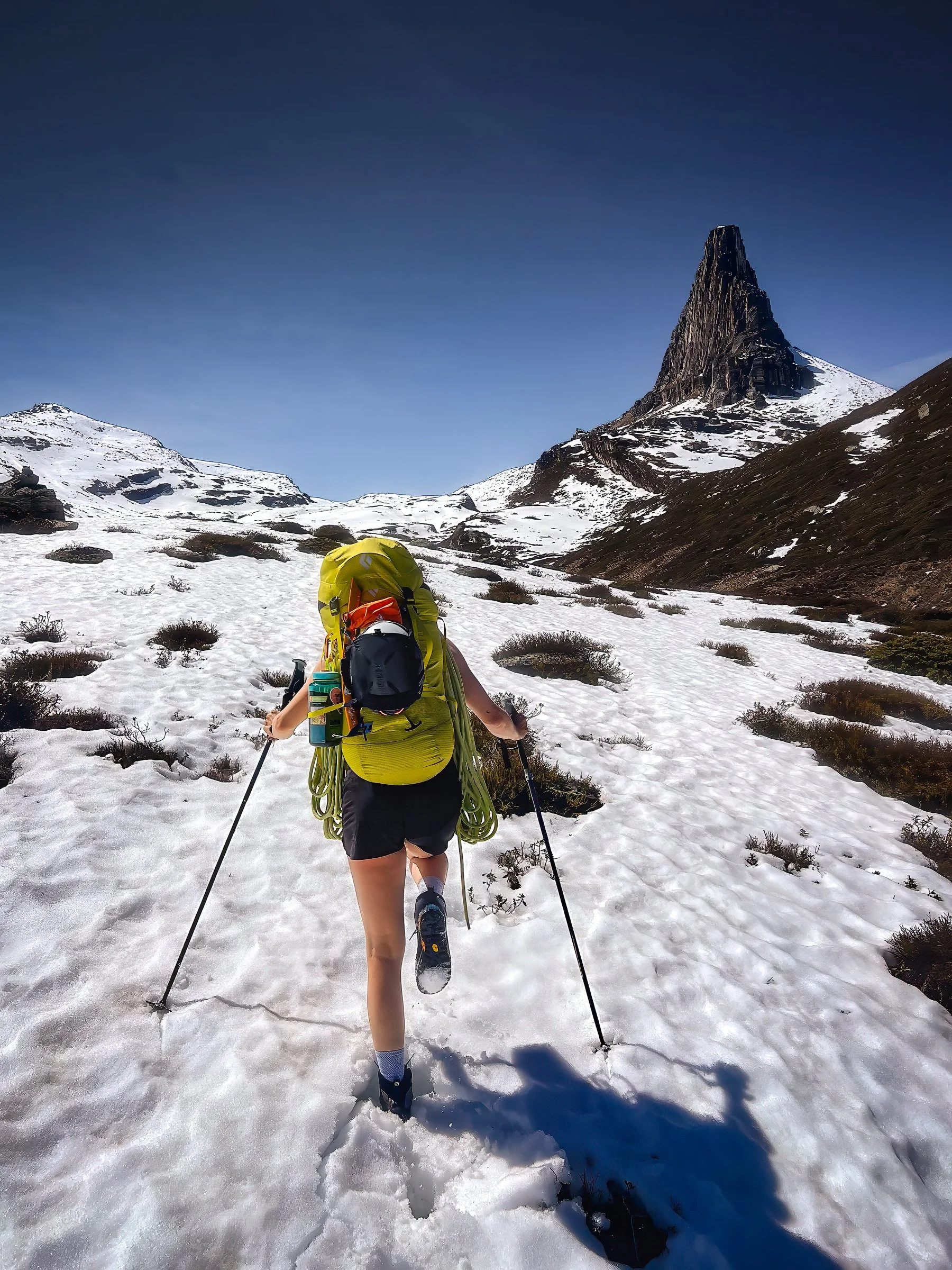
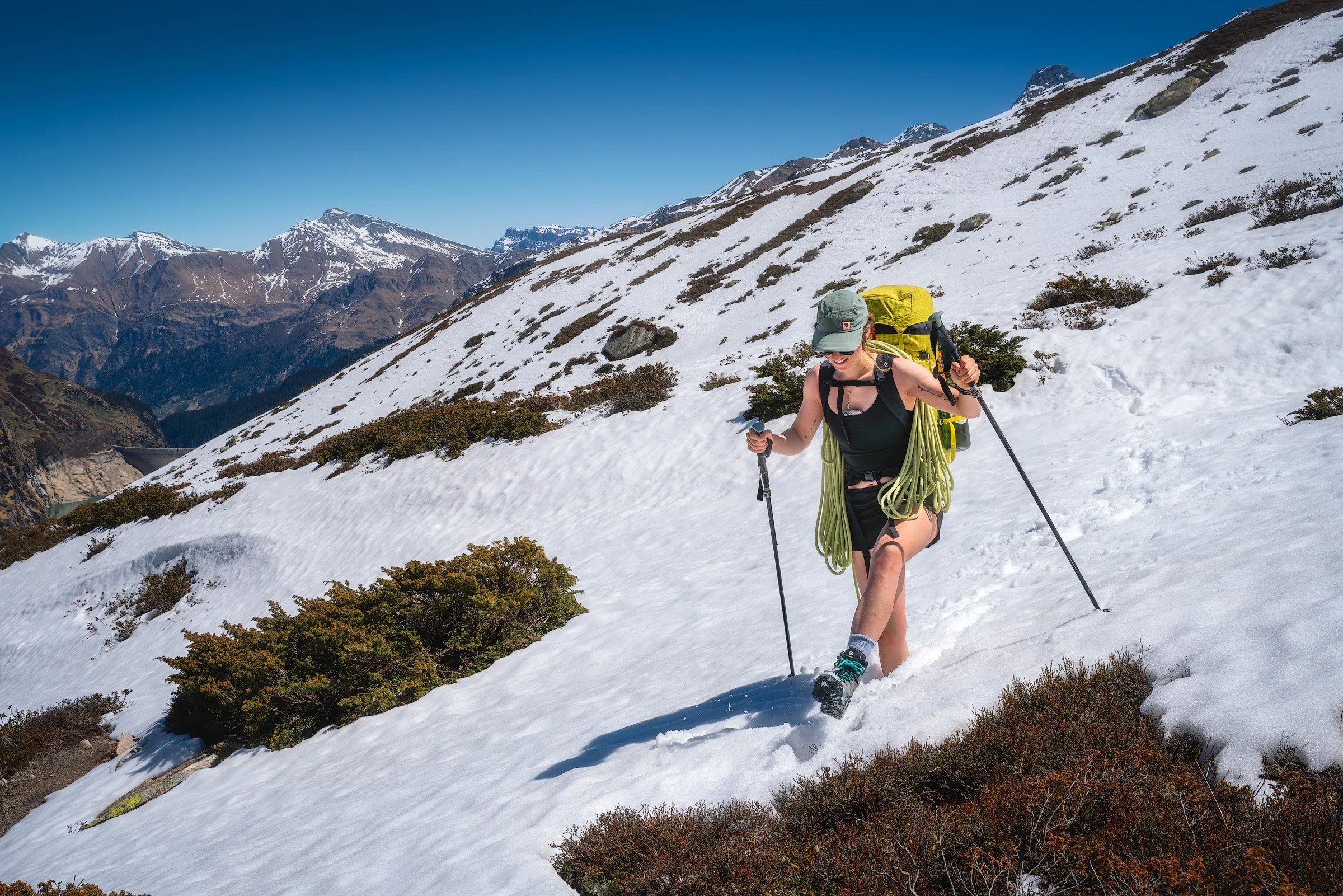
As we hiked higher, we eventually came into contact with the first of the remaining snow. At first, we could avoid sinking into the wet slush by hopping from one bush or protruding rock to another, but eventually the snow cover became dominant enough that we had to accept walking on the snow, which meant being in ever-present danger of breaking through and sinking up to your knees or even your hips into the soft snow. It was quite an ordeal, but once again humour proved the ultimate weapon, and we simply laughed when one of us had the misfortune of finding a particularly deep hole in the snow, only for instant karma to return the favour a couple of steps further along. There were still enough rocks between the snow that we didn’t regret leaving our skis, and as our socks and boots grew increasingly drenched, we hoped from stone to stone, glad for every chance to avoid the treacherous snow cover. We eventually reached a small flat area where I had camped during my first visit to the Zervreilahorn last autumn. We decided to cut through the brambles and climb another steep slope to the crest of a ridge leading toward the plateau below the Zervreilahorn, where we intended to set up camp.
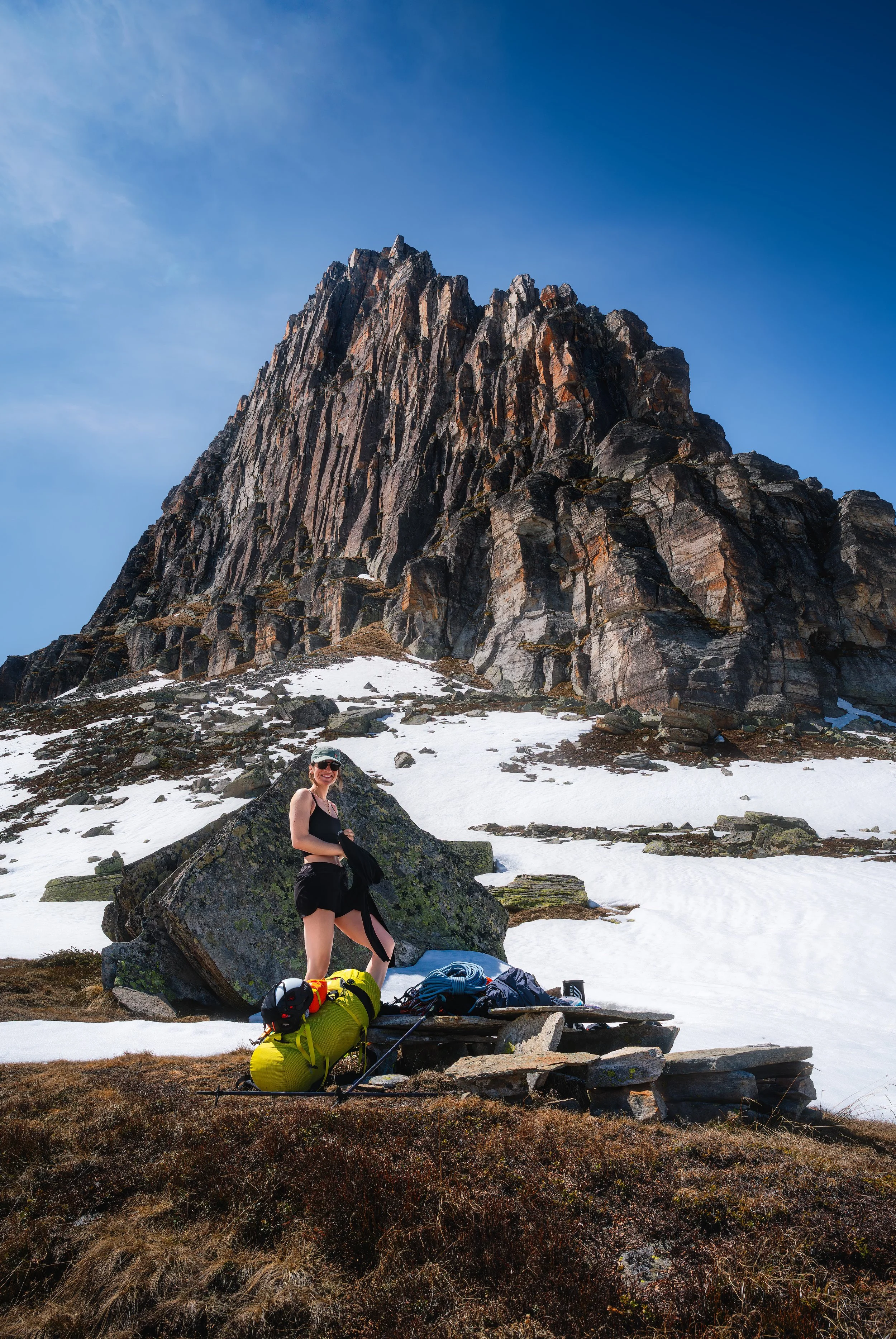
Charly keeping warm while relaxing at our camp
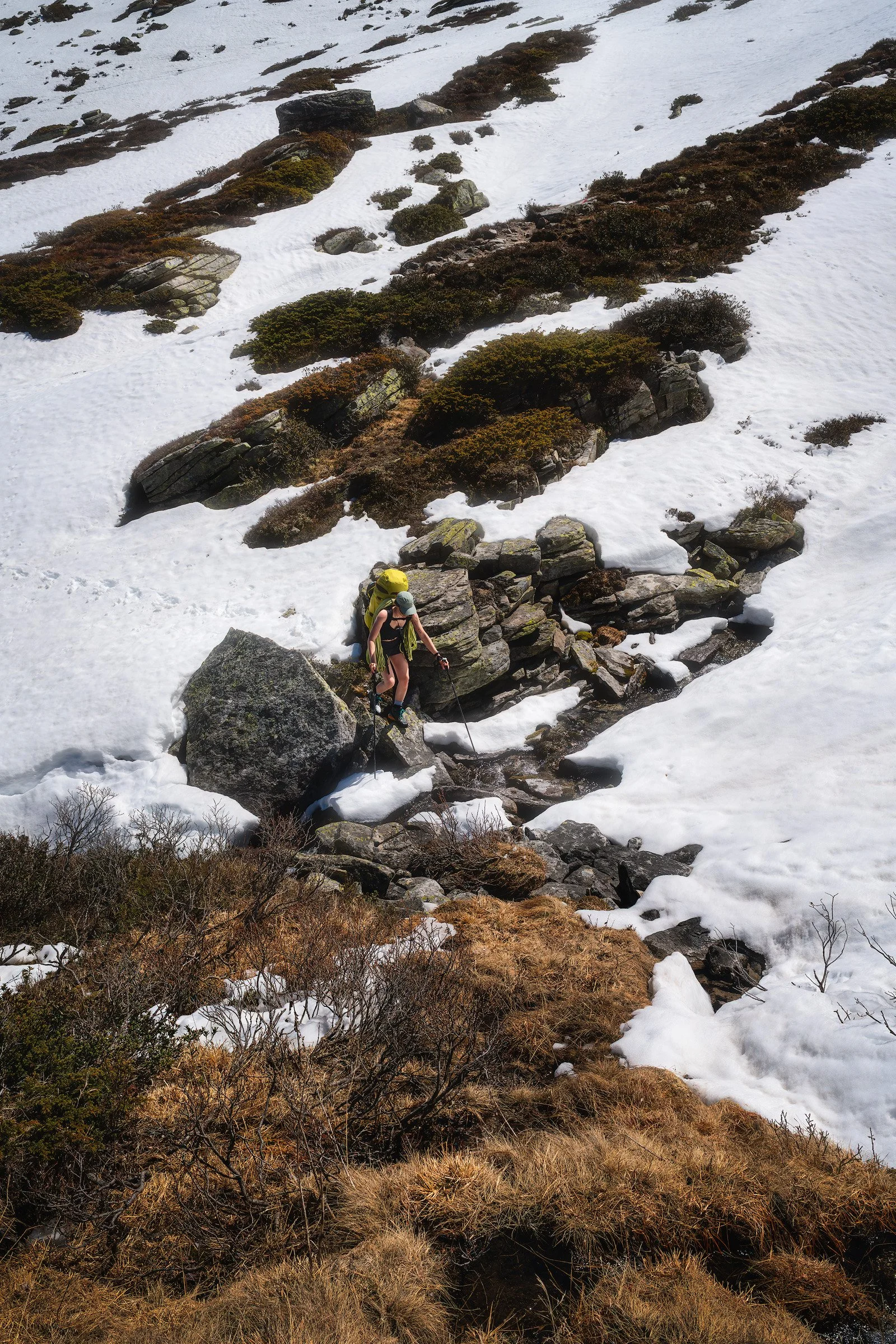
Toward the end of the ridge, we had to scramble between rocks, but eventually we reached easier terrain where the gurgle of running water caught my ear. Could we find a small creek and save our gas provisions by not melting snow? A few moments later, we found out. Not only did I come upon a little creek, but it also turned out to be a small waterfall, about three metres high, which could almost make for a perfect outdoor shower, if not for the fact that you would have to stand with both feet in the snow to enjoy it. When it came to finding a suitable campsite, we didn’t have to search for long, as more ready-made appliances by nature (with the help of some previous camping enthusiasts) were readily provided for us. This included a perfectly shaped dinner table and even some benches built around it. There was even enough dry ground that we didn’t have to pitch our tent on the snow, so setting up camp was a quick affair. We were both quite tired from the approach, however. In the end, it took us three and a half hours, and while leaving our skis had alleviated some strain on our backs, the heavy packs still made it a very exhausting hike in. So, after some snacks, we decided to take a short nap in the afternoon sun and enjoy the beautiful surroundings.
I couldn’t say how long we lay on my foam sleeping pad, but eventually it was clear that if we wanted to get any climbing in today, we would have to get up sooner rather than later. By the time we finally geared up, it was late afternoon, but fortunately, the climbing was only a 10-minute hike away. We decided to climb some single-pitch routes at the base of the Zervreilahorn, which featured some aesthetic cracks and would serve as a good warm-up to get used to the rock, while giving Charly the opportunity to break in her newly acquired crack gloves. While climbing, we saw the shadow of the Zervreilahorn creep over our basecamp and realised we would unfortunately spend the rest of the evening without the warmth of the sun. This put a little damper on our otherwise stellar camping position, but with enough layers packed, we weren’t too worried about getting cold. Charly enjoyed her first full pitch of crack climbing, and while it looked like she had certainly gained more respect for the dark wizardry of crack climbing, she seemed to enjoy herself and be quite happy with her new crack gloves.
Back at camp, it was time for dinner, and we had to decide whether to use our freeze-dried meal or the more extravagant options. Last year, at the Hanibalturm, I had carried 400 grams of cheese and a fondue pot up the mountain. Learning from my mistakes, I opted for a much lighter option and replaced the bulky pot with a portable candle-fuelled raclette set (I still had to bring 400 grams of cheese, so it’s debatable how much more lightweight my setup really was this time). But in the end we decided to save that feast for the next day. As we spooned the freeze-dried meals from their plastic bags, we watched the cloudless sky over the lake to the north turn from the pink sunset hues to a deep, saturated purple. After dinner, we didn’t waste much time and quickly wriggled into our sleeping bags to start working on digesting the lump of cheese and potatoes in our stomachs.
A calm sunset over our camp above the Zervreilalake
A last look towards the the north-ridge, our objective for the next day
The view from our tent
The next morning, we let the sun wake us, knowing we had a full day of stable weather ahead. After spending dinner in the shade of the Zervreilahorn last night, we enjoyed the sun warming our skin as we crawled out of our tent. Some cirrus clouds hung high in the sky, promising a beautiful day. The morning was slow, and we took our time to prepare breakfast. The morning sun still lacked strength at the beginning of May, and after leaving the warmth of our sleeping bags, we quickly pulled on our big puffy jackets. After enjoying our blueberry porridge, the day's most unpleasant task awaited: putting on our wet boots. Yesterday’s knee-deep approach through soft snow had left them completely soaked, and the shady evening had done little to dry them out. I cringed as I slid on my wet wool socks; at least the night hadn't been cold enough to freeze them. I made a mental note to take them in my sleeping bag the next night if they were still wet by the end of the day. But I was hopeful we could leave our socks and boots in the sun to dry before the shadow of the Zervreilahorn would engulf our camp in the evening.
As we left camp, we counted on the snow covering the approach being firm and easier to walk on after a cold, clear night. It was a futile hope; we still sank to our knees. At least this time we could follow our tracks from yesterday, which made the ordeal slightly more manageable. We passed where we had climbed yesterday, and a short but steep scramble through a narrow gully brought us to the rock band running along the south side of the Zervreilahorn. A few minutes later, after a couple of somewhat exposed scrambling moves, we were standing at the base of our chosen route: the north-east ridge. Patches of orange gneiss seemed to glow under the bright morning sun.
Enjoying breakfast on the large granite slab we used as our kitchen table
Charly was quicker to crawl out of the tent than me
Charly leading the first pitch of the north-east ridge
Our first move was to remove our boots and put them in the morning sun to dry out. Then we geared up, and Charly started leading the first pitch. We had both climbed the initial bits of the north-east ridge on separate occasions last year, but each had to abandon our climb because of time constraints. The first pitch started on a slab, then led into a small leaning dihedral where not every hold within reach was 100% solid, and the next bolt was higher than Charly would have liked. The dihedral led under a small roof where an old anchor could trick you into thinking the pitch ends there. The friend Charly climbed with last year had made that mistake. Remembering this, Charly exited from underneath the roof and climbed across a short slab to reach the proper belay. As I followed her, I felt a slight sense of déjà vu and remembered thinking last year that this first pitch didn't feel exactly straightforward for a 5a. I experienced a similar sentiment now, especially climbing the slab after the roof.
The next pitch was a 5b, and as I set off to climb it, I tried to remember how I had solved the sequences last time I was here. The start went across big blocks of granite stacked vertically atop one another, creating something resembling a chimney and climbing them offered an interesting challenge. It wasn’t always clear what the best sequences were, and stemming or bridging between the big blocks created a truly three-dimensional climbing experience. After a couple of metres, I came across a stuck cam that hadn’t been here last year. On closer inspection, I realised it was almost brand new. I spent a few minutes trying to wriggle it out of the crack, but eventually had to accept that this piece of protection was now part of the route, feeling sorry for the unlucky person who had to leave their shiny new gear behind.
The top of this pitch marked where Charly and I had started rappelling on our respective first attempts at the north ridge. Now, instead, we got to inspect the next section of the ridge. It led horizontally across some huge blocks of granite. A prominent orange wall, marked in the topo as “Roter Turm”, stood out against the lichen-covered rock. We shortened our rope to start simul-climbing across the easier terrain. After Charly set off, I waited until the 30 metres of rope between us ran out, then followed her. The terrain was easy but pleasant, and the granite was so superb that it was simply a joy to scramble between the huge chunks of rock. Charly connected the next 2 pitches in one long simul-climbing lead. The final metres led across an easy but exposed traverse where even I, with my long legs, had to leap across a gap in the rocks. But the granite blocks were perfectly flat, making for a very pleasant landing zone. Charly’s simul lead ended below a short vertical wall. We had now left the eastern aspects of the north-east ridge and experienced where the “north” came from. With the morning sun gone, temperatures plummeted quickly, and Charly donned an extra jacket before she started belaying me in the upcoming 5b pitch.
Charly leading the beginning of the first 5c+ pitch
The pitch started on a steep wall with large, flat edges set far apart, with nothing but a blank face between them. Moving between the good holds required some deliberation, and I was glad we'd brought a couple of cams to reduce the risk of a fall sending me down onto the ledge Charly was belaying me from. But the tricky bits were short-lived, and I soon found myself in easier terrain once more. After another short horizontal traverse, I reached the base of a large granite face. After searching for the belay, I realised it must still be hidden under the remaining snow patches, so I was left to build an anchor myself, which was thankfully quite easy in the featured granite. The next section of climbing was the first of the two crux pitches. It was Charly’s lead, and I could sense her getting a bit apprehensive. The bolt spacing didn’t look exactly inviting, but she still wanted to go for it. She made steady progress and supplemented the alpine bolt spacing with a couple of cams. After about 20 metres of climbing, Charly stopped. “I can’t see the next bolt,” she shouted down to me. I tried to consult the topo, but couldn't give her a definite answer about where she needed to go. After a bit of back and forth, she eventually spotted the bolt way out to the left. Sensibly, she climbed a few metres down to the last bolt she had clipped first, extended it to reduce rope drag, then started to traverse left. She climbed out of my sight, but from the slow speed at which I fed out the rope, I sensed the crux of this pitch hadn’t been in the initial section of climbing. It took a long while before I felt Charly tug on the rope in a way that made it clear she had reached the anchor. I couldn’t see her climbing the higher sections of the pitch and wondered what kind of climbing was waiting for me.
Charly using her hands and feet to recount the beta she used for her lead on the first crux pitch
As I followed her, I soon discovered what had taken Charly a minute to figure out. Below a ledge, a short dihedral guarded the final metres towards the belay. The walls were smooth, but a crack split the right side of the dihedral and led to a victory jug near the top. As I tried to jam up this crack, I struggled to find any climbing rhythm. The crack's proximity to the dihedral's corner made it hard to get my body in the right position and use my feet in it. I felt I was constantly pushed off balance by the left side of the dihedral. In the end, I wrestled my way up and, with a powerful move, launched for the jug, which, thankfully, was even better than it looked from below. “That was an impressive lead,” were my first words as I joined Charly at the belay. “How did you climb the crack down there?” “Laybacking,” Charly responded as if it was an obvious answer. I had to admit I had probably made this pitch harder on myself than it needed to be by sticking to pure crack climbing. Still, I felt this section certainly deserved its 5c+ grade, maybe even more, and given that a mistake in the dihedral could have ended in a fall onto the ledge below, it also required a strong head from the leader, making Charly’s lead all the more remarkable.
At the top of this pitch, a short horizontal section of the ridge led to a large slab that would bring us to the base of the final pitch, the second 5c+. Before we continued climbing, however, we enjoyed a short break in the sun, which we had now re-entered. We soaked in its warmth and snacked on Peak Punk Bars while Charly vividly recounted her beta for the previous pitch, using her hands and feet to paint the sequences in the air. She then started to lead the next pitch, first climbing across some blocky horizontal terrain and then gaining the easy and featured 4b slab. Once she reached the top, she disappeared from my view, and I assumed she would soon reach the next belay. But the rope was still feeding out slowly, giving me every indication that Charly was still climbing. This went on for a while. More than once, it appeared Charly had stopped, and I eagerly waited for her “Safe!” call. But every time, she started moving slowly again. Only when the rope was almost out did some sudden, quick yanks assure me she was off belay and taking in the remaining rope. After I had climbed across the slab, I quickly found out what had taken her so long. There was snow. A lot of snow, in fact. Before, we had never encountered any remaining patches of snow, but here, deep in the shade of the Zervreilahorns north face, the easy traverse to the base of the final pitch became a very slippery affair. We had at least confirmation that we were the first party to climb here that season, as Charly had to break trail through ankle-deep snow in her climbing shoes. Fortunately, she found some dry rock near the belay and was visibly amused as she watched me hesitantly accept my fate and step into the snow in my climbing shoes.
The next pitch was mine to lead. It looked steep, but featured. Large, rectangular blocks of granite stacked atop one another made this chimney very climbable, with lots of big holds to grab and stand on. There were also a couple of small snow patches, but I managed to climb around them. The climbing felt very three-dimensional, and I often paused to decide how to climb the next section and decipher which way I should have my body face to make the best use of the large holds around me. The entire pitch felt like a series of short, powerful boulders, broken up by amazing resting positions that gave me all the time in the world to plan my next moves. Near the top of the pitch, I saw the sun creating a halo over the final granite lip, and I gladly climbed from the shaded chimney into its warmth. This marked the end of our route, though the summit proper lay a few hundred metres of easy scrambling further, guarded by significant patches of snow. When Charly joined me, we quickly agreed to forego more climbing across snow in our climbing shoes and have our summit snacks here, at the final belay of the north-east ridge.
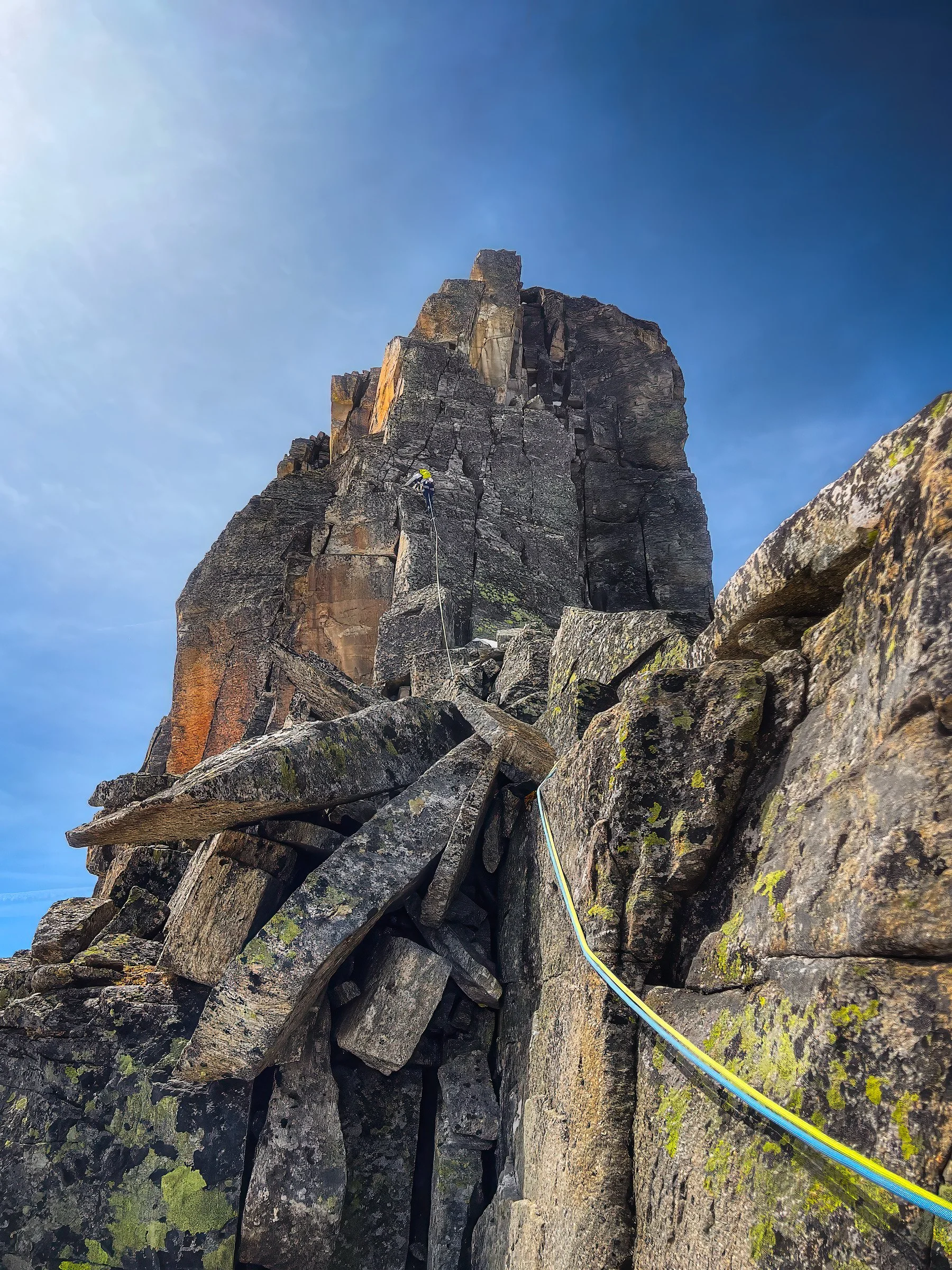
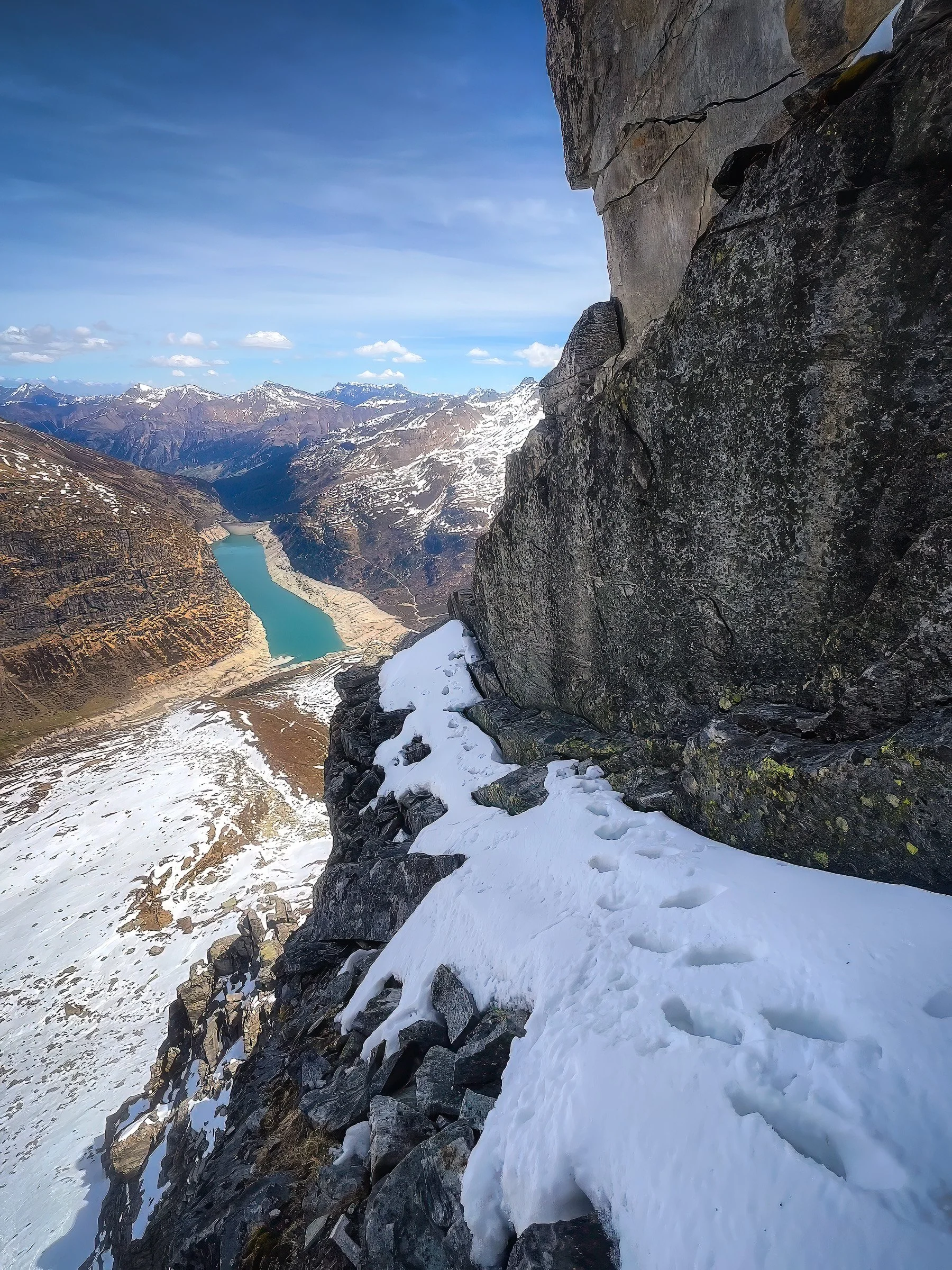
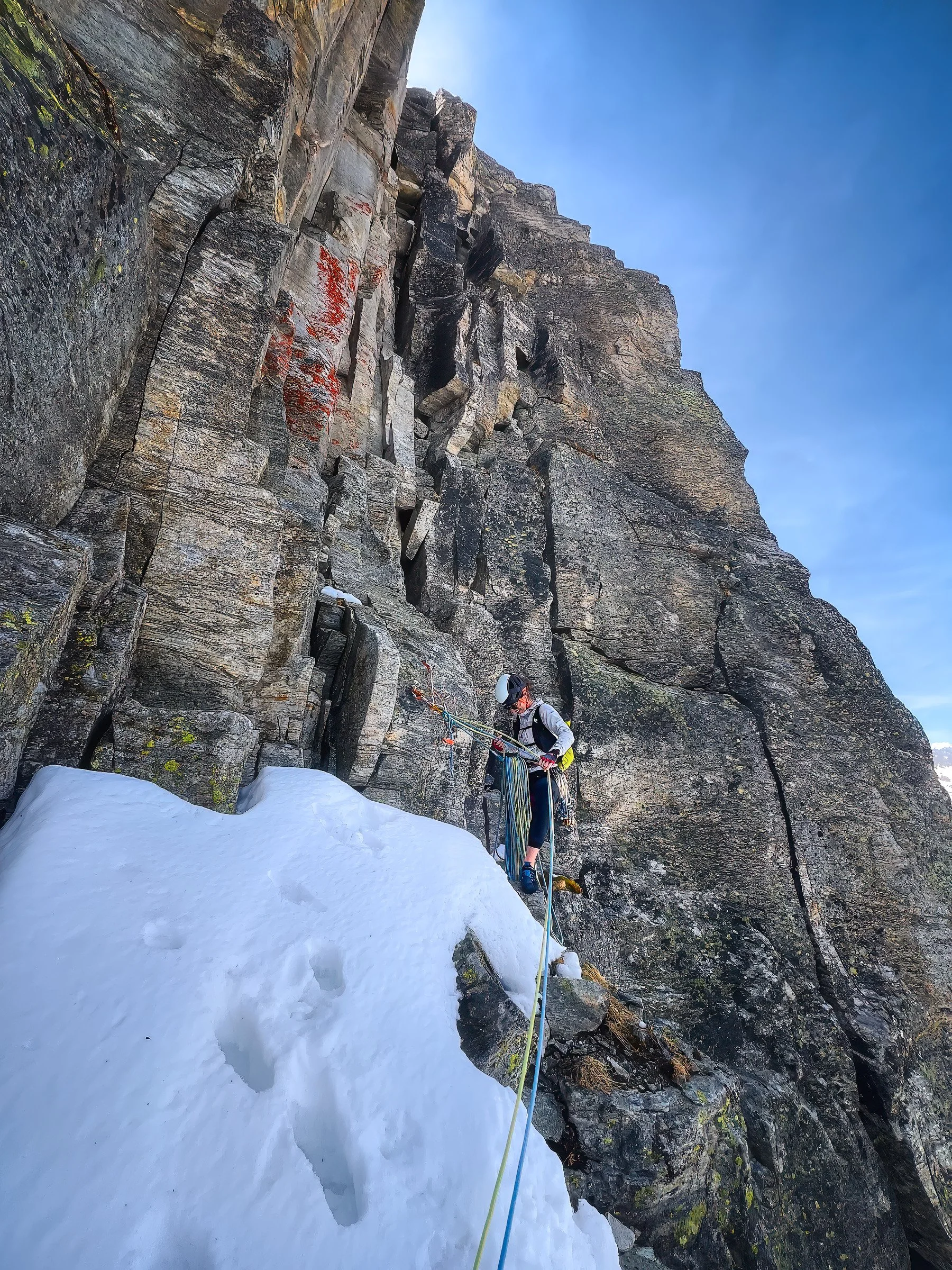
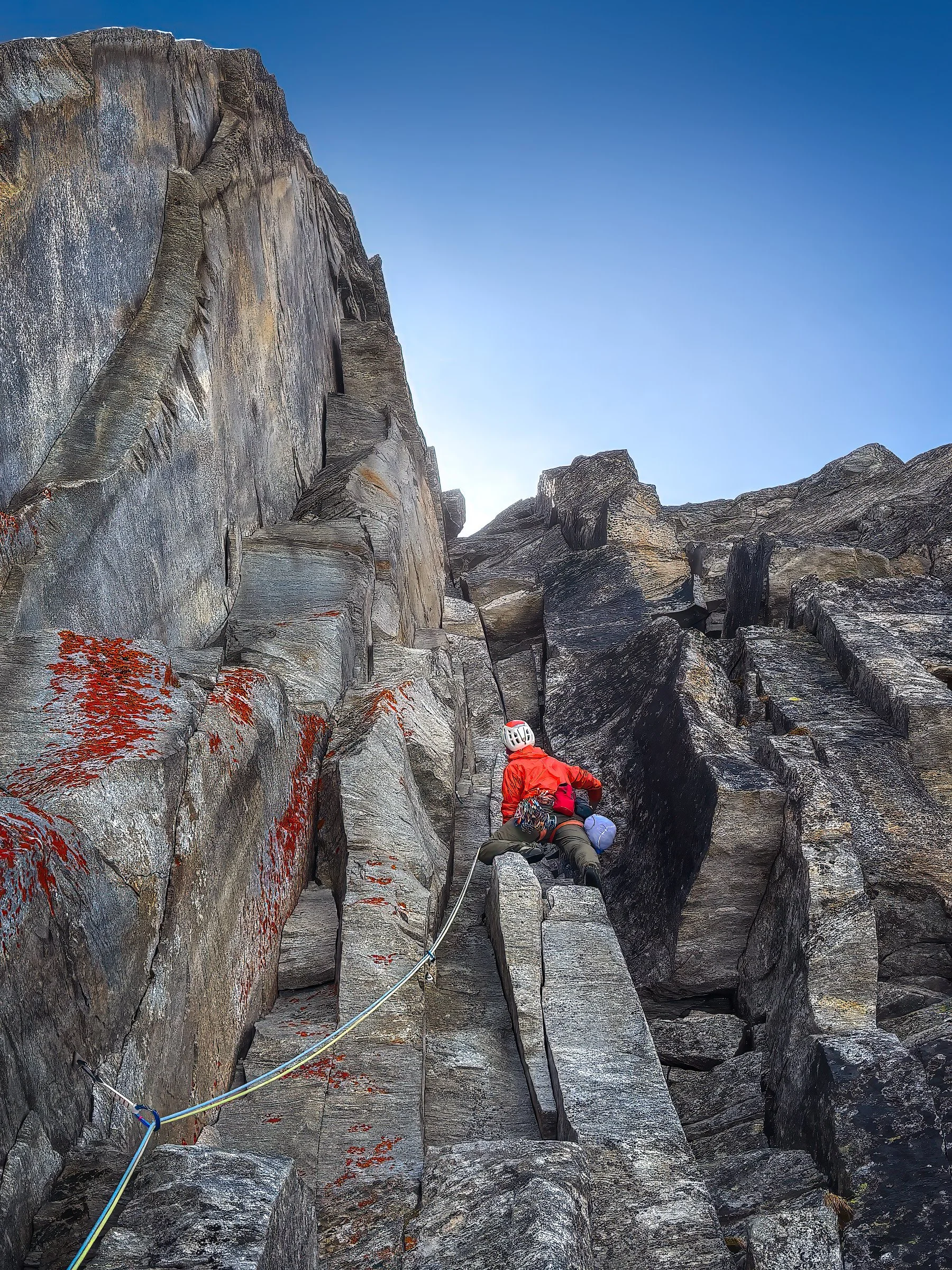
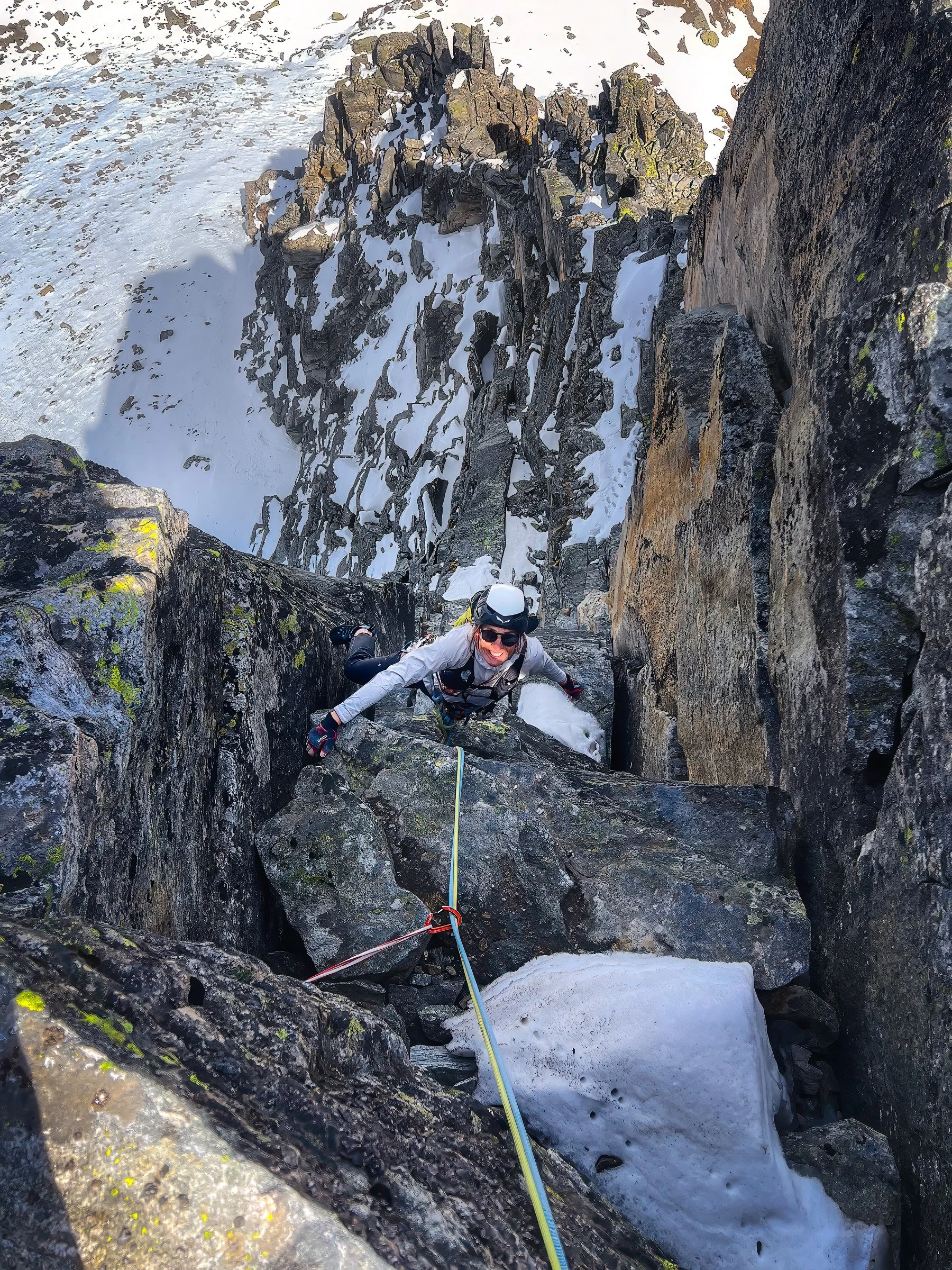
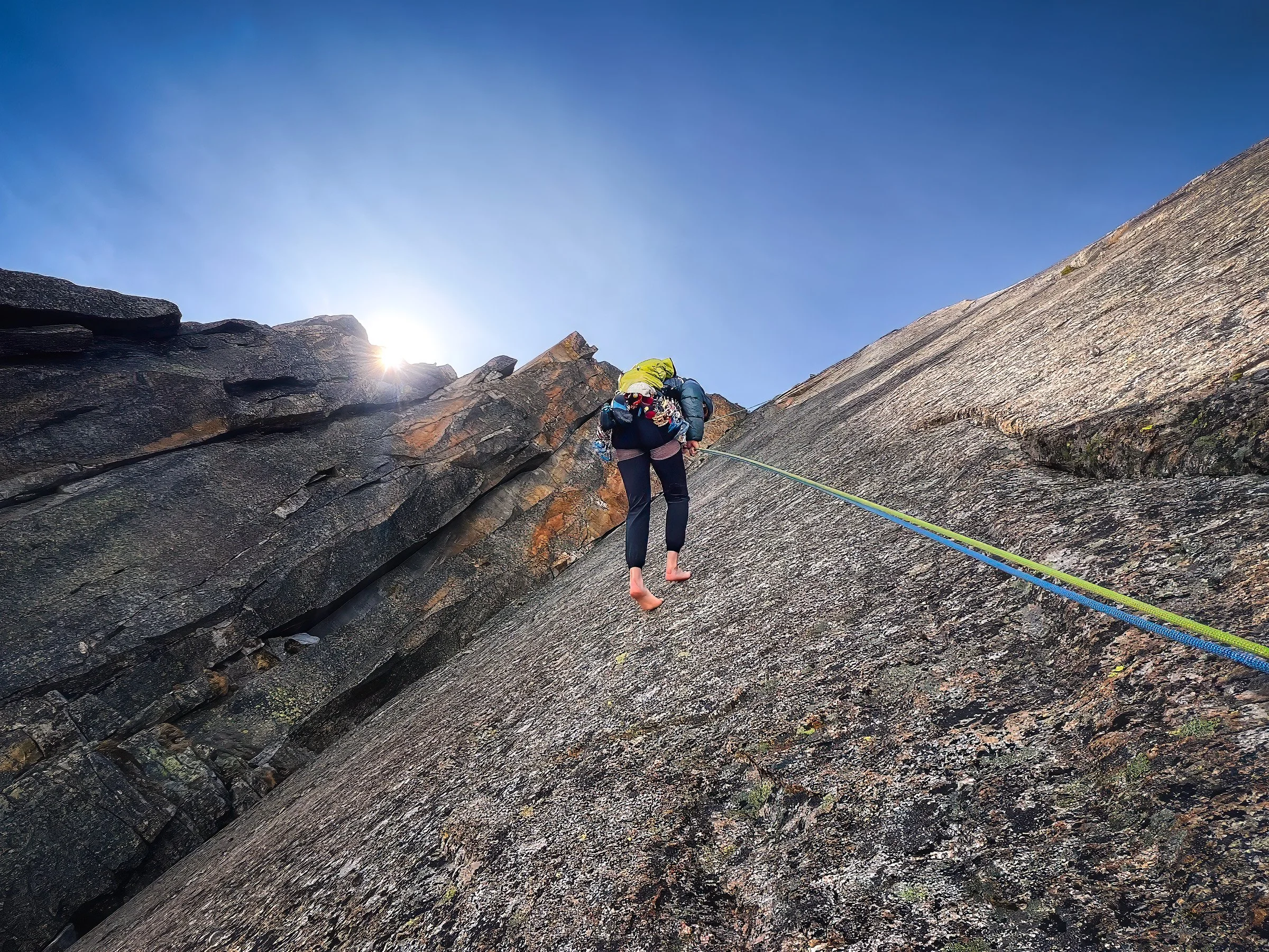
The rappel line ran down the south side of the Zervreilahorn, and after a quick survey we found the chains above a seemingly blank wall. Rappelling down, I traced a line of bolts (as well as some pitons from an old aid route), and when I reached the next anchor, I wondered what kind of route we were descending. The bolts went up a seemingly blank slab, and only on closer inspection could I make out some minute features in the rock. But the wall’s angle was slightly less than vertical, and it was impossible to conclusively say how hard this pitch might be. I felt it could be anything from 7a to 8a. The rest of the rappels went smoothly, and we descended the wall quickly. At the second-to-last rappel, I thought I had spotted a fixed rope below. This made me confident enough to skip an anchor and go all the way to where the rope was fixed, stretching our 60 metre ropes to their limit. But when I reached the anchor, I realised it hadn't been a fixed rope at all. Or rather, it was, but unintentionally so. It appeared someone had forgotten to untie the knot at the end of their rope as they pulled it down. A knot was firmly stuck in the maillon, and I pitied the people who had to abandon their rope. I untied the knot and threw the rope down. Later, I found it at the bottom and saw it was very new (a blue Mammut half rope), and the parts not exposed to the sun were still in pristine condition. But evidently this rope had spent all winter here on the mountain, left behind by what were likely the last people to climb here last fall. I coiled the rope to take it to our camp. The final rappel went through a difficult-looking dihedral, and I couldn’t resist trying some moves on top-rope while rappelling. It felt very hard; the seam I had to use for laybacking was almost completely closed, and the wall offered few footholds. A later look in the guidebook told me this pitch was a 7a+, not totally out of reach and something I might project at a sport crag, but it would certainly take a lot of effort for me to come here multiple times in a row and attempt to free it. But I was intrigued to see what kind of high-quality climbing the Zervreilahorn offers once you reach the level to try some of its harder routes.
Preparing our raclette dinner on the second evening
We then took a short hike back (either in climbing shoes or barefoot, depending on our preferences) to the base of the route where we had left our gear. The midday sun had done its course, and we gladly slid into dry boots, taking care on the short hike back to camp to keep any fresh snow out. Back at camp, we started preparing what I had been looking forward to all day: our raclette. So we set up a delicious meal on our “dinner table”. Charly used her stove to warm up the boiled potatoes I had brought while I tended the candle flames and made sure the wind gusts didn’t hamstring our dinner plans. I was excited to see how well the little raclette oven turned the cheese slices into a molten, scrumptious fluid. We took turns pouring the bubbling cheese over our potatoes, letting the heat warm our stomachs. It felt a bit surreal to have some delicious raclette in these alpine surroundings, and sipping from a small plastic bottle of white wine I had brought added to that bourgeois feeling. The next day's weather was supposed to be overcast, but still stable enough for us to try another route. For this, we wanted to attempt Alphornklänge; it wouldn't be as long as the north ridge, but it would have harder climbing while still being alpine in character. We didn’t expect to find many bolts, so we'd have to make full use of the heavy trad rack we had brought.
The following day, we left and followed our usual approach, retracing our steps through the snow to avoid sinking into uncharted territory. After the short scramble to the band running the southside of the Zervreilahorn, we now turned left where we had turned right yesterday. I knew the approach well. Last year I tried the route but got rained off after the first pitch. Soon my eyes landed on the prominent slab that flowed from the base of the wall and made up the first pitch. It was easy climbing, around 5a, and Charly wanted to lead it, despite her well-documented disdain for slab climbing. But the decision to try and overcome her slab-phobia was one she soon regretted. As is often the case with the easy pitches, the first ascensionist seemed determined to save their precious bolts for the harder climbing higher up. To make matters worse, the slab was dusty and, with so few bolts, the route finding wasn’t obvious. Charly took a long time before committing to a sequence, and when I joined her at the belay, she looked frustrated. The grey, overcast sky seemed to taint her mood in a similarly sombre fashion, and at times I felt her thoughts were somewhere else entirely. But she was still motivated to keep going, even if only following.
Catching the alpenglow on the peaks on the horzizon
The last glow of dusk before going to bed
Charly following the second pitch of Alphornklänge
So I set off to lead the rest of the route. The second pitch, a 5b, was steep but had good holds; however, the bolting was just as sparse as on the first pitch, so finding protection in the rock to substitute the bolts was mandatory. I enjoyed the climbing, which was engaging but never really challenging, and Charly enjoyed this pitch much more than the second. At the same time, the lack of bolts convinced her she'd made the right call to hand over the lead for the rest of the route. The next pitch started with a traverse that led into a big dihedral with no bolts at all. I placed a solid #2 before starting up the dihedral, but as I climbed higher, finding additional protection proved not trivial. The climbing wasn’t hard (around 5b, just as the previous pitch), so I opted for long runouts instead of fiddling with gear. As I neared the top of the dihedral, I realised my last piece of protection was now several metres below my feet, too much for even my appetite for adventurous climbing. I managed to place a small #0.3 that was not entirely above suspicion. But I shoved the thought of where I would end up if the cam ripped to the back of my mind and climbed the final moves to exit the dihedral.
The next pitch was the crux of the route, a 6a that consisted mostly of face climbing and was therefore now bolted in a way that could ease the leader’s mind. It was engaging, technical climbing, and the belay was set up so I could snap dozens of gorgeous photos of Charly following this pitch, with the Zervreila Lake prominently in the background. Pitch five starts with a traverse until a bolt next to a large crack indicates where you have to start climbing up. These first moves off the narrow band I had been traversing were tricky, and the pitch's 5c+ grade comes almost entirely from these couple of moves. After I reached easier ground, I searched for a while before I found the belay. I had to climb higher than I expected and over a series of large ledges. The bolting here was very sparse, and you couldn’t afford any mistakes, even if the climbing was easy. With how few bolts were sometimes used in easier sections, a good nose for routefinding was definitely necessary to avoid wandering off route. The next pitch was the last hard one, also a 5c+. Its crux is a short, powerful sequence on an undercling around a large flake that leads into a few short, burly laybacking moves. The first bolt was quite high, and a footslip before clipping it would have resulted in a very unpleasant fall onto the ledge below. So I protected the first move with a green cam in the seam I used for the undercling. But once I clipped the bolt, I reversed my moves and retrieved the cam to deal with the enormous rope drag I had created. The rest of the pitch was much easier; again, almost all the difficulty lay in one short sequence.
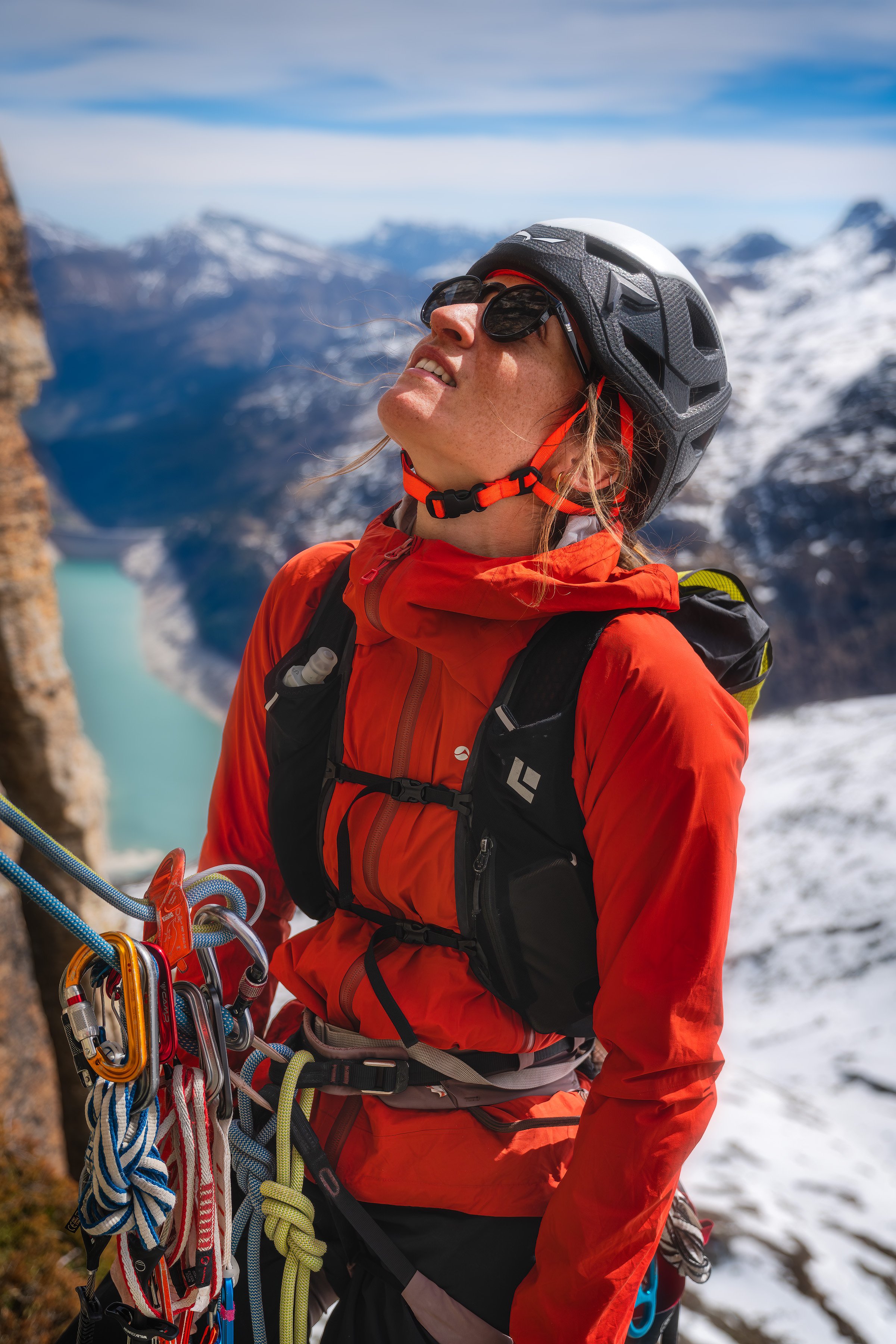
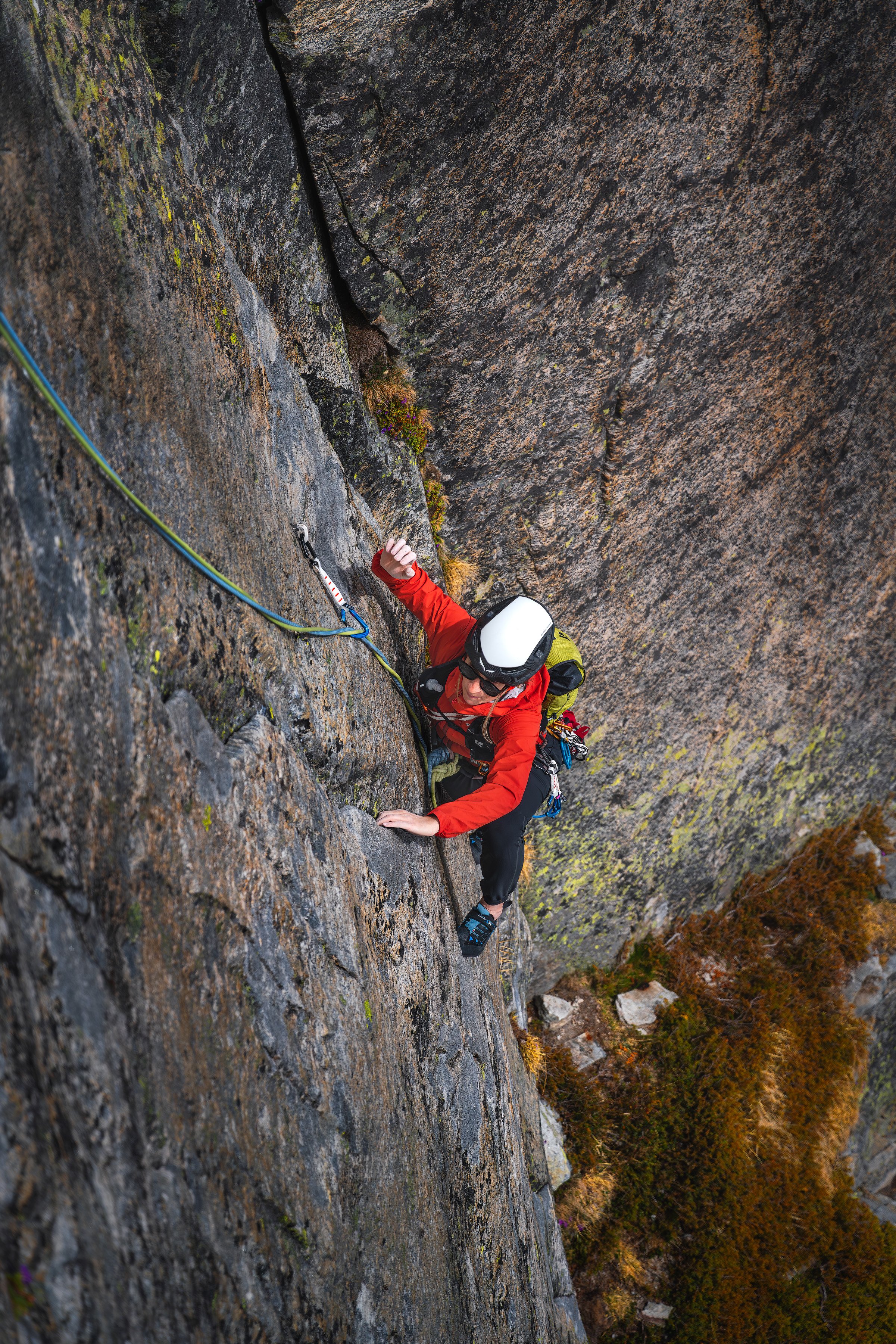
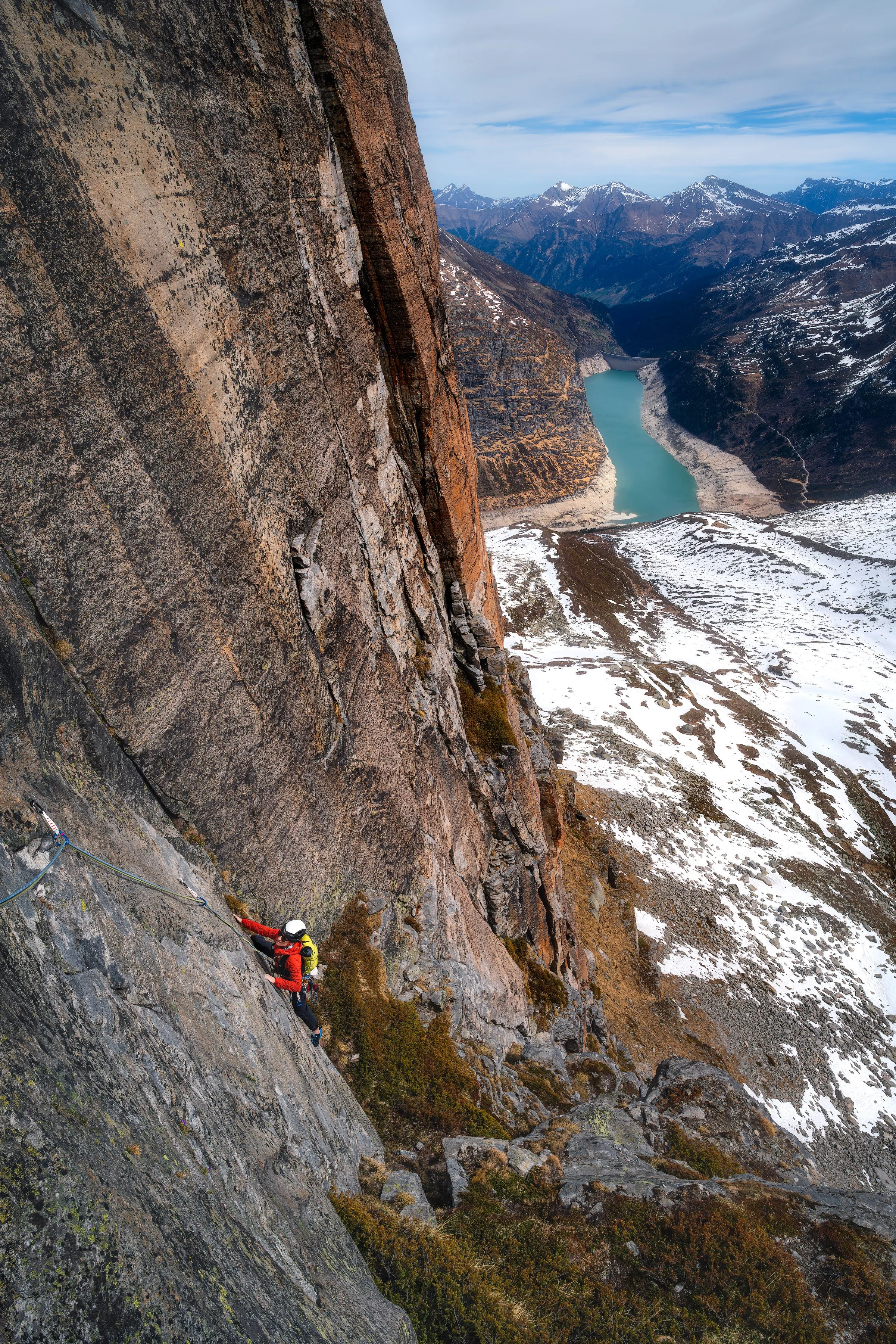
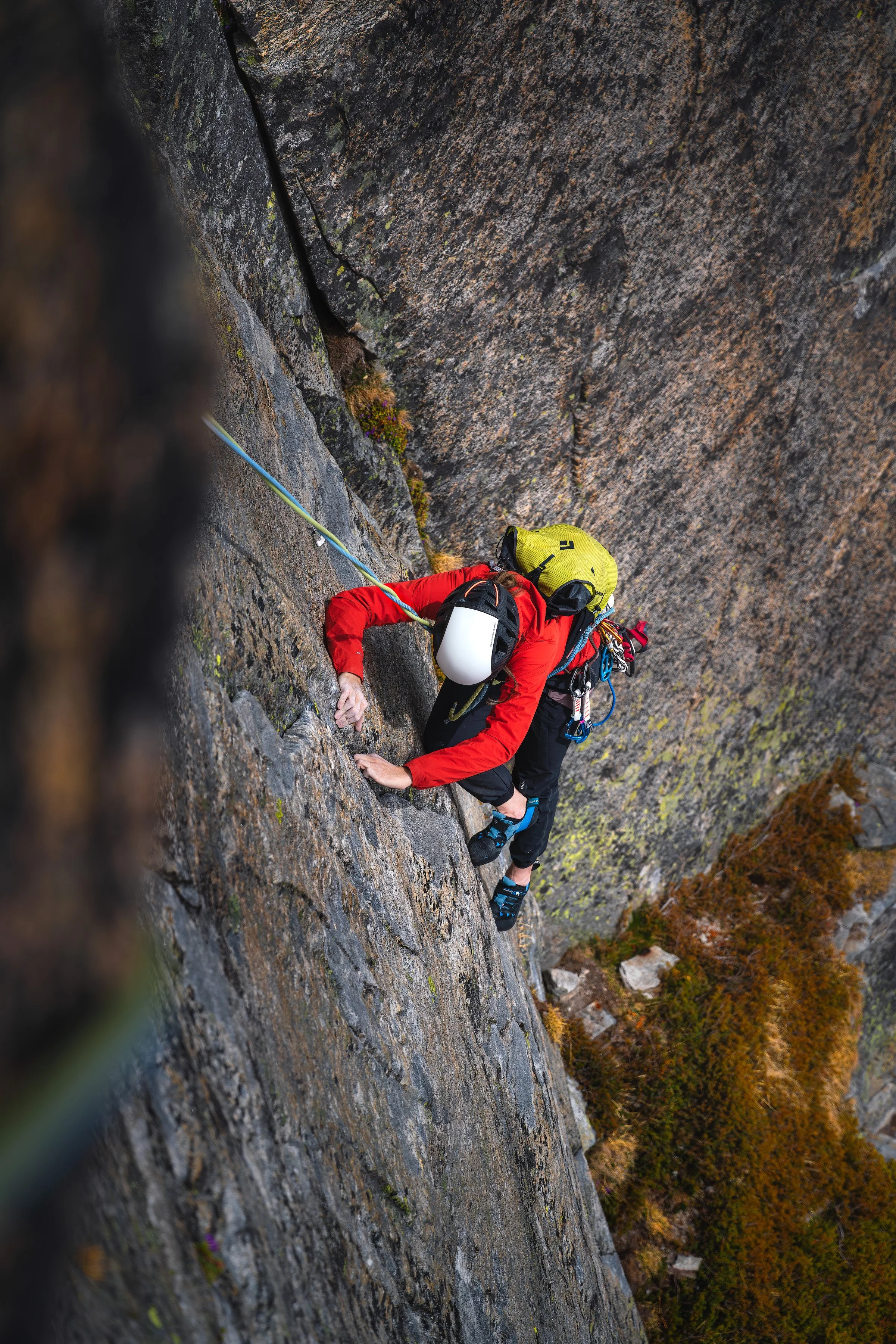
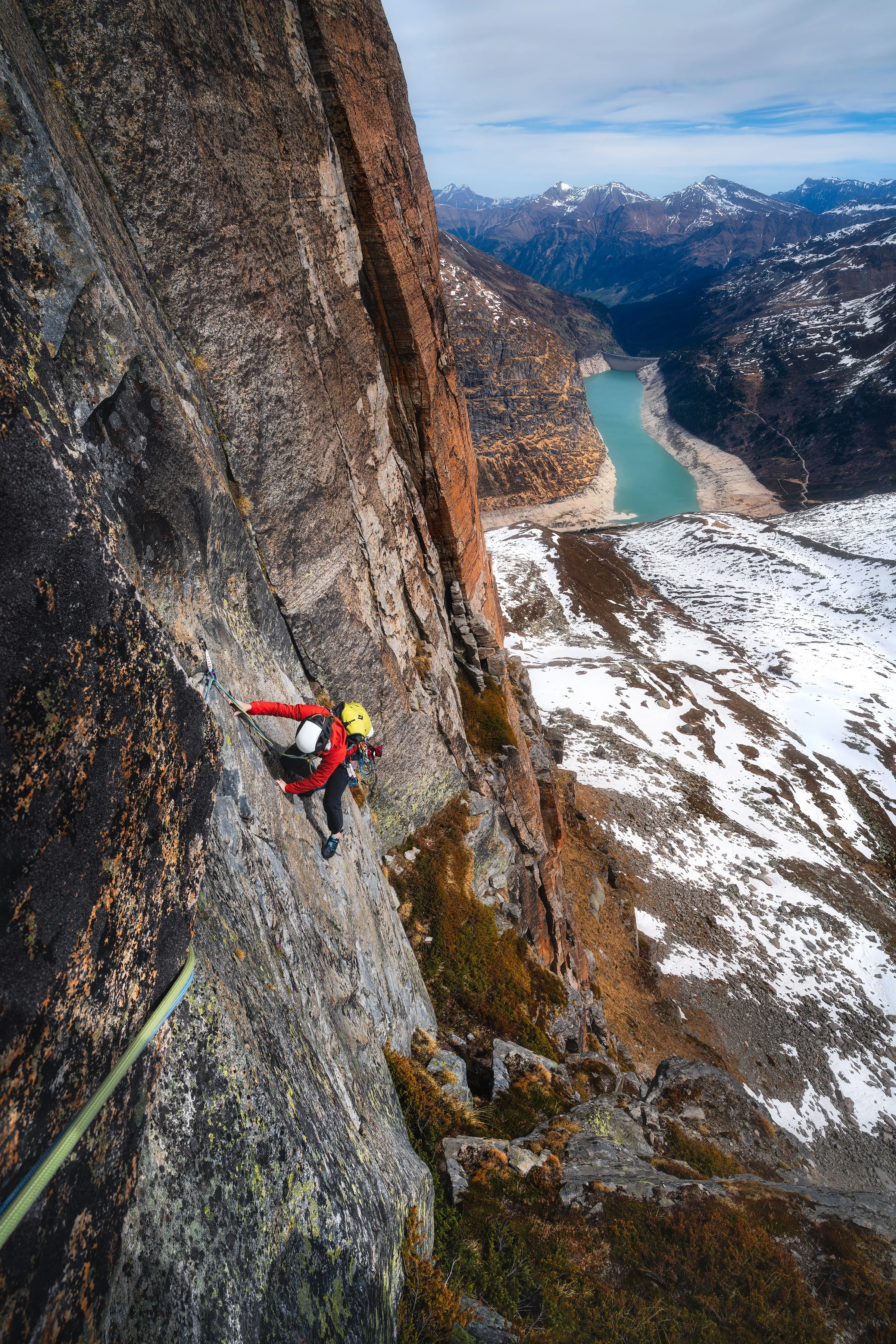
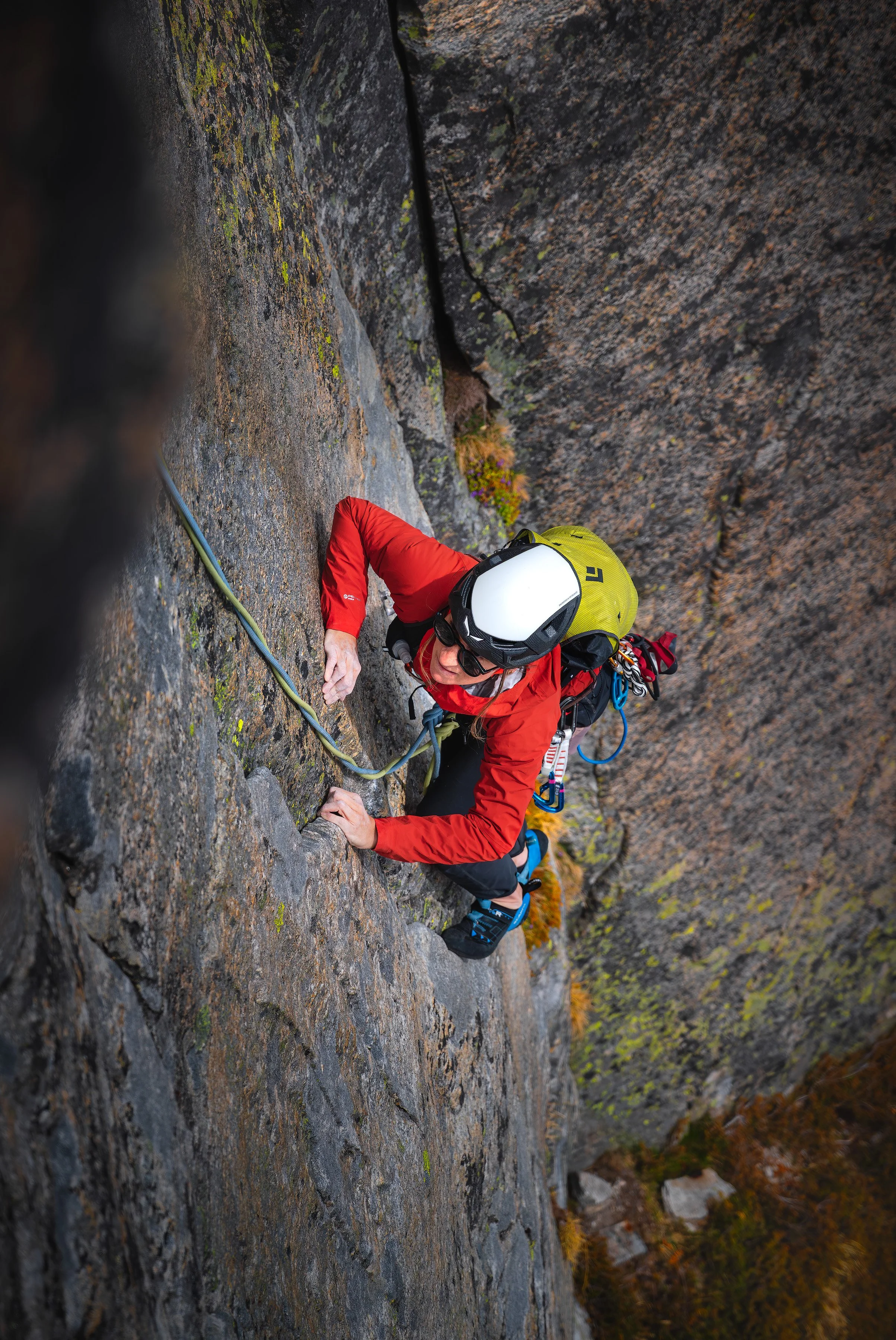
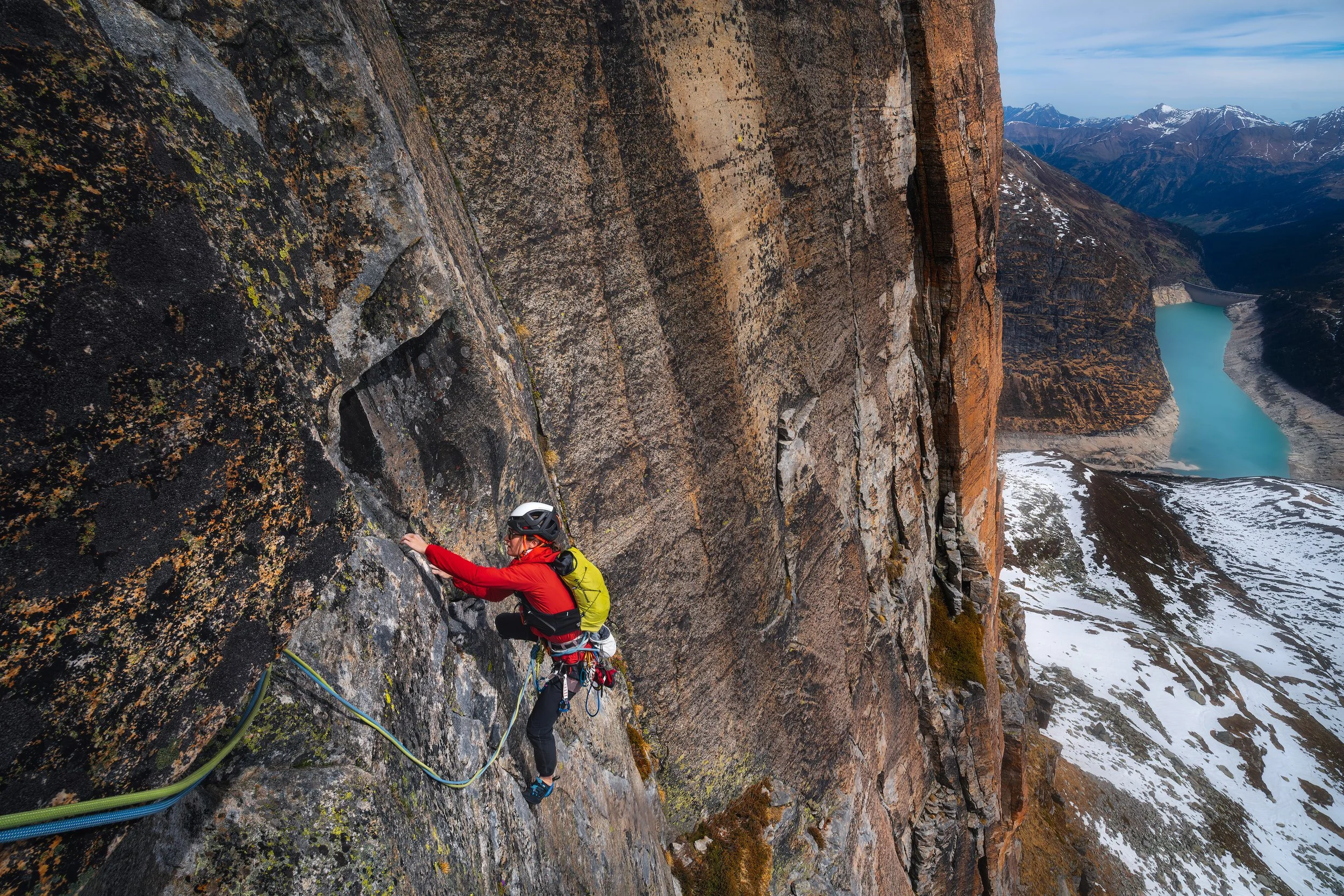
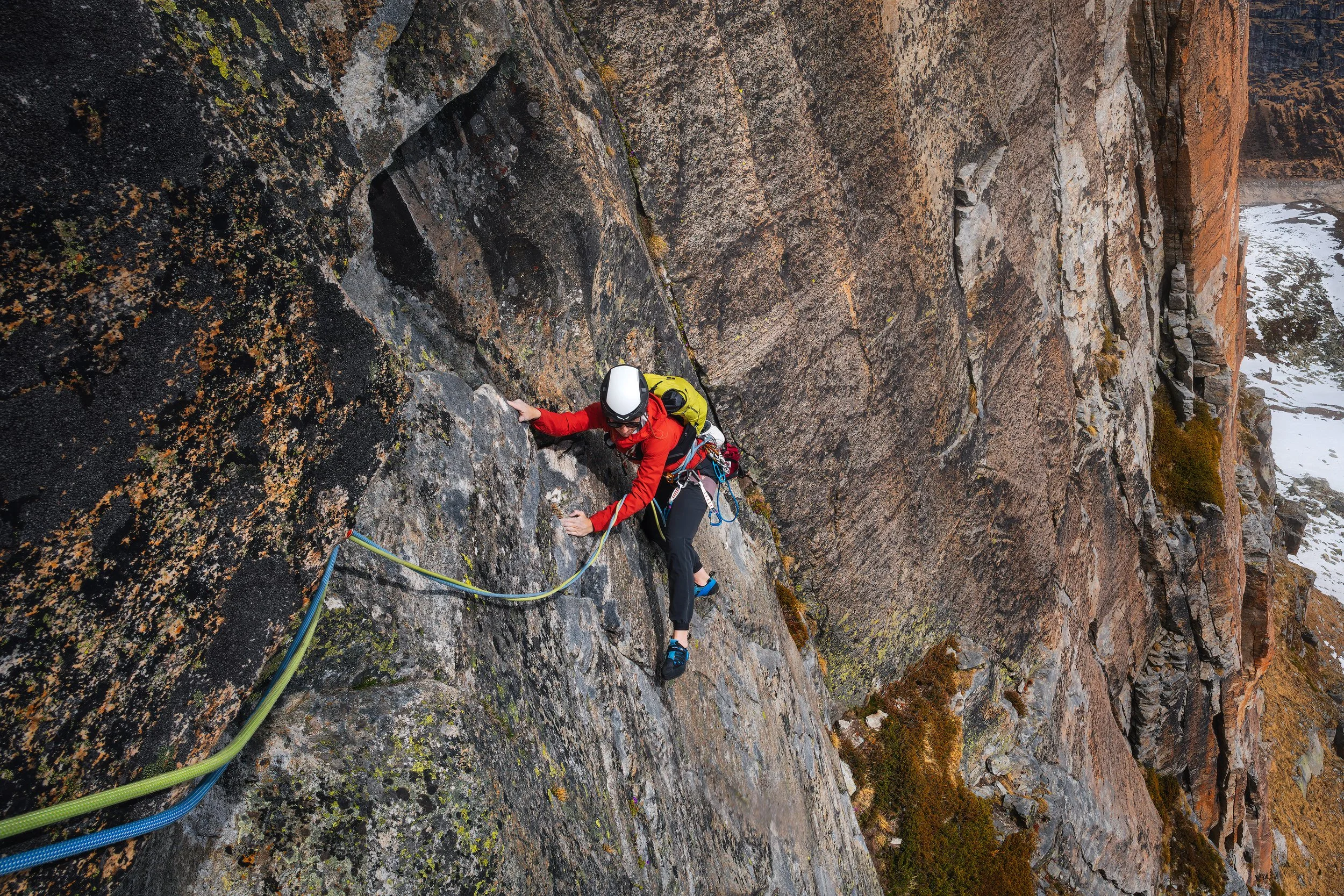
The final pitch was easier, though the rock quality started to deteriorate, so I stayed extra careful as I climbed through the blocky terrain. Charly joined me at the top of the route just after midday. A dedicated rappel line was in place to avoid rappelling the route's wandering pitches. All went smoothly until the third rappel. “Is the knot stuck?” I unintelligently asked Charly, who was yanking on the rope without moving it an inch further. Fuck. Everything had gone so well, up until this point. We took turns trying to flick the rope out of the crack it was stuck in, but it wouldn't budge. After weighing our options, I decided I had no choice but to ascend the rope. Thankfully, we still had hold of both ends of the rope, making it an annoying, tiring prospect, but at least a safe one. We were perched on a small pillar beside the wall, and the rope ran diagonally up. I had to downclimb from the pillar and traverse over a ledge to stand below the ropes, where I got ready to ascend them. Just as I had attached my footloop, Charly shouted to me. “Tim, maybe try and flick the rope from where you are now?” I had been so focused on getting ready to ascend the ropes that I'd completely forgotten to consider whether, now that I was standing directly below them, I might be able to free them from their stuck position. And sure enough, with a pull angle that was no longer diagonal, I freed the ropes and watched the knot come down as I started pulling. I scrambled back onto the pillar where Charly was waiting. The sky had grown quite cloudy, and Charly had cooled down considerably from standing around. She had taken off her tight climbing shoes for the rappels but now wore gloves as makeshift socks to warm her cold toes, quite an amusing sight. We were relieved we'd solved the little pickle we had gotten ourselves into and eager to get off the mountain as quickly as possible.
Crossing the Horabach on our hike out
The rest of the rappels went smoothly, and we were soon at the base where we had left our boots. We quickly returned to our camp, which we had already broken down this morning, and just packed our climbing gear into our backpacks. Mine felt marginally lighter, mainly thanks to a lack of potatoes and cheese. We decided to leave the rope we had found yesterday stashed beneath our “kitchen table”; maybe someone could use it to install fix lines while projecting one of the harder routes or putting up a new one. We descended down the ridge, this time staying on its crest for much longer instead of bushwhacking down its steep side. We eventually reached a faint hiking path, which we followed until we had to cut across the brambles after all. The final obstacle was a river crossing, which turned out to be easier than expected; then we rejoined the path, which led us down toward the lake. The long stretch along the lake felt interminable, not least because it went uphill ever so slightly. Along the way, we met a hiker and his dog. He was probably in his 70s, seemed intrigued by our backpacks, and asked if we had been climbing. “Yes, we camped just below the Zervreilahorn and had the entire mountain to ourselves,” we enthusiastically recounted. “You know, I was a bit of a climber myself when I was your age”. He proudly told us how fit he used to be, climbing to the top of the Zervreilahorn via the south ridge in under three hours from the lake. “I’m still out hiking with my dog every single day to keep me fit,” he continued. “You know, I just hope I’m still so fit and motivated when I’m 70,” I told Charly after we left him and his dog behind. She nodded in agreement. There was nothing more to add. We took one last look back at the isolated tower we had been climbing before turning our backs and heading back to the car park, already discussing what sort of adventure we would get up to on the next 1st of May.